
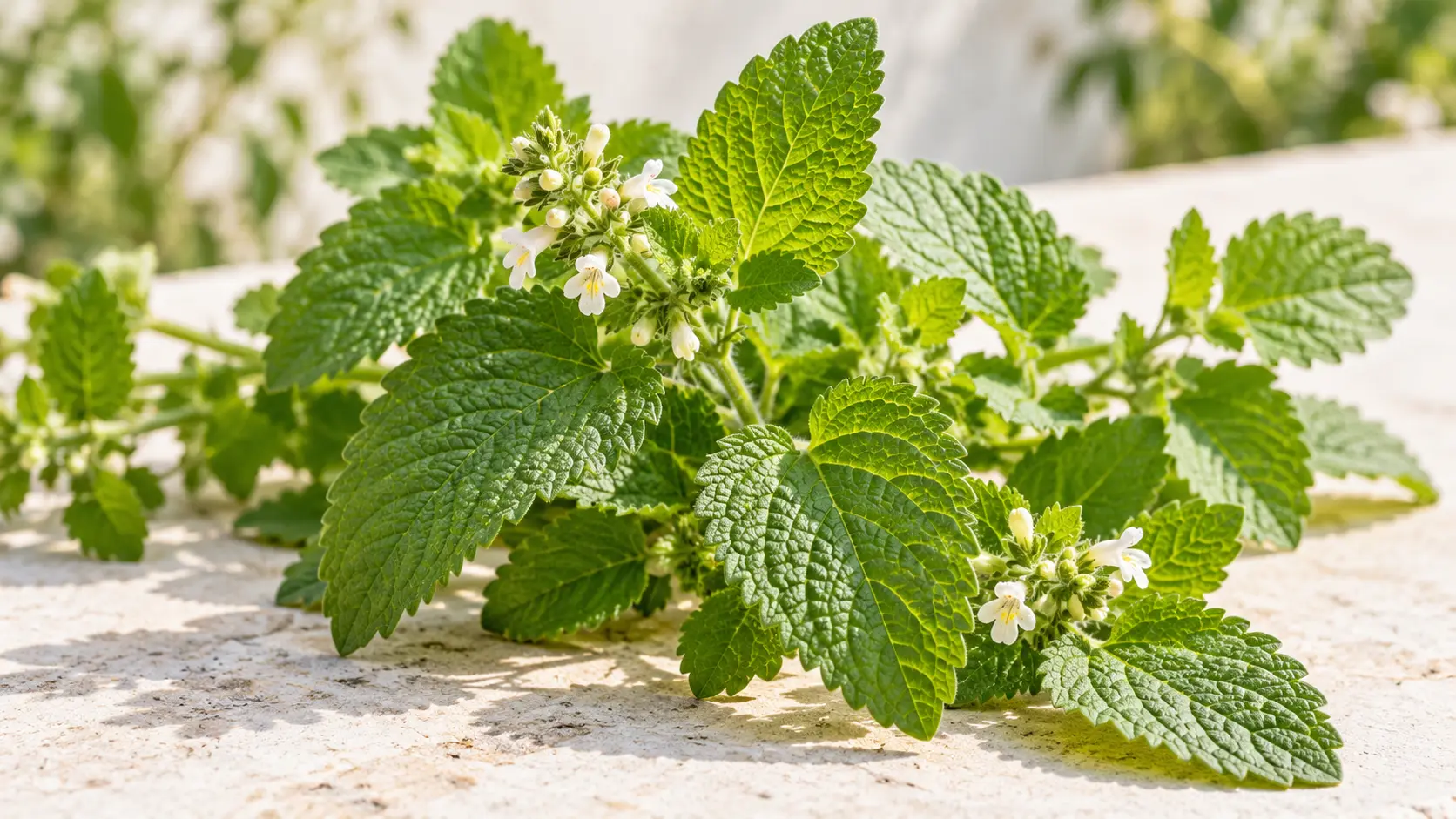
Lemon balm is a gently calming, lemon-scented herb commonly used when nervous tension, trouble winding down, or stress-linked digestive discomfort are part of the picture. Its leaf is most often used as tea, tincture, or extract, with certain topical preparations used for cold sores. It is generally considered a mild herb, but the form you choose and the medicines you take still matter.
QUICK HERB Profile
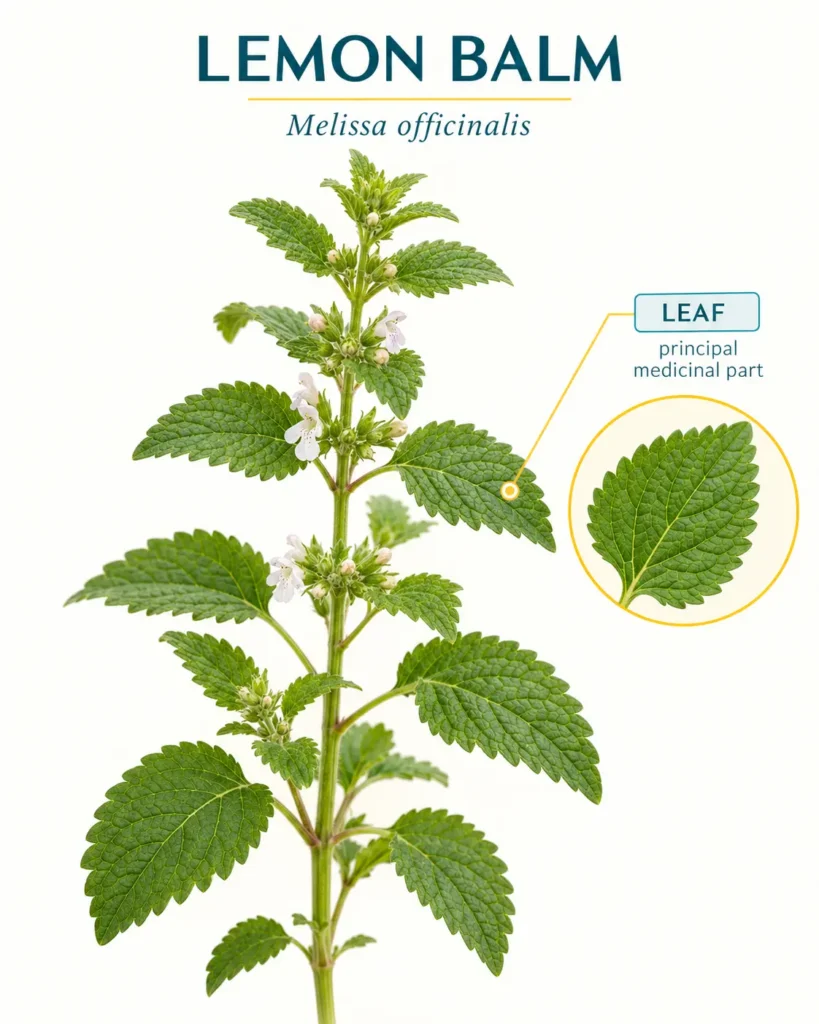
Common name: Lemon balm; also called balm or melissa.
Botanical name: Melissa officinalis L.
Part used: Primarily the leaf for medicinal preparations.
Herbal role: A calming nervine and aromatic carminative—commonly used to ease nervous tension and support digestive comfort.
Common forms: Tea/infusion, tincture or liquid extract, dry extract capsules/tablets, and certain standardized topical creams.
Herbal Role and Functions
Lemon balm has several useful functions—it may help the body relax, make it easier to wind down for sleep, and support digestion when tension shows up as gas, bloating, or mild cramping.
Calming nervine: Lemon balm is commonly used to settle nervous tension, restlessness, irritability, or the feeling of being “wired” after a demanding day. It fits best when someone wants gentle calming rather than a strong sedative.
Aromatic carminative: Its fragrant leaf supports digestive comfort, especially when bloating, gas, or mild digestive spasm seem to accompany nervous tension. The European Medicines Agency recognizes melissa leaf for mild digestive complaints such as bloating and flatulence. [2]
Gentle sleep support: Lemon balm is often used in the evening when mental tension makes it hard to settle down. It is better thought of as a gentle winding-down herb than as a strong sleep medicine. [2]
Aromatic herb: Fresh and dried leaves contain volatile aromatic compounds and polyphenols, including rosmarinic acid. The aroma and taste are part of why tea and liquid preparations remain popular forms.
Common Forms and How They’re Used
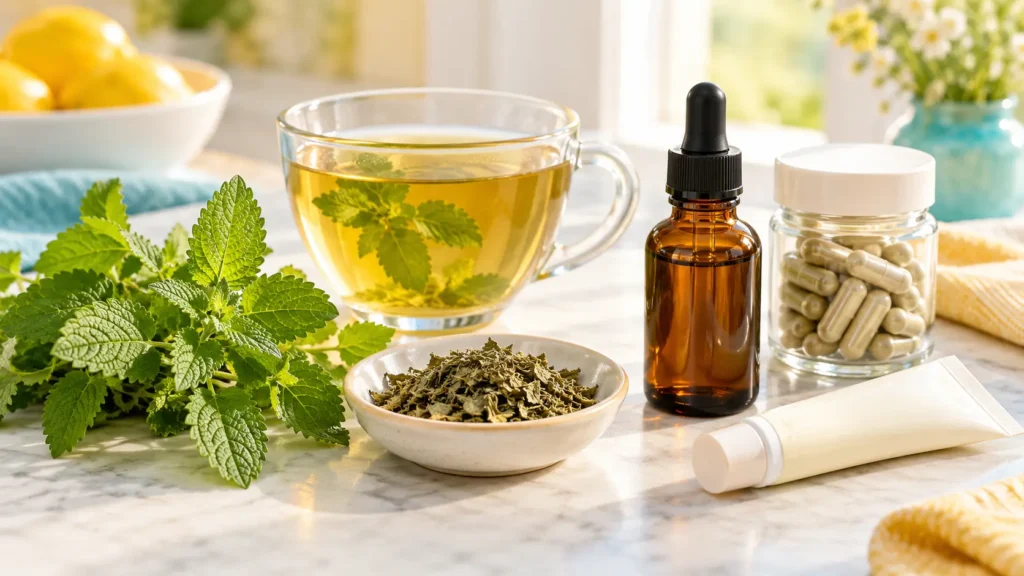
Tea or infusion: Fresh or dried leaf is steeped in hot water. This is the simplest everyday form and is often used in the evening or after meals.
Tincture or liquid extract: A concentrated liquid form that is easy to take in small amounts. Strength varies by product, so follow the specific label rather than assuming all tinctures are equivalent.
Dry extract capsules or tablets: A more concentrated and convenient form. Check the extract details because different products can vary substantially in strength and composition.
Topical cream: Certain standardized lemon balm creams are used on the skin for recurrent cold sores. Topical use is separate from drinking tea or taking an oral extract.
Where Lemon Balm May Help
Lemon balm is most useful in a few practical areas. The key is matching the form to the reason you are using it.
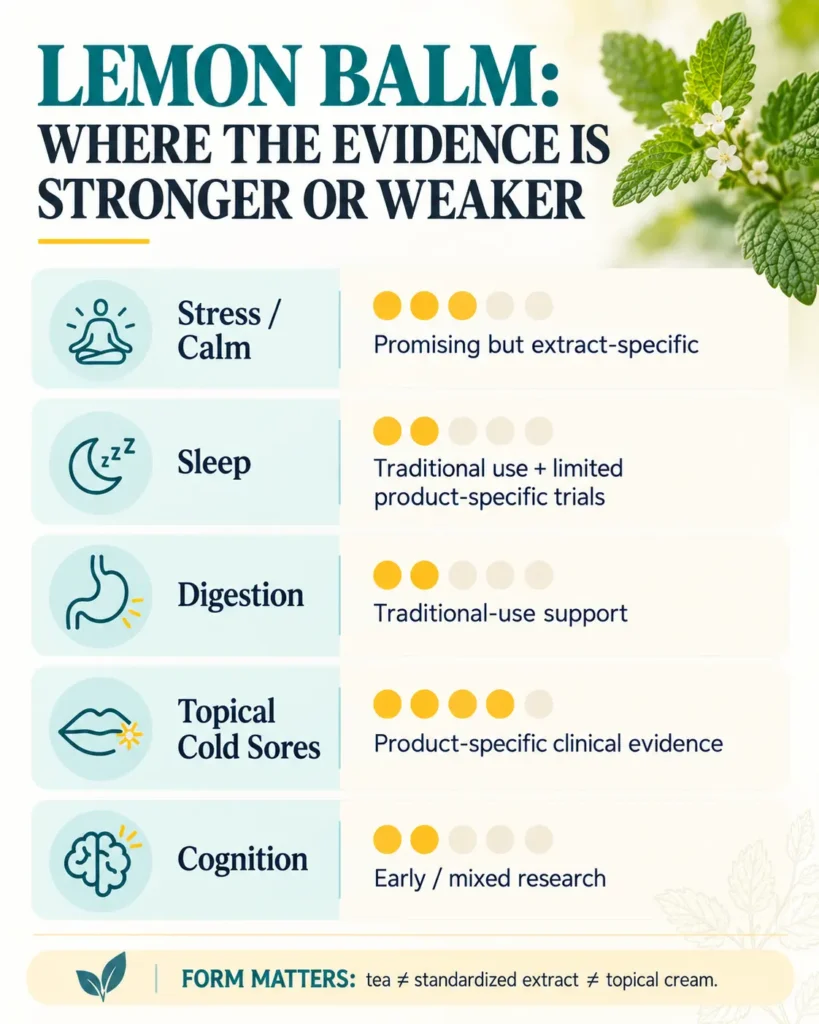
Stress and nervous tension: Lemon balm may help take the edge off mild tension and make it easier to unwind. Small human studies of standardized extracts have found calming effects, although results are product-specific. [3] [4] [6]
Sleep and winding down: It is commonly used in evening tea or extract form when mental tension makes settling difficult. Some product-specific studies report better sleep or emotional well-being, but ordinary tea has not been studied as thoroughly. [2] [5]
Digestive comfort: As an aromatic carminative, lemon balm may help with mild gas, bloating, and digestive spasm, especially when tension is part of the picture. The EMA recognizes melissa leaf for mild digestive complaints. [2]
Cold sores — topical use: Specific standardized lemon balm creams have shown benefit for recurrent cold sores. This applies to topical preparations, not to tea or oral supplements. [7] [8]
SAFETY First
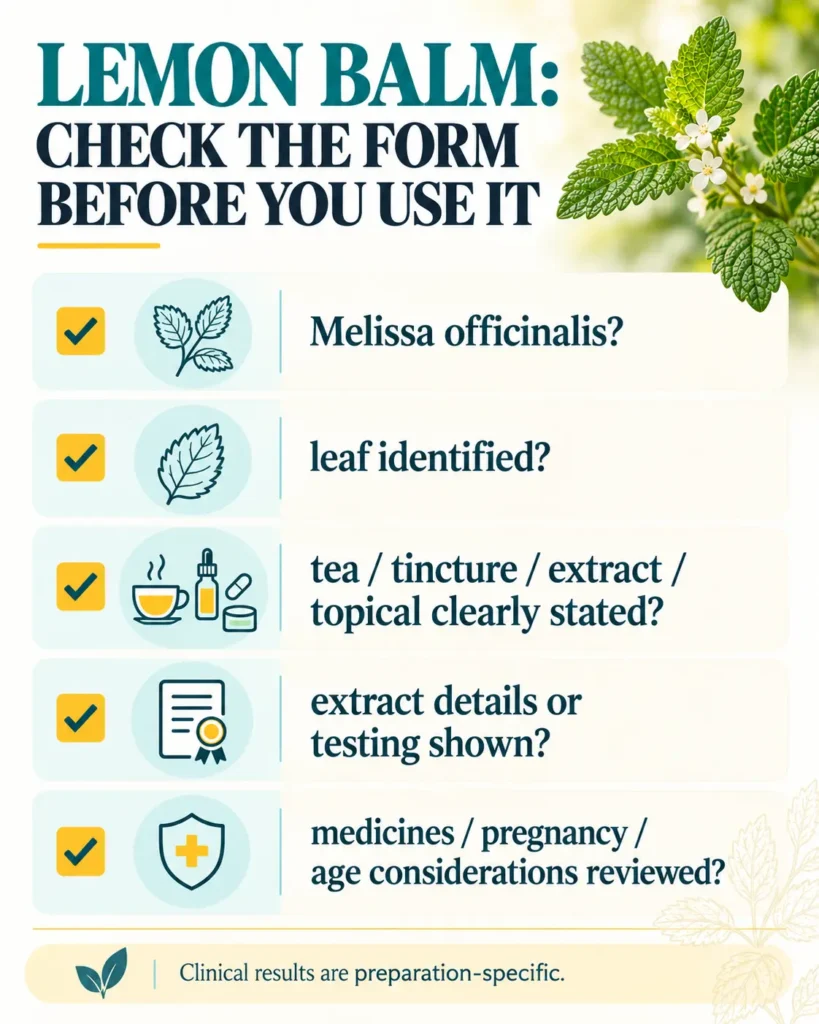
Identity first: Look for Melissa officinalis and the plant part used. “Calming herb blend” is not enough information.
Short-term tolerance: Lemon balm has generally been well tolerated in short clinical studies, but drowsiness or reduced alertness can occur with some concentrated extracts.
Essential oil: Lemon balm essential oil is highly concentrated and is not equivalent to leaf tea, tincture, or dry extract. Do not ingest it or apply it undiluted without qualified guidance.
Driving and alcohol: If a product makes you sleepy or less alert, do not drive or combine it casually with alcohol or other sedating substances.
Pregnancy and breastfeeding: Reliable safety data are limited. Avoid concentrated medicinal use unless a qualified clinician advises otherwise.
Children: The EMA monograph for medicinal melissa leaf applies oral use to adults and adolescents over age 12; younger children should not be given medicinal-strength products without professional guidance.
Medication interactions: Direct clinical interaction data are limited. Ask a pharmacist or clinician before regular concentrated use if you take sedatives, multiple prescription medicines, or medicines with a narrow safety margin.
Persistent symptoms: Ongoing anxiety, insomnia, digestive symptoms, or frequently recurring cold sores deserve appropriate evaluation rather than indefinite self-treatment.
Quality and Buying Basics
Botanical identity: The label should state Melissa officinalis. Avoid products that rely only on a vague common name.
Plant part: For the traditional medicinal uses described by the EMA, the leaf is the relevant plant material. A product should tell you what part was used.
Extract details: For concentrated extracts, look for the extract ratio, solvent, standardization marker, or a clearly identified proprietary extract when one is used. These details help you compare the product with clinical research.
Tea quality: Dried leaf should be clearly identified and reasonably aromatic. Freshness matters because volatile aromatic compounds decline with poor storage, though scent alone cannot prove potency or purity.
Testing and transparency: Prefer manufacturers that identify the botanical, plant part, lot information, and quality testing. Third-party testing can help with identity and contamination concerns but does not prove clinical effectiveness.
Combination products: Multi-herb formulas may be useful, but they make it harder to know which ingredient is responsible for a benefit or side effect. The amount of each herb should be disclosed whenever possible.
How It Fits With Other Herbs
Lemon balm is often paired with other herbs that add either more calming support or more digestive support. Examples include:
Chamomile: another gentle calming herb that also fits well when digestive tension is part of the picture.
Passionflower: often chosen when restlessness and difficulty switching off are more prominent, especially in evening formulas.
Valerian: a more sleep-focused partner that may make a combination more sedating, so it is better suited to nighttime use.
Hops: commonly paired in evening or sleep formulas when a stronger settling effect is wanted.
Peppermint: useful when the main reason for pairing is gas, bloating, or digestive discomfort rather than sleep.
Fennel: another aromatic digestive herb that may complement lemon balm when bloating or gas is the main concern.
Combining several calming herbs can increase drowsiness. If you take prescription medicines, especially sedating medicines, review the full combination with a pharmacist or clinician rather than evaluating each herb in isolation.
What to Explore Next
The next useful question depends on why you are considering lemon balm. A condition-specific application page can examine the evidence for stress or sleep in more depth; a preparation guide can explain tea or tincture use; a safety page can focus on interactions and special populations; and a comparison can help distinguish lemon balm from similar calming herbs.
Frequently Asked Questions
Is lemon balm the same as lemongrass or lemon verbena?
No. Lemon balm is Melissa officinalis, a member of the mint family. Lemongrass and lemon verbena are different plants with different chemistry and uses.
Is lemon balm tea the same as a lemon balm extract?
No. Tea is a water infusion of leaf and varies in strength. Clinical trials often use concentrated or standardized extracts, sometimes proprietary ones. A positive trial does not automatically tell you how much benefit to expect from ordinary tea.
Does lemon balm make you sleepy?
It can be calming, and some concentrated extracts have reduced alertness in human studies. Other people may notice little sedation. Treat your first use cautiously, especially before driving or combining it with alcohol or sedating medicines.
Can lemon balm help with stress?
It may help with mild nervous tension and difficulty unwinding. Small human studies of standardized extracts have reported calming effects, but results vary by product and should not be generalized to every tea or supplement. Persistent or severe stress symptoms deserve a broader plan and, when appropriate, professional help.
Can lemon balm be used every day?
Short-term use has generally been well tolerated in studies, but strong evidence for indefinite daily medicinal use is limited. If you find yourself relying on concentrated lemon balm continuously for anxiety, insomnia, digestive symptoms, or recurrent cold sores, it is worth reviewing the underlying issue with a qualified professional.
For a closer examination of clinical studies involving this herb, read Lemon Balm for Stress: Calming Herb or Mostly Tradition?.
References
1. Kew Science — Plants of the World Online: Melissa officinalis L. — Botanical identity, family, accepted species, and distribution.
2. European Medicines Agency — Melissae folium — Traditional-use monograph summary for stress, sleep, digestive complaints, forms, and age guidance.
3. Kennedy DO, Little W, Scholey AB. Attenuation of laboratory-induced stress in humans after acute administration of Melissa officinalis — Randomized crossover trial of standardized extract and laboratory stress.
4. Ghazizadeh J, et al. The effects of lemon balm on depression and anxiety in clinical trials: systematic review and meta-analysis — Meta-analysis with important heterogeneity and small-study limitations.
5. Bano F, et al. Standardized Melissa officinalis extract in adults with emotional distress and poor sleep — Three-week randomized placebo-controlled trial of a proprietary phospholipid-based extract.
6. Mathews I, et al. Acute effects of Zensera Melissa officinalis extract during cognitive overload — 2026 randomized placebo-controlled study showing mixed mood and cognitive outcomes.
7. Koytchev R, et al. Balm mint extract for topical treatment of recurring herpes labialis — Randomized placebo-controlled trial of 1% standardized topical extract cream.
8. Herbal Medicine for Treating Herpes Labialis: A Systematic Review — 2025 systematic review including topical lemon balm trials.
9. Kennedy DO, et al. Modulation of mood and cognitive performance following acute administration of Melissa officinalis — Early randomized trial illustrating dose- and preparation-specific mood/cognitive effects.