

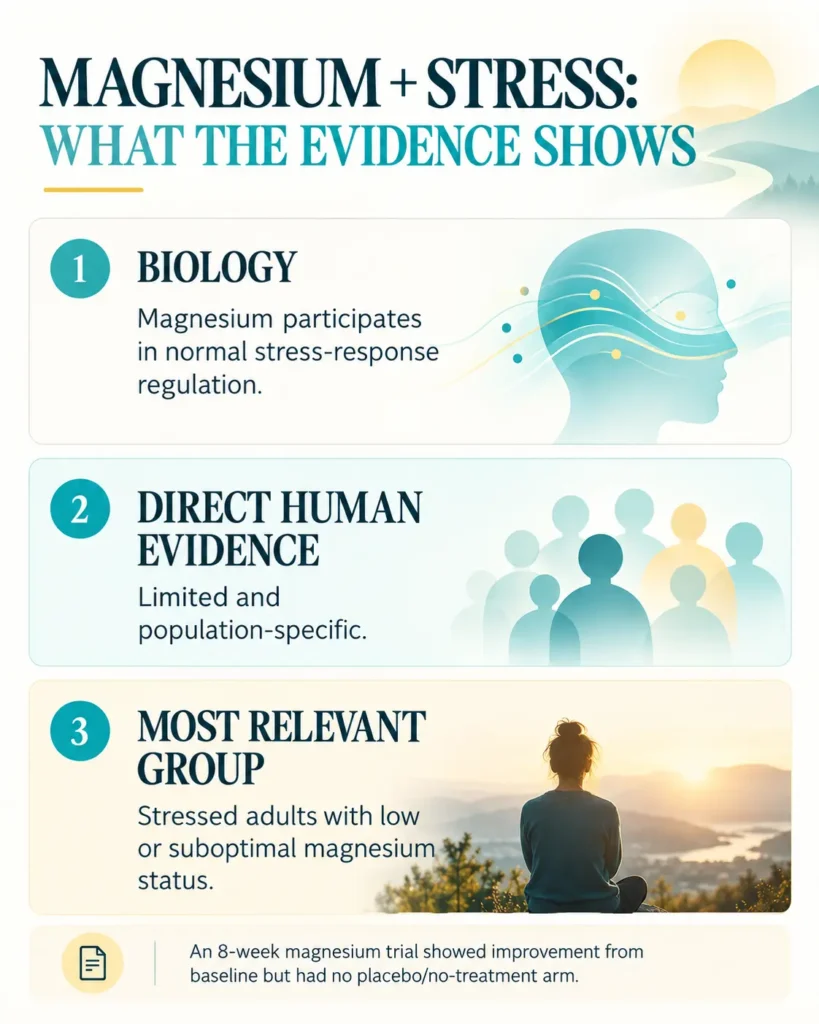
Magnesium is involved in normal nerve signaling, energy metabolism, and regulation of the body’s stress-response systems. That makes a connection with stress biologically plausible—but it does not mean a magnesium supplement reliably reduces everyday stress for everyone. Human evidence is still limited, and the clearest signal comes from people who were stressed and had low or suboptimal magnesium status. [1–4]
QUICK ANSWER
Bottom line: Magnesium adequacy may matter for stress, but routine supplementation is not proven to reduce stress for everyone.
Evidence snapshot: Limited and population-specific. The best direct trial enrolled stressed adults with low/suboptimal magnesium; because all randomized groups received magnesium, it could not isolate a magnesium-specific effect.
Who the evidence applies to most: People with low magnesium intake, suboptimal magnesium status, or factors that increase the chance of inadequacy.
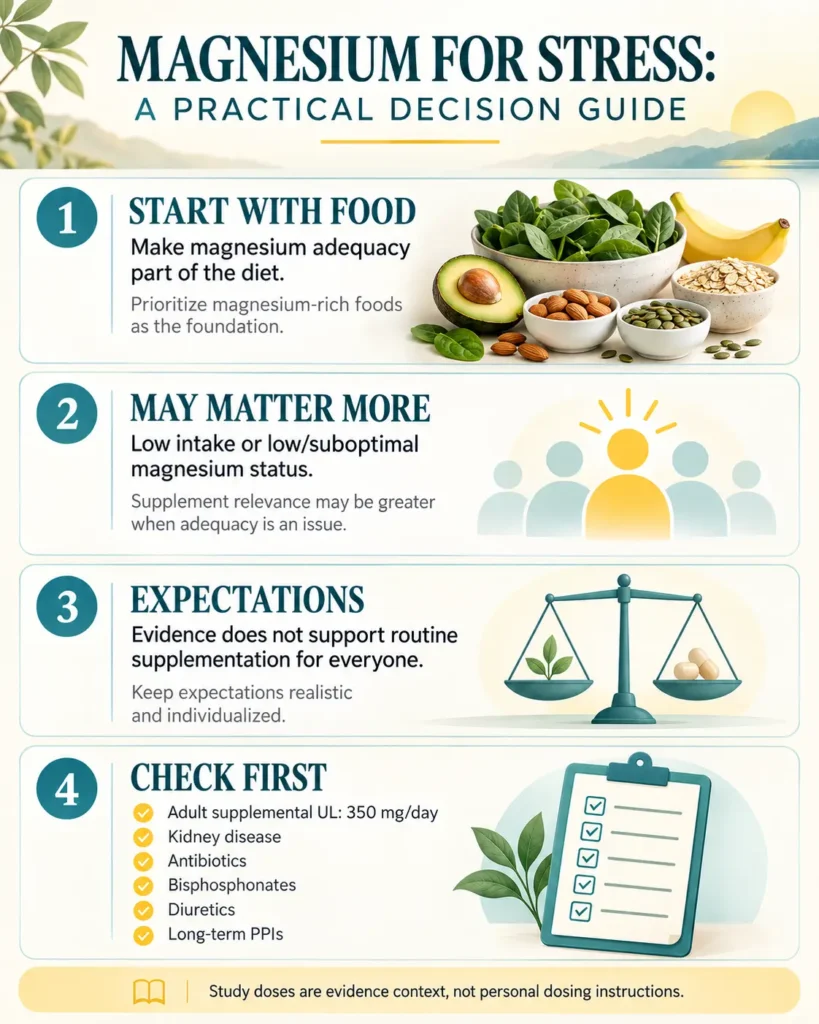
Practical route: Start with food adequacy. Consider a supplement only for a real intake/status reason or with clinician/pharmacist guidance—not simply because stress is present.
Key safety point: For U.S. adults, the 350 mg/day upper limit applies to magnesium from supplements and medications, not food. Kidney disease and medication interactions can change what is safe.
How Magnesium Connects to Stress
Magnesium has several normal physiological roles that overlap with the stress response. It helps regulate nerve-cell excitability, participates in energy production, and influences signaling systems involved in the hypothalamic-pituitary-adrenal (HPA) axis and neurotransmission. Reviews also describe a possible two-way relationship: prolonged stress may affect magnesium balance, while inadequate magnesium may make normal stress regulation less resilient. [1,4]
That connection explains why magnesium is often described online as a “calming mineral.” But mechanism is not the same as a clinical outcome. A nutrient can be essential to a pathway without extra supplementation improving that pathway when a person already has enough.
What the Evidence Shows
The strongest direct stress trial is encouraging—but has an important limitation
In a 2018 randomized trial, 264 otherwise healthy adults had elevated stress scores and low-to-suboptimal serum magnesium. They received either about 300 mg/day of elemental magnesium as magnesium lactate or the same magnesium dose plus vitamin B6 for 8 weeks. Stress scores fell substantially in both groups—about 42% from baseline with magnesium alone and about 45% with magnesium plus B6. In the full sample, the combination was not significantly better than magnesium alone. [3]
The key limitation is easy to miss: everyone in the trial received magnesium. There was no placebo or no-treatment group. That means the study shows that stress improved while participants were taking magnesium, but it cannot tell us how much of that change was caused by magnesium rather than time, expectation, regression toward the mean, or other changes during the study. The trial was also funded by the manufacturer of one of the study products, and the sponsor participated in study design, analysis, and manuscript preparation. [3]
The study is still useful because it tested a clearly defined stressed population with low magnesium status and measured stress directly. It is much less persuasive as evidence that any person with stress should start a magnesium supplement.
Earlier evidence was too weak to answer the stress question
A 2017 systematic review identified 18 magnesium intervention studies focused mainly on anxiety-prone groups, premenstrual symptoms, postpartum anxiety, and hypertension. The authors found suggestive but inconclusive evidence for anxiety-related outcomes and emphasized poor study quality. Importantly, at the time of that review, none of the included studies used a validated subjective stress measure. [2]
That matters for this article: anxiety, sleep problems, and stress often overlap, but they are not interchangeable outcomes. Evidence that magnesium may help an anxiety score or a sleep measure cannot automatically be counted as evidence that it reduces perceived stress.
Stress biomarkers add biological support, not proof of stress relief
A placebo-controlled trial in 49 overweight adults ages 45–70 tested 350 mg/day of magnesium for 24 weeks and found lower 24-hour urinary cortisol excretion compared with placebo. The study supports the idea that magnesium can influence glucocorticoid metabolism in at least some populations. [5]
But cortisol is a biomarker, not the same thing as how stressed a person feels or functions day to day. The study population was also narrow, so it cannot establish routine magnesium supplementation as a general stress-management strategy.
Food Intake vs Supplements
For most people, the lowest-risk starting point is simply to make sure magnesium intake is adequate. Nuts, seeds, beans, leafy greens, and whole grains are meaningful food sources. Food-based magnesium is not subject to the adult 350 mg supplemental upper limit. [1]
What we do not have is strong evidence that eating a specific amount of magnesium-rich food directly lowers perceived stress independent of the rest of the diet. Food adequacy is sensible because magnesium is essential and because low intake can contribute to inadequate status—not because pumpkin seeds or spinach have been proven to act like a stress treatment.
Supplement trials are a different question. They deliver a defined dose in a defined population. Results from those trials should not be translated into “more magnesium is better,” and a study dose should not automatically become a personal dose recommendation.

Who May Benefit Most — and Who May Not
More plausible benefit: People whose magnesium intake is chronically low or who have a clinically relevant reason to suspect inadequate magnesium status. The direct stress trial specifically enrolled adults with stress plus low-to-suboptimal serum magnesium, so that population is more relevant than healthy, magnesium-replete adults. [3]
Less certain benefit: People who already meet their magnesium needs and have no evidence of low status. Human studies have not established that adding magnesium above adequacy reliably lowers everyday stress in this group.
Higher-risk situations deserve individual guidance: Gastrointestinal disorders that impair absorption, some medications, heavy alcohol use, older age, and certain chronic conditions can affect magnesium status. Serum magnesium is useful in clear deficiency but does not perfectly reflect total body stores, so testing and interpretation can require clinical context. [1]
This is one reason “I felt calmer after taking magnesium” cannot diagnose a deficiency. Stress fluctuates, placebo effects are real, and the symptoms of low magnesium are not specific enough to self-diagnose.
Forms and Doses Used in Research
The main direct stress trial used magnesium lactate and supplied about 300 mg/day of elemental magnesium for 8 weeks. The cortisol trial used 350 mg/day for 24 weeks. These numbers describe the research—they are not instructions to take those amounts. [3,5]
There is also no convincing stress-specific evidence showing that magnesium glycinate, citrate, oxide, threonate, or another form is the “best magnesium for stress.” Different forms can differ in absorption and gastrointestinal tolerance, but superiority for stress outcomes has not been established. The amount of elemental magnesium on the Supplement Facts panel matters more than the total weight of the compound. [1]
Practical Decision Guide
A SIMPLE WAY TO THINK ABOUT MAGNESIUM + STRESS
1. Check the foundation
Make magnesium-rich foods part of a balanced diet before assuming you need a supplement.
2. Look for a real reason
A supplement makes more sense when intake is low, magnesium status may be compromised, or a clinician has identified a need.
3. Keep expectations realistic
Magnesium may help some people—especially when adequacy is an issue—but evidence is not strong enough to treat it as a stand-alone stress therapy.
4. Do not chase study doses
Research doses describe experiments. Follow product directions and stay within established safety limits unless a clinician is supervising a different plan.
5. Treat stress as a whole problem
Sleep, workload, relationships, movement, nutrition, mental strategies, and professional support can matter more than any single nutrient.
MAGNESIUM SAFETY AT A GLANCE
MAGNESIUM SAFETY AT A GLANCE
For U.S. adults, the 350 mg/day upper limit applies to magnesium from supplements and magnesium-containing medications—not magnesium naturally present in food. Higher supplemental intake commonly causes diarrhea, nausea, or abdominal cramping. Impaired kidney function increases the risk of magnesium accumulation and toxicity. Magnesium should not replace appropriate care for severe, persistent, or disabling stress or related symptoms. [1]
Kidney disease: Do not self-treat with high-dose magnesium; impaired clearance can raise toxicity risk.
Tetracycline or quinolone antibiotics: Magnesium can reduce absorption; a clinician or pharmacist can advise on timing separation.
Oral bisphosphonates: Magnesium can reduce absorption; follow medication-specific spacing guidance.
Diuretics or long-term proton pump inhibitors: These can affect magnesium status; discuss persistent use or suspected deficiency with a clinician.
What to Explore Next
Magnesium is one possible piece of stress support, not a complete strategy. A broader approach may include sleep and recovery, regular movement, balanced nutrition, practical mental skills, workload or environmental changes, and professional support when stress is persistent or significantly affecting daily life.
For magnesium itself, a broader nutrient profile can cover food sources, daily intake targets, supplement forms, deficiency risk, and general safety without repeating the stress-specific evidence reviewed here.
FAQ
Does magnesium lower cortisol? One placebo-controlled trial found lower 24-hour urinary cortisol after 24 weeks of 350 mg/day magnesium in overweight adults. That is interesting mechanistic evidence, but it does not prove that magnesium reliably reduces perceived stress in the general population. [5]
Is magnesium glycinate the best form for stress? There is not enough stress-specific comparative evidence to name one form as best. The main direct stress trial used magnesium lactate, and different forms can differ in absorption and gastrointestinal tolerance. [1,3]
How quickly should magnesium work for stress? There is no established timeline. In the 8-week trial, stress scores improved over the study period, but because there was no placebo group, those changes cannot be attributed confidently to magnesium alone. [3]
Should I take magnesium just because I feel stressed? Not automatically. Stress by itself does not prove magnesium deficiency. Food adequacy is a reasonable first step; supplementation is more defensible when intake is low, risk of inadequacy is higher, or a clinician or pharmacist identifies a reason to use it.
For magnesium food sources, daily intake recommendations, supplement forms, and safety information, see our complete magnesium guide.
References
1. NIH Office of Dietary Supplements — Magnesium: Fact Sheet for Health Professionals
https://ods.od.nih.gov/factsheets/Magnesium-HealthProfessional/
2. Boyle NB, Lawton C, Dye L. The Effects of Magnesium Supplementation on Subjective Anxiety and Stress — A Systematic Review. Nutrients. 2017;9(5):429.
https://pubmed.ncbi.nlm.nih.gov/28445426/
3. Pouteau E, et al. Superiority of magnesium and vitamin B6 over magnesium alone on severe stress in healthy adults with low magnesemia: A randomized, single-blind clinical trial. PLOS ONE. 2018;13(12):e0208454.
https://journals.plos.org/plosone/article?id=10.1371/journal.pone.0208454
4. Pickering G, et al. Magnesium Status and Stress: The Vicious Circle Concept Revisited. Nutrients. 2020;12(12):3672.
https://pubmed.ncbi.nlm.nih.gov/33260549/
5. Long-term magnesium supplementation improves glucocorticoid metabolism: A post-hoc analysis of an intervention trial. Clinical Endocrinology. 2021.
https://pubmed.ncbi.nlm.nih.gov/33030273/
6. Examining the Effects of Supplemental Magnesium on Self-Reported Anxiety and Sleep Quality: A Systematic Review. 2024.
https://pubmed.ncbi.nlm.nih.gov/38817505/