
Lemon balm has a long history as a calming herb, and modern research gives that tradition some support—but not enough to call it a proven stress treatment. A few human trials of specific Melissa officinalis leaf extracts have reported improvements in calmness or stress-related measures, while newer results are mixed and strongly preparation-specific. [2–6]
QUICK INSIGHT
Bottom line: Lemon balm is more than tradition, but the evidence for stress is still limited and preparation-specific. It may be a reasonable supportive option for mild stress, not a stand-alone stress treatment.
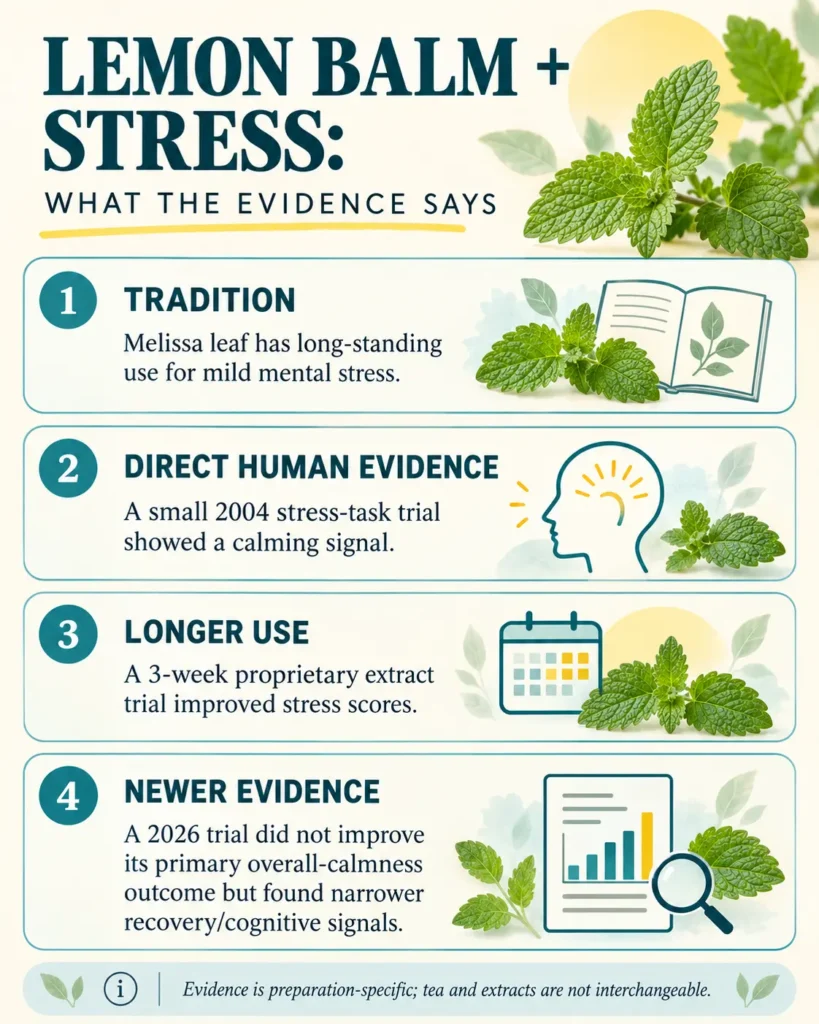
Evidence snapshot: Limited but increasingly informative. A small 2004 stress-task trial was positive at one extract dose; a 2023 3-week extract trial improved stress scores; a 2026 trial did not improve its primary overall-calmness outcome but found narrower mood-recovery and cognitive signals.
Preparation / form that matters: The direct stress trials used specific oral leaf extracts. Their findings should not automatically be applied to ordinary tea, tinctures, gummies, essential oil, or every product labeled “lemon balm.”
Practical route: For mild stress, think of lemon balm as optional support. If you use a concentrated product, choose clearly identified Melissa officinalis leaf, follow the product directions, and keep broader stress-management steps in place.
Key safety point: Some lemon balm preparations can reduce alertness. Avoid driving if you feel sleepy, use extra caution with sedating medicines or alcohol, and avoid medicinal use during pregnancy or breastfeeding unless a clinician advises otherwise.
How Lemon Balm Connects to Stress
Lemon balm (Melissa officinalis L.) is a member of the mint family whose leaf is traditionally used for mild mental stress and to help with sleep. The European Medicines Agency recognizes those uses as traditional herbal medicine—meaning the conclusion rests on long-standing use rather than the level of clinical evidence required for a well-established treatment. [1,2]
Researchers have proposed several ways lemon balm might influence calmness, including effects on GABA-related and cholinergic signaling and other stress-response pathways. Those mechanisms can make the idea biologically plausible, but they do not prove that a tea or supplement will reduce a person’s everyday stress. The clinical trials matter more.
What the Evidence Shows
A small stress-task trial found an acute calming effect
In a 2004 randomized, double-blind, placebo-controlled crossover trial, 18 healthy volunteers took single doses of a standardized lemon balm extract—300 mg, 600 mg, or placebo—before a laboratory stress task. The 600 mg dose increased self-rated calmness during the stress challenge, but it also reduced alertness. The 300 mg dose improved the speed of mathematical processing without reducing accuracy. [3]
This study is directly relevant because it measured responses during experimentally induced stress and included a placebo control. Its main limitation is size: 18 healthy volunteers and a single laboratory session cannot tell us how well lemon balm works for ongoing real-world stress.
A 3-week trial found better stress scores—but with one specific extract
A 2023 randomized, double-blind, placebo-controlled trial enrolled 100 adults with moderate emotional distress and/or poor sleep. Participants received either placebo or 400 mg/day of a proprietary phospholipid-based aqueous Melissa officinalis leaf extract for 3 weeks. Stress scores on the DASS-42 improved significantly more in the extract group than in the placebo group, along with anxiety, depression, sleep and several well-being measures. [4]
That is encouraging, but it does not establish that every lemon balm preparation has the same effect. The study used a standardized proprietary extract, and participants could qualify through depression, anxiety, stress, or poor sleep rather than stress alone. The manufacturer supplied the study extract and placebo; the authors reported no commercial or financial conflicts. [4]
A 2026 trial makes the picture more nuanced
A newer 2026 randomized, double-blind, placebo-controlled study tested a single 300 mg dose of a proprietary lemon balm extract in 106 healthy adults reporting moderate subjective stress. The primary outcome—overall calmness across the day—did not improve versus placebo. The study did find better recovery of transient calmness after cognitive-demand sessions and signals of better performance on the hardest executive-function tasks later in the day. [5]
Those secondary findings are interesting, but the negative primary calmness result keeps the overall conclusion cautious. The study was funded by the ingredient manufacturer, and two coauthors were employed by the company; the funder was reported not to have controlled data collection, analysis, interpretation, or the publication decision. [5]
Anxiety and mood studies are supportive—but they answer a different question
A 2021 systematic review and meta-analysis reported improvements in anxiety and depression outcomes across lemon balm clinical trials, but the studies were few and highly heterogeneous. That literature supports a broader calming or emotional-well-being signal, yet anxiety and depression are not the same outcome as stress and should not be counted as direct stress evidence. [6]
Why Preparation, Extract, and Route Matter
This is where lemon balm articles often become misleading. “Lemon balm” is not one interchangeable intervention.
Traditional leaf tea: The EMA’s mild-stress use is based on long-standing use of melissa leaf. Tea may fit that traditional context, but the strongest direct stress trials did not test an ordinary cup of tea.
Standardized oral extracts: The 2004, 2023, and 2026 studies used defined extracts at defined amounts. The 2023 product was an aqueous leaf extract formulated with a phospholipid carrier and standardized to hydroxycinnamic-acid derivatives. [4]
Tinctures and liquid extracts: These are legitimate lemon balm forms, but strength and extraction method vary. A positive trial of one standardized extract cannot be converted into an equivalent tincture dose without evidence.
Essential oil: Lemon balm essential oil is a different, highly concentrated preparation. This article’s stress conclusions are about leaf preparations and oral extracts, not about ingesting or applying essential oil.

Who the Evidence Applies to Most — and Where It Is Less Certain
The evidence is most relevant to adults with mild-to-moderate stress or emotional-distress complaints who use a preparation similar to the one studied. The 2004 trial involved healthy volunteers under an acute laboratory stressor; the 2023 trial enrolled adults with emotional distress and/or poor sleep; and the 2026 trial enrolled healthy adults ages 18–40 with moderate perceived stress. [3–5]
It is much less certain how well these findings apply to severe or chronic stress, diagnosed anxiety or depressive disorders, people taking multiple medicines, pregnancy or breastfeeding, children, or people using a completely different lemon balm preparation. Persistent or disabling stress needs a broader assessment rather than repeated self-treatment with an herb.
Forms and Amounts Used in Research
The direct stress studies used 300–600 mg as single doses of standardized extracts in acute experiments, 400 mg/day of one proprietary phospholipid-based extract for 3 weeks, and 300 mg of another proprietary extract in a one-day cognitive-overload study. [3–5]
These amounts describe research protocols, not a personal dosing plan. Extracts differ in composition and manufacturing, so the same number of milligrams on two products does not make them clinically equivalent. For ordinary use, follow the product’s directions rather than trying to reproduce a research dose.
Practical Decision Guide
- Know what form you are using
Tea, tincture, standardized extract, and essential oil are not interchangeable. Direct stress evidence is mainly for specific oral leaf extracts. - Keep expectations modest
The evidence suggests a possible calming effect for some adults, but it is not consistent enough to treat lemon balm as a proven stress therapy. - Use product directions—not study doses
Research amounts describe the tested preparation. Do not translate them automatically into a dose for a different product. - Check how it affects alertness
Some studies found reduced alertness at certain doses. First use should not be right before driving or another task requiring full attention. - Treat ongoing stress as a whole problem
Sleep, workload, movement, nutrition, mental skills, relationships, and professional support may matter more than any single herb.
LEMON BALM SAFETY
Lemon balm is generally well tolerated in short human studies, but some concentrated preparations can reduce alertness. If a product makes you sleepy or less alert, do not drive or operate machinery. The EMA also advises caution with sedatives and notes that safety during pregnancy and breastfeeding has not been established. [2,3]
CHECK FIRST
Sedating medicines or alcohol: Interaction data are limited, but combining calming agents can increase drowsiness. Ask a pharmacist or clinician if you use sedatives or multiple medicines.
Pregnancy or breastfeeding: Medicinal use is not recommended when safety data are insufficient unless a qualified clinician advises otherwise. [2]
Children: The EMA melissa-leaf monograph applies medicinal use to adults and adolescents over 12; younger children should not be given medicinal-strength products without professional guidance. [2]
Persistent or severe symptoms: Ongoing stress, marked anxiety or depression, major sleep disruption, or impaired daily functioning deserves appropriate professional support rather than indefinite self-treatment.

What to Explore Next
Frequently Asked Questions
Is lemon balm actually proven to reduce stress?
Not conclusively. Several controlled studies give supportive signals, including one acute laboratory-stress trial and one 3-week extract trial, but the evidence is still limited, product-specific, and not fully consistent. A 2026 trial did not improve its primary overall-calmness outcome. [3–5]
Is lemon balm tea as effective as the extracts used in studies?
We do not know. Tea fits the herb’s traditional-use context, but the direct stress trials used standardized or proprietary extracts. A positive extract trial should not be treated as proof that ordinary tea produces the same effect.
Can lemon balm make you sleepy?
Yes, it can reduce alertness in some people and at some studied doses. If you feel drowsy or less alert, do not drive, and be cautious about combining it with alcohol or sedating medicines. [2,3]
Can I use lemon balm every day for stress?
Short-term trials provide some safety information, but evidence for indefinite daily medicinal use is limited. If stress is persistent enough that you feel you need a concentrated product continuously, it is worth reviewing the cause and your overall plan with a qualified professional.
References
1. Kew Science — Plants of the World Online: Melissa officinalis L.
https://powo.science.kew.org/taxon/urn:lsid:ipni.org:names:450084-1
2. European Medicines Agency — Melissae folium / Melissa officinalis L., folium herbal monograph.
https://www.ema.europa.eu/en/medicines/herbal/melissae-folium
3. Kennedy DO, Little W, Scholey AB. Attenuation of laboratory-induced stress in humans after acute administration of Melissa officinalis (Lemon Balm). Psychosom Med. 2004;66(4):607-613.
https://pubmed.ncbi.nlm.nih.gov/15272110/
4. Bano A, et al. Standardised phospholipid carrier-based Melissa officinalis extract in adults with emotional distress and poor sleep. Front Pharmacol. 2023;14:1250560.
https://www.frontiersin.org/journals/pharmacology/articles/10.3389/fphar.2023.1250560/full
5. Mathews I, et al. Acute effects of Zensera Melissa officinalis extract during cognitive overload in adults with moderate subjective stress. Ther Adv Psychopharmacol. 2026;16.
https://pmc.ncbi.nlm.nih.gov/articles/PMC12954045/
6. Ghazizadeh J, et al. The effects of lemon balm on depression and anxiety in clinical trials: a systematic review and meta-analysis. Phytother Res. 2021;35(12):6690-6705.
https://pubmed.ncbi.nlm.nih.gov/34449930/