

When stress makes your thoughts race, having something simple to focus on can help. Box breathing uses four equal phases of breathing and counting. You can try it gently while seated—but the breath holds are optional, and it is not the right exercise for everyone.
QUICK INSIGHT
Box Breathing – Quick start
Time: Try two or three comfortable cycles first; stop at any point
Equipment: None. Sit comfortably with your feet supported, or choose another relaxed position.
Safety: Do not force a deep inhale or hold your breath if it feels unpleasant. If you are dizzy, short of breath, or panicky, return to natural breathing.
For a broader approach to everyday stress, see the UGetWell Stress guide:
Stress: A Whole-Picture Guide: https://ugetwell.com/health/stress-whole-picture-guide
What is box breathing?
Picture tracing the four sides of a square. One side is breathing in, the next is a gentle pause, the third is breathing out, and the fourth is another gentle pause. A common version counts four for each side. The goal is steady attention and comfort—not reaching a perfect count, taking huge breaths, or overcoming discomfort.
Before you start
Choose a safe, quiet place where you can sit without needing to drive, swim, exercise, or supervise a hazardous task. Relax your shoulders and jaw. Let your breathing settle naturally. Do not practice prolonged breath holds or make yourself lightheaded.
How to try box breathing: four simple steps
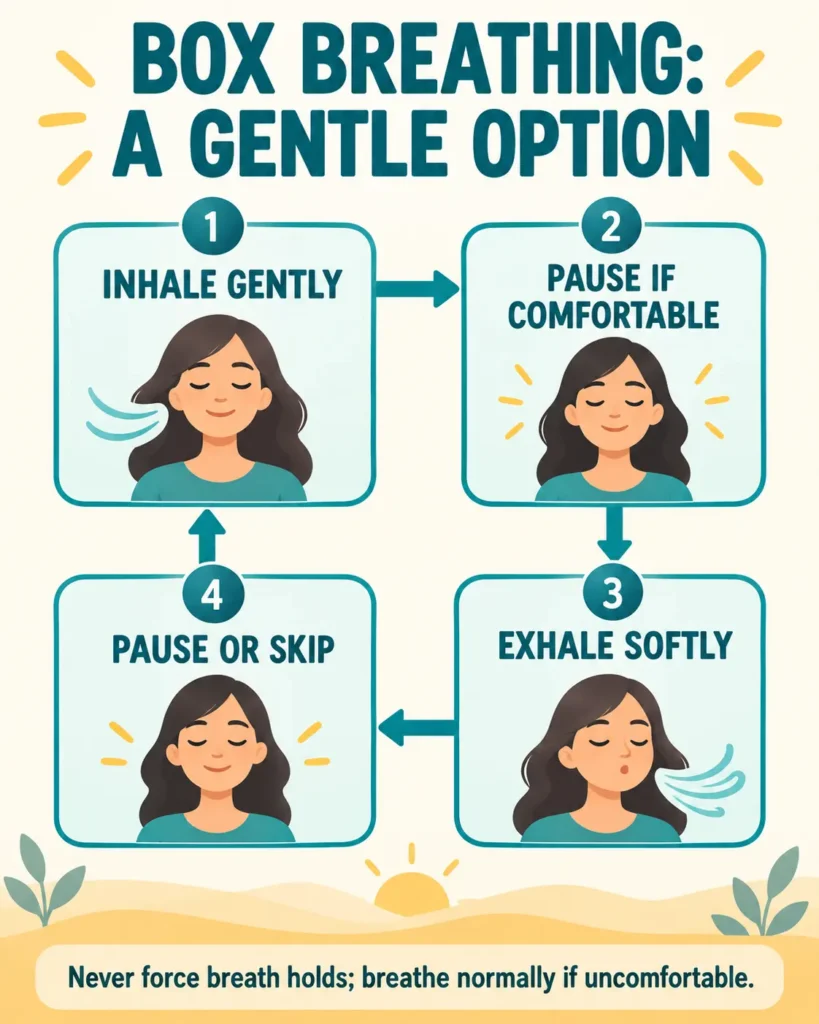
1. Inhale gently
Breathe in through your nose, if comfortable, for an easy count of four. Do not try to fill your lungs completely.
2. Pause without straining
Pause for up to four counts only if effortless. Skip this step if holding your breath causes discomfort.
3. Exhale softly
Breathe out gently for an easy count of four. Avoid blowing hard or squeezing every last bit of air out.
4. Pause—or just breathe
If comfortable, pause briefly for up to four counts. Otherwise start the next easy inhale without a pause.
Repeat only while the pattern feels comfortable, then return to your ordinary breathing. Two or three rounds are enough for a first try; there is no need to push through symptoms.
Choose the version that fits today
| Option | What to do | Best used when |
|---|---|---|
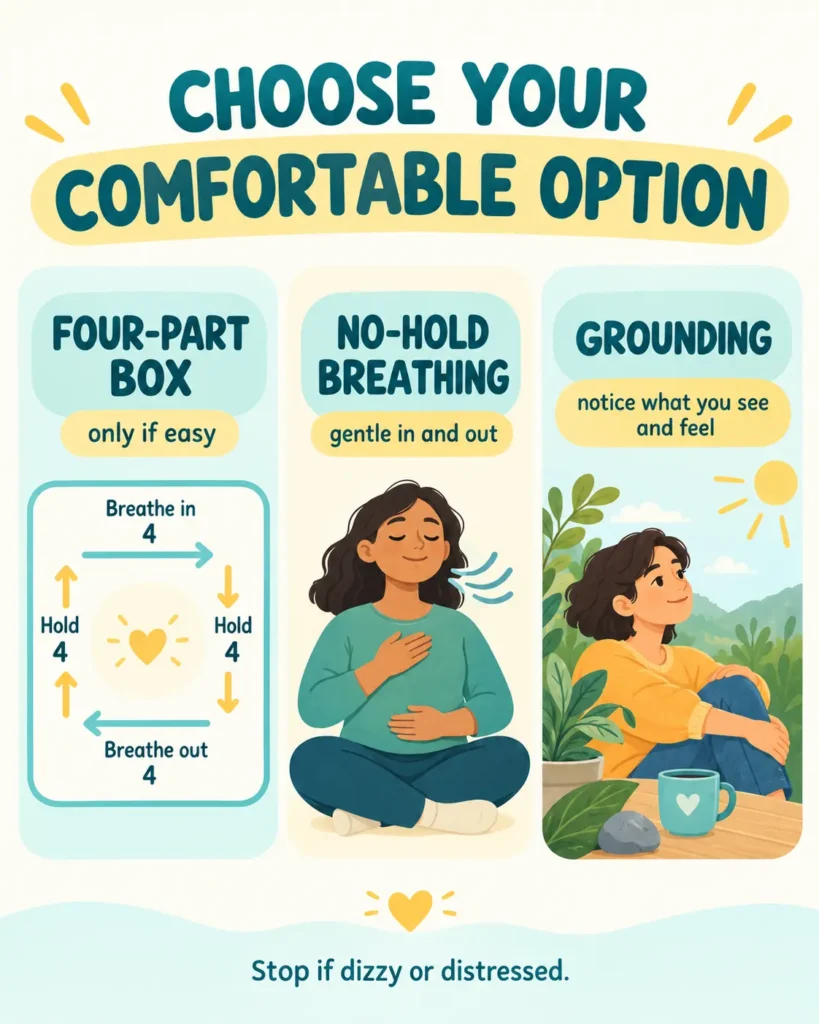
| Classic four-part pattern | Inhale 4 • easy hold up to 4 • exhale 4 • easy hold up to 4 | All phases feel completely comfortable |
| No-hold option | Breathe in gently, then breathe out gently; follow a comfortable natural rhythm | A hold feels unpleasant, stressful, or awkward |
| Grounding instead | Keep breathing normally; name five things you can see or notice feet touching the floor | Counting or breath attention increases anxiety |
These are examples, not required timing or clinical prescriptions. There is no prize for holding longer.
What might you notice?
Some people notice their attention move from worries to the rhythm of breathing. Others find the counting irritating or the pauses uncomfortable. Either response is useful information: you can keep, change, or skip the exercise. The aim is an optional moment of steadiness, not instant stress relief.
What the evidence does—and does not—say
Research on relaxation methods and slow or diaphragmatic breathing suggests they may help some people feel less stressed. However, many studies test breathing methods other than the exact four-count box pattern, and study quality and methods vary. We cannot assume box breathing has the same results as every form of paced breathing. It is a coping exercise, not a treatment for an anxiety disorder or another medical condition.
For stress that is ongoing or affecting daily life, breathing exercises work best as one optional tool alongside addressing stressors, sleep, movement, social support, and appropriate professional care.
When to skip it or stop
- Stop immediately if you feel dizzy, faint, unusually breathless, chest discomfort, or increasingly distressed. Breathe normally and seek appropriate help if symptoms persist or are severe.
- Skip the breath holds if you have a breathing condition, are pregnant, feel unwell, or have been advised not to hold your breath; ask your healthcare professional before breath-hold exercises if unsure.
- If focused breathing makes panic, trauma-related distress, or an urge to control breathing worse, choose a non-breathing grounding exercise instead.
- Never do breath-holding exercises in water, while driving, or during tasks requiring full attention.
Seek urgent medical attention for severe chest pain, fainting, or serious breathing difficulty. Persistent stress, panic, or anxiety that interferes with daily life deserves professional assessment; do not delay care in favor of a breathing exercise.
For a broader understanding of anxiety and supportive choices, see:
Anxiety: A Whole-Picture Guide: https://ugetwell.com/health/anxiety
Common questions
Do I have to use exactly four counts?
No. Four counts describes the common pattern, not a medical target. Comfort matters more than symmetry; shortening or removing holds is fine.
What if I feel more anxious?
Stop the technique. Let your breath return to normal, look around the room, or switch to a grounding activity that does not focus on breathing.
Can it replace treatment for anxiety?
No. It may be an optional self-care technique, but it does not replace professional evaluation or treatment when needed.
A practical takeaway
Try one comfortable cycle while sitting somewhere safe. If the pauses feel awkward, drop them. If breathing exercises feel worse instead of better, skip the practice entirely and choose another coping skill.
References
NCCIH — Relaxation Techniques: What You Need To Know: https://www.nccih.nih.gov/health/relaxation-techniques-what-you-need-to-know
NCCIH — Mind and Body Approaches for Stress and Anxiety: https://www.nccih.nih.gov/health/providers/digest/mind-and-body-approaches-for-stress
Cleveland Clinic — How Box Breathing Can Help You Destress: https://health.clevelandclinic.org/box-breathing-benefits