

Some days are stressful because there is simply too much to do. A perfect morning routine won’t make an unreasonable deadline disappear. But a few ordinary habits can make demanding days easier to navigate—and help protect time for recovery.
The useful question isn’t “Which habit fixes stress?” It’s “What can I change without adding yet another chore?” Start with the friction point you actually notice: poor sleep, nonstop notifications, missed meals, isolation, or no time to unwind.
QUICK INSIGHT
About Helpful Habits
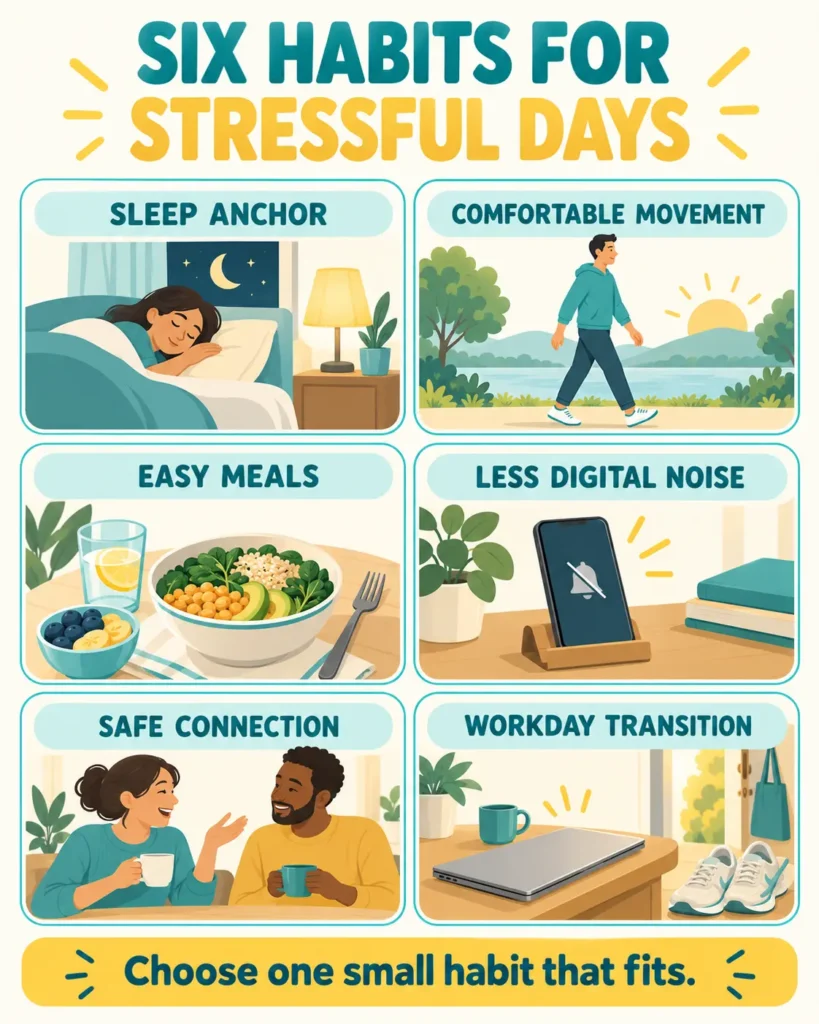
Choose one small change: keep a more consistent wake-up time, step away from a screen, take a comfortable walk, eat a simple meal, contact someone supportive, or create an end-of-day boundary. These habits may support coping and recovery; they do not replace help for serious or persistent stress. [1–3]
Six everyday habits worth considering
1. Protect a realistic sleep window
Stress can interrupt sleep; poor sleep can also make an already busy day feel harder. Keep one anchor consistent—for example, your usual wake-up time—rather than chasing a flawless bedtime. A short wind-down period with softer light and fewer work messages can be a practical starting point. Most adults need at least seven hours of sleep, though needs differ. [1]
Try tonight: set a 15-minute “closing time” for work messages. If you work shifts, focus on a sleep opportunity that fits your schedule rather than an idealized 10 p.m. bedtime.
2. Move in a way your day allows
Movement can support physical health and emotional wellbeing, but your starting point matters. A comfortable ten-minute walk, brief stretch, seated movement, or active household task may feel more accessible than a fitness program. Build toward recommended activity levels only as you are able. [1]
Try today: walk during a call or step outside between tasks. If pain, dizziness, or unusual breathlessness develops, stop and seek advice as appropriate.
3. Make food and water easier to reach
Stress can change appetite and disrupt meals. You do not need a “stress-fighting superfood.” Keep easy options available: yogurt or soy yogurt, fruit, leftovers, toast with eggs or beans, soup, and water with meals. If caffeine worsens jitteriness or sleep, experiment with earlier or smaller servings instead of assuming coffee is always the culprit.
Try today: assemble one low-effort meal before you become very hungry. Food and hydration support basic needs; they are not treatments for anxiety or stress.
4. Put boundaries around constant input
A nonstop stream of alerts can make recovery time hard to protect. The CDC recommends breaks from distressing news and social media when they add to stress. [1] Pick one time when you do not need immediate updates, silence nonessential notifications, and check messages at a planned interval.
Try today: turn off one optional notification category for the afternoon. Keep urgent or caregiving communication available when needed.
5. Make room for a real connection
Support is not measured by how many messages you send. One person who listens, a neighbor who helps, or a community group can matter. Research associates stronger social connections with better health and coping; that does not guarantee an individual outcome. [2]
Try today: send a specific, low-pressure invitation: “Could we talk for ten minutes this week?” Choose safe relationships; distance and boundaries can be healthy too.
6. Create a transition out of work or obligations
A short ritual can mark the difference between “still available” and “off duty”: write tomorrow’s first task, close the laptop, change rooms, or take a short walk. Boundaries should reflect real responsibilities and resources. A personal routine cannot solve unsafe work, financial pressure, discrimination, or excessive workload.
Try today: choose a two-minute shutdown action. If you have little control over your schedule, start with one small, negotiable boundary rather than a rigid rule.
Which habit should you try first?
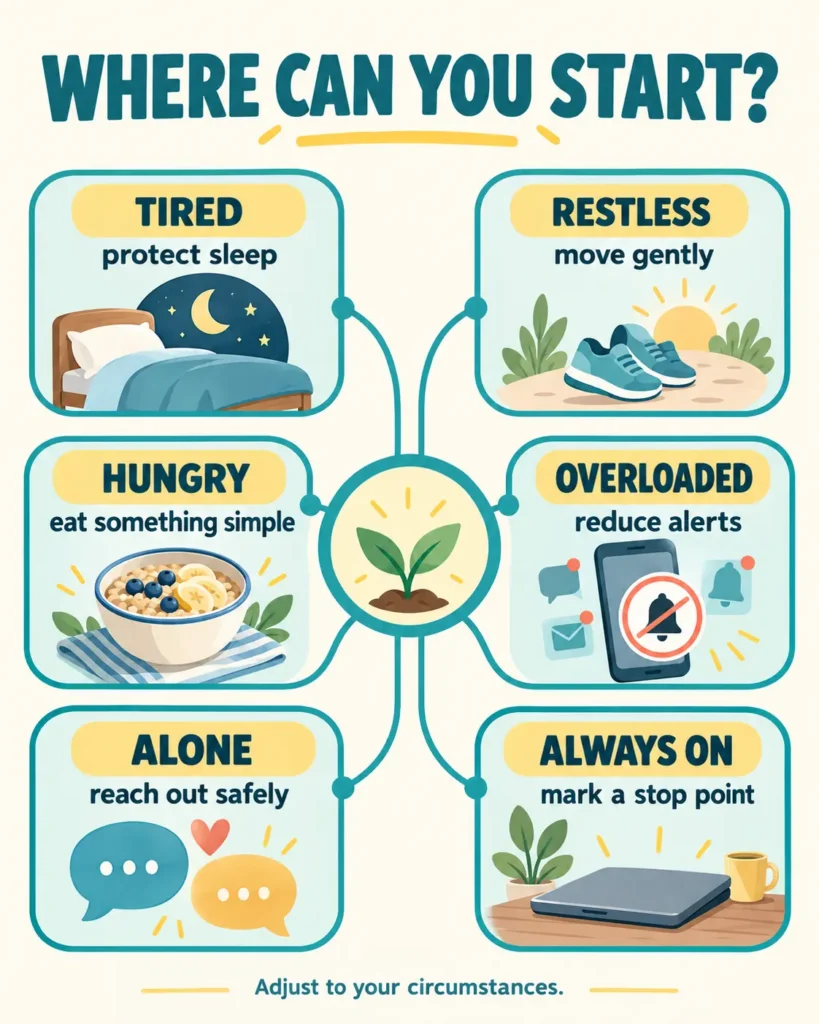
You do not have to do all six. Choose by the obstacle that is most immediate—not by the habit that looks impressive online.
| When the day feels like… | Try this first | Keep it realistic |
|---|---|---|
| Exhaustion and irregular sleep | One consistent sleep anchor | Protect opportunity; seek help for persistent insomnia |
| Restlessness or time indoors | Comfortable movement | Short bouts and adaptations count |
| Skipped meals or extra coffee | Easy meal + water | No special diet required |
| Constant buzzing and scrolling | Notification boundary | Keep essential alerts |
| Isolation | One safe check-in | Quality over social quotas |
| No separation from work | Two-minute closing ritual | Workplace factors may need bigger changes |
A seven-day starter plan (not a challenge)
Day 1: Notice when stress builds and what you most need. Day 2: Choose one change that takes under ten minutes. Day 3: Repeat it or simplify it. Day 4: Remove an obstacle (shoes by the door, water at your desk, alerts off). Day 5: Ask whether it helped *your* day—not whether you did it perfectly. Day 6: Make room for a safe social connection or quiet recovery. Day 7: Keep, adjust, or drop the habit; add another only if useful.
Example: someone who works late might protect a 15-minute wind-down rather than promise a 6 a.m. workout. Someone who cares for a family member might use a phone call for connection, not another appointment.
What the evidence can—and cannot—tell us
Public-health guidance recommends sleep, movement, connection, relaxation, and breaks from distressing media as healthy coping strategies. [1, 2] Some mind–body interventions have been studied for perceived stress or anxiety symptoms, but effects vary by practice, population, study quality, and personal circumstances. [3, 4]
Many lifestyle studies examine broad wellbeing outcomes or associations rather than proving that a particular 5-minute habit reduces stress in everyone. Use these ideas as adaptable support, not a substitute for treatment or action on external stressors.
When small changes are not enough
Consider speaking with a healthcare or mental-health professional when stress is persistent, disrupts sleep or functioning, worsens symptoms, or feels unmanageable. Seek urgent help for severe symptoms or immediate safety concerns. In the U.S., call or text 988 for a mental-health crisis. [1]
Avoid abrupt changes to prescribed medicines or using alcohol, supplements, or stimulants as a substitute for needed care. Workload, caregiving demands, housing insecurity, and relationship safety may require practical or professional support beyond habits.
Common questions
Do I need an elaborate morning routine?
No. Choose a small action you can repeat and adapt. A schedule that raises pressure is not the goal.
Is exercise better than sleep or social support?
There is no universal winner. The better starting point depends on your health, constraints, and the stress pattern you notice.
What if I cannot control my work hours?
Use flexible anchors, realistic transitions, and support where available. The point is not to blame you for constraints outside your control.
Can lifestyle habits cure chronic stress or anxiety?
No. They may support wellbeing and coping, but ongoing distress may need clinical care and changes to the circumstances causing it.
The practical takeaway
Pick one habit that removes friction from today. Make it smaller than you think it needs to be. Keep what helps, and give yourself permission to change the plan when life changes.
References
1. CDC — Managing Stress (2026) — https://www.cdc.gov/mental-health/living-with/index.html
2. CDC — Social Connection — https://www.cdc.gov/social-connectedness/about/index.html
3. CDC — Improve Your Emotional Well-Being — https://www.cdc.gov/emotional-well-being/improve-your-emotional-well-being/index.html
4. NCCIH — Mind and Body Approaches for Stress and Anxiety — https://www.nccih.nih.gov/health/providers/digest/mind-and-body-approaches-for-stress