

Stress can make a reasonable day feel like twenty urgent problems at once. Maybe a deadline is real, a family need cannot wait, or your thoughts keep replaying a conversation. A coping skill cannot erase those pressures. But a good match can help you decide what to do next.
You do not need to master meditation or fix your mindset. Start by asking what the moment calls for: settling your attention, examining a thought, solving a practical problem, accepting what you cannot change yet, or getting support.
QUICK INSIGHT
About Mental Strategies
Try one small response rather than six techniques at once. If you feel flooded, orient to something around you; if the problem is changeable, choose one concrete action; if it is not, focus on what remains within your control. Skills can support coping, but ongoing stress may also require changes in circumstances or professional help. [1, 2]
What mental strategies can—and cannot—do
Mental strategies can help you notice what is happening, reduce automatic reactions, make choices more deliberately, and sometimes feel steadier. They cannot make an unsafe workplace safe, resolve a financial crisis, cure a mental health condition, or replace a supportive relationship. Stress responses vary; a method that helps one person may feel frustrating to another. [1, 2]
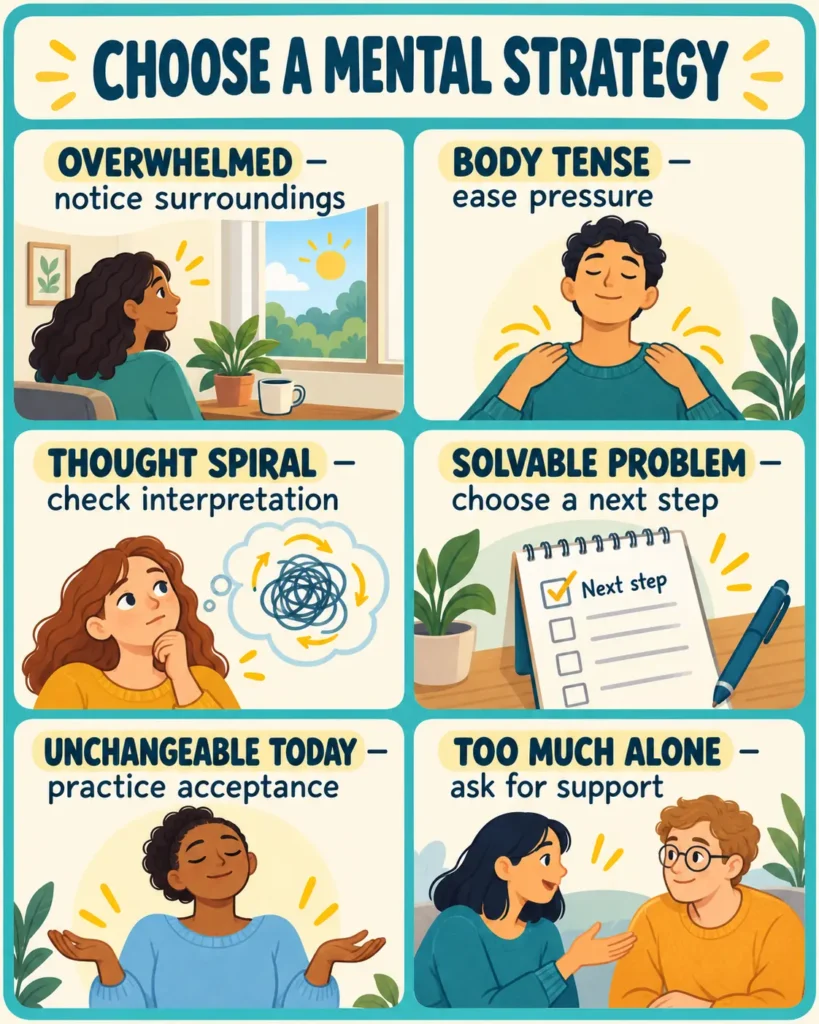
Choose the approach that fits your moment
| If this is happening… | Consider trying… | First small move |
|---|---|---|
| You feel overwhelmed right now | External grounding | Name 3 things you can see |
| Your body feels tense | Comfortable breathing or relaxing muscles | Let your exhale be unforced |
| A thought keeps escalating | Check the interpretation | Ask: what facts do I actually know? |
| There is a fixable problem | Structured problem-solving | Define one next action |
| The situation cannot change today | Acceptance + self-kindness | Name the difficulty without fighting reality |
| You are carrying too much alone | A boundary or support request | Ask for one specific kind of help |
You can switch methods. The point is usefulness, not completing an exercise perfectly.
Six strategies worth knowing
1. Ground your attention when the moment feels too loud
WHAT IT DOES: Grounding directs attention toward immediate, concrete cues. It may help you reorient during a stressful moment; evidence specifically for short sensory exercises is limited compared with research on broader mindfulness programs.
HOW TO START: Look around and silently name three ordinary objects. Notice the feel of your feet on the floor. Then identify one next task. Keep your eyes open if that is more comfortable.
WHEN IT FITS: Before a difficult call, after an upsetting message, or when your attention is racing. ADAPT: Use just one object, or notice sounds rather than bodily sensations. LIMIT: Stop if it increases distress; it is not a treatment for trauma or panic. [3, 4]
For another practical example, see our published grounding guide: https://ugetwell.com/mental/grounding-techniques-stress-they-cannot
2. Use easy breathing or muscle release—not forced breathing
WHAT IT DOES: Relaxation practices such as slow breathing may help some people ease short-term tension. Research on relaxation approaches varies by technique and population. [3]
HOW TO START: Sit comfortably and allow your breathing to settle. You might soften your shoulders as you exhale. Do not force long inhalations or breath holds.
WHEN IT FITS: A pause between tasks. ADAPT: Skip breath focus and instead stretch your hands or relax your jaw. LIMIT: If breath attention causes dizziness, panic, or discomfort, stop. Box breathing includes holds and is not right for everyone.
For a breathing variation and when to skip it:
https://ugetwell.com/mental/box-breathing-stress-skip
3. Examine an alarming thought without demanding positivity
WHAT IT DOES: Sometimes an interpretation—not only the situation—adds fuel to stress. Thought examination is one element used within structured cognitive behavioral approaches, but this brief self-help question is not the same as therapy.
HOW TO START: Write the thought: “I made a mistake; everything will go wrong.” Ask what is known and unknown. Try a balanced statement: “I made one mistake; I can check the impact and repair what I can.”
WHEN IT FITS: Harsh self-judgment or worst-case predictions. ADAPT: Speak the alternative out loud instead of writing. LIMIT: Do not use reframing to excuse discrimination, danger, or a real need for change.
4. Solve the part you can influence
WHAT IT DOES: Problem-solving converts a vague threat into a practical, manageable decision. NHS self-help guidance recommends distinguishing problems that can be addressed from worries that cannot be resolved right now. [5]
HOW TO START: Define the problem in one sentence. Brainstorm two reasonable options. Choose the smallest feasible test and decide when you will revisit it.
WHEN IT FITS: An overdue bill, a confusing schedule, or competing work priorities. ADAPT: Ask someone to help identify the first step. LIMIT: Not every stressor is under personal control; solutions may require organizational or professional support.
5. Practice acceptance when certainty is unavailable
WHAT IT DOES: Acceptance is acknowledging what is happening while still acting on what matters. It is not approval, surrender, or pretending the situation is fine.
HOW TO START: Name the situation: “I do not have the answer today.” Separate what can be done now from what must wait. Choose a modest action such as checking for updates at a planned time.
WHEN IT FITS: Waiting for results or a decision outside your control. ADAPT: Use a short phrase rather than a formal meditation. LIMIT: Acceptance should never become a reason to tolerate harm or forgo needed assistance.
6. Reduce the load through compassion, boundaries, and support
WHAT IT DOES: Stress can intensify when we speak harshly to ourselves or accept unlimited demands. A supportive conversation or a realistic boundary may create room to recover. CDC recommends connecting with others as one component of coping. [1]
HOW TO START: Replace “I should handle everything” with “This is a lot; what is one reasonable next step?” Then request specific help: “Can you cover pickup on Thursday?” or “I can respond tomorrow morning.”
WHEN IT FITS: Caregiving, workload, or relationship strain. ADAPT: Write a message instead of speaking. LIMIT: Boundaries carry different risks depending on power dynamics and safety; seek help making a plan if needed.
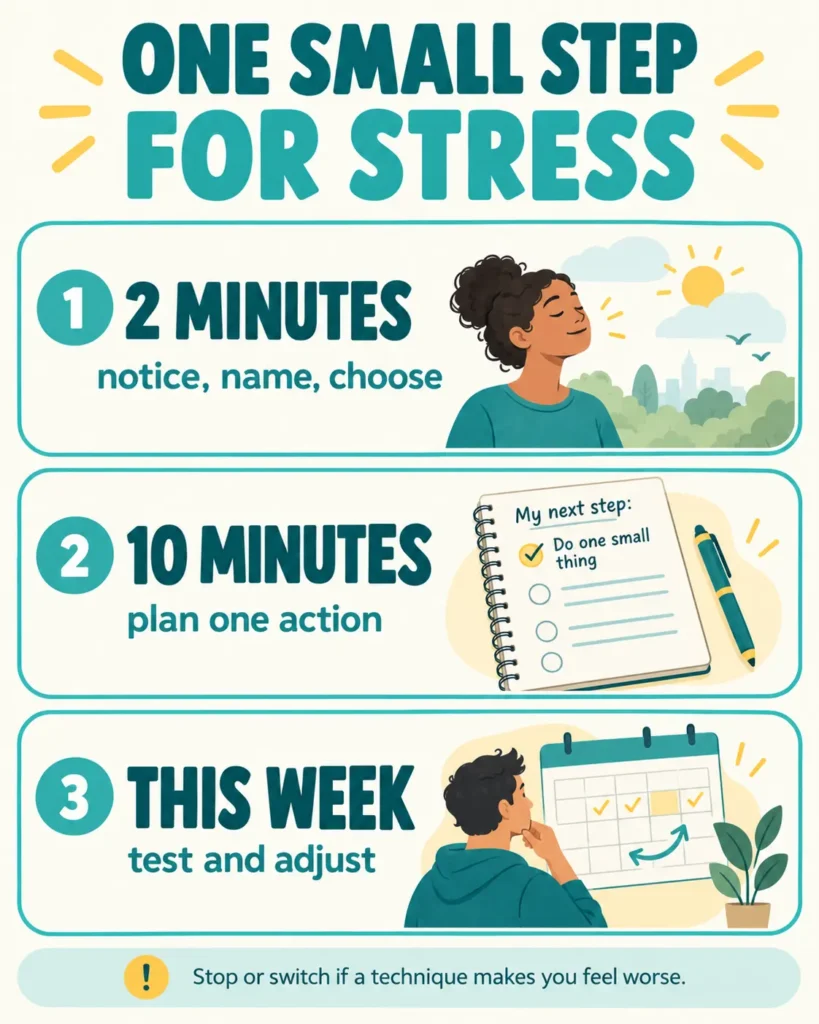
Try one plan—not a new full-time routine
| Time available | A workable experiment |
|---|---|
| About 2 minutes | Notice one visible object, name the stressor, select one next action. |
| About 10 minutes | Write what is controllable; test one problem-solving step; ask for help if useful. |
| Across the week | Try the same technique in a few situations, note whether it helps, and change course when it does not. |
Example: After a frustrating meeting, you first look away from your screen and notice the room. Then you ask whether there is a specific follow-up you can take. If not, you schedule a check-in rather than replaying the meeting all afternoon.
What if it does not help?
If a technique leaves you more tense, shorten it, switch to an external focus, or stop. If repeated thought-checking becomes rumination, move toward a concrete next action or supportive conversation. If a problem requires money, childcare, safety measures, or workload changes, internal coping alone is not enough. A useful strategy makes daily life a little more manageable; it is not a test of discipline.
What does the evidence really support?
Evidence is not equally strong for every technique. Structured mindfulness-based programs and some relaxation approaches have been studied for stress-related symptoms and mental health outcomes, although study quality, populations, and effects vary. [3, 4] Problem-solving is a recognized self-help method and part of established psychological approaches; that does not mean one worksheet has proven clinical effects for everyone. [5] Simple grounding, self-compassion phrases, and brief reappraisal examples are practical options, but findings from full therapeutic programs should not be presented as proof for these stand-alone exercises.
There is no proven universal “best combination.” Matching the tool to the kind of stressor—and addressing the situation itself—usually makes more sense than collecting techniques.
Safety and when to seek support
Skip any exercise that causes dizziness, disorientation, intensified panic, distressing memories, or an uncomfortable focus on your body. People with trauma histories or dissociation may prefer eyes-open external orientation and guidance from a qualified clinician. Relaxation exercises are not a substitute for medical or mental health care. [3, 4]
Seek qualified support when stress persists, affects sleep or work, harms relationships, or feels unmanageable. If you or someone else is in immediate danger, contact emergency services. In the United States, call or text 988 for crisis support. [1]
A question worth asking tonight
“Is my next step to steady myself, solve something, set a limit, or ask for help?” The right answer can change from day to day. Choosing one appropriate response is enough to begin.
References
1. CDC — Managing Stress https://www.cdc.gov/mental-health/living-with/index.html
2. NIH/NCCIH — Stress overview https://www.nccih.nih.gov/health/stress
3. NIH/NCCIH — Five Things To Know About Relaxation Techniques for Stress https://www.nccih.nih.gov/health/tips/things-to-know-about-relaxation-techniques-for-stress
4. NIH/NCCIH — Meditation and Mindfulness: Effectiveness and Safety https://www.nccih.nih.gov/health/meditation-and-mindfulness-effectiveness-and-safety
5. NHS — Problem solving https://www.nhs.uk/every-mind-matters/mental-wellbeing-tips/self-help-cbt-techniques/problem-solving/