
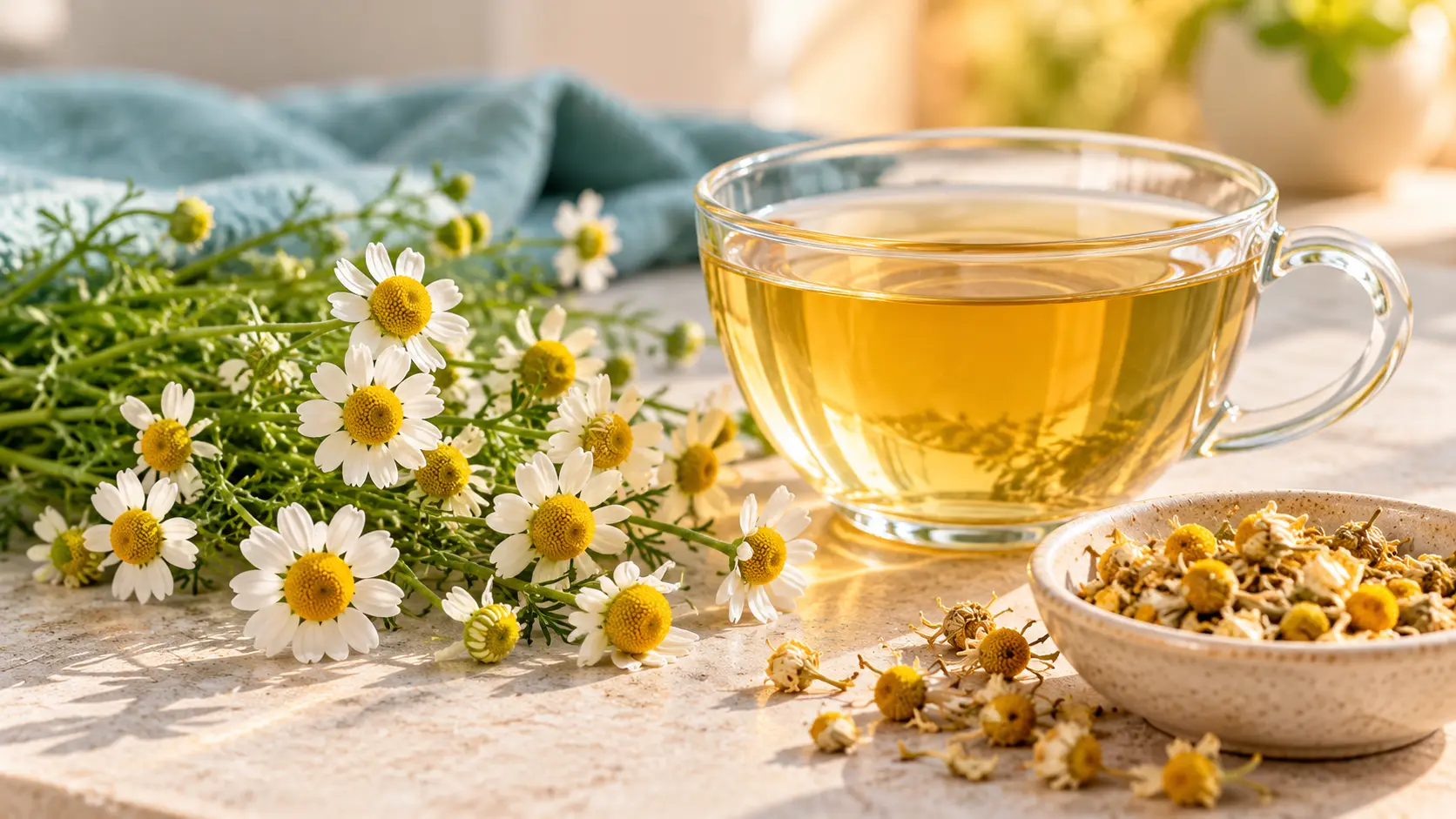
A cup of chamomile tea can be a pleasant way to mark the end of a demanding day. But if you are hoping chamomile will noticeably reduce stress, the evidence calls for a more careful answer: small studies of particular chamomile extracts have explored anxiety symptoms, while direct evidence for everyday stress relief from chamomile tea remains limited. [1–4]
The plant, preparation, and outcome matter. Feeling comforted by a tea ritual is valid, but it should not be confused with proof that the tea treats chronic stress or an anxiety disorder. Some people also need to avoid chamomile or check its interactions before using it regularly. [1]
Quick Answer
| Field | Reader-facing answer |
|---|---|
| Bottom line | Chamomile may fit a soothing evening routine, but reliable evidence that chamomile tea reduces everyday stress is lacking. |
| Evidence snapshot | Limited and indirect: small human trials of oral chamomile extracts studied generalized anxiety symptoms, not all kinds of everyday stress. |
| Preparation / form that matters | German chamomile (Matricaria recutita / M. chamomilla) flower preparations. Studied oral extracts cannot be assumed equivalent to tea. |
| Practical route | If chamomile is appropriate for you, treat tea as an optional ritual rather than prescribed stress treatment; discuss concentrated extracts with a clinician. |
| Key safety point | Avoid if allergic to chamomile or related daisy-family plants; check medication interactions, particularly warfarin and sedatives. |
How chamomile connects to stress
German chamomile is an aromatic herb in the Asteraceae family. The flower heads are used in teas and some extracts. Herbalists sometimes describe chamomile as a calming nervine—an herb commonly chosen for quiet, settling rituals. That practical description does not establish a measurable physiological effect for every consumer product. [1]
Stress is also not the same outcome as generalized anxiety disorder (GAD). Stress can arise from workload, caregiving, uncertainty, or circumstances that require practical support. Anxiety studies may offer clues about chamomile, but their results cannot be directly transferred to short-term work stress or to any cup of tea.
For the herb’s broader identity, typical forms, and general precautions, read Chamomile: Uses, Evidence, Safety, and How It’s Used
What the evidence actually shows
An eight-week placebo-controlled extract trial
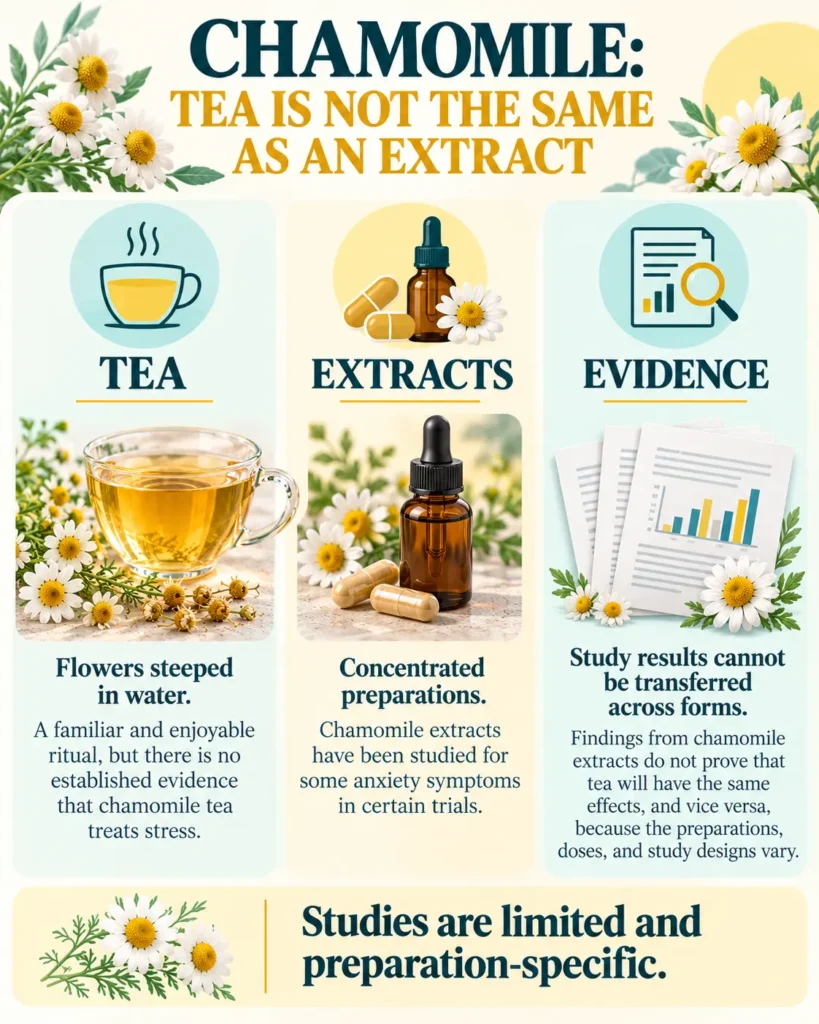
In a randomized, double-blind trial, 57 adults with mild-to-moderate generalized anxiety disorder received oral Matricaria recutita extract or placebo for eight weeks. Average anxiety-rating scores improved more in the chamomile group, suggesting a possible effect in that defined setting. The study was small and concerned a concentrated research preparation and diagnosed anxiety, not a typical tea routine or everyday perceived stress. [2]
A longer study did not clearly prevent relapse
A later two-phase trial enrolled 179 adults with moderate-to-severe generalized anxiety disorder. After an open-label phase using a pharmaceutical-grade chamomile extract, 93 responders entered a randomized continuation-versus-placebo phase. The primary relapse outcome did not show a statistically significant difference, although some symptom measures favored ongoing extract use. This design and responder selection limit what can be concluded for new users or for general stress. [3]
What reviews and public-health guidance conclude
The NIH National Center for Complementary and Integrative Health describes the evidence for chamomile supplements in generalized anxiety disorder as preliminary and not conclusive. A review of randomized studies did not find clear benefit for situational anxiety. There is even less research directly testing whether an ordinary tea helps people cope with everyday stress. [1,4]
EVIDENCES
Evidence is suggestive for certain oral extracts in selected anxiety populations, but insufficient for claims that chamomile tea treats stress or insomnia.
Why tea and extracts are not interchangeable
Tea uses flowers steeped in water. Extracts may differ in starting material, solvent, concentration, processing, and amount consumed. An extract used in a trial may be manufactured to specifications that are not matched by ordinary retail teas or tinctures. A label that says “chamomile” does not demonstrate equivalence. [1–3]
A typical chamomile tea ritual can still be a personally enjoyable, non-caffeinated pause. Just avoid assigning the results of extract research to tea, and do not assume that a stronger product is a better or safer option.
Who might find it useful—and where uncertainty remains
If you enjoy herbal tea, have no relevant allergies, and do not take medicines that could interact, a gentle tea break may fit an overall stress-management routine. The rest, reduced stimulation, and personal meaning of a ritual can matter independently of the herb. Its contribution has not been reliably isolated in trials of everyday stress.
People with persistent worry, panic, impaired sleep, or difficulty coping may benefit more from a broader assessment and evidence-based support than from experimenting with herbal extracts. The available chamomile trials do not establish it as a substitute for psychological or medical care. [4]
KEY STEPS
- Define your goal. Is it simply to enjoy an evening pause, or are stress symptoms affecting sleep, work, or daily life?
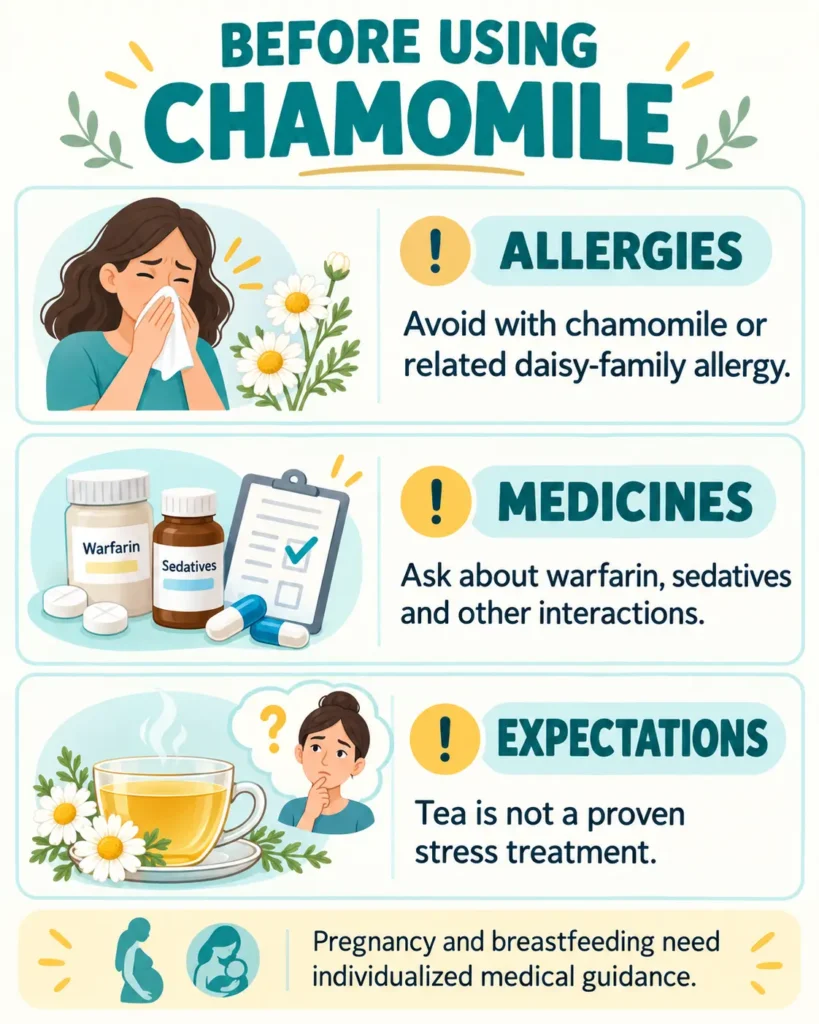
- Check your allergy history. Chamomile is related to ragweed, chrysanthemums, marigolds, and daisies; reactions may be serious. [1]
- Review medicines and health circumstances. Ask a pharmacist or clinician before regular medicinal use, especially with blood thinners or sedating medicines. [1,5]
- Keep expectations realistic. A tea ritual is not a proven treatment; a study extract is not a dosing guide for you.
- Pair any optional ritual with a practical stress response, such as protecting sleep opportunity, light movement, asking for help, or changing an overwhelming demand.
SAFETY
Chamomile is not risk-free simply because it is an herb. Stop use and seek emergency help for breathing difficulty, throat swelling, or signs of a severe allergic reaction. [1]
**Allergy:** Anyone with an allergy to chamomile or related Asteraceae plants should avoid it; severe hypersensitivity, including anaphylaxis, has been reported. [1]
**Medication interactions:** Reports involve warfarin and drugs metabolized through some liver pathways. Sedative interactions are theoretically possible. Chamomile has also raised preliminary concerns about interactions with cyclosporine and hormonal medicines. Ask a pharmacist about your exact medication list. [1,5]
**Pregnancy and breastfeeding:** Evidence on medicinal use is inadequate to establish safety. Seek individualized prenatal or postnatal advice rather than assuming supplements are safe. [1]
**Other cautions:** Nausea, dizziness, and allergic reactions may occur; concentrated preparations are not equivalent to food-level tea exposure. People with hormone-sensitive conditions should discuss medicinal use with a clinician. [1]
Interactions / Who Should Avoid
Use the above safety points as a reader-facing pattern if available.
If stress is persistent, escalating, or substantially disrupting life, consult a healthcare professional. Immediate safety concerns, severe symptoms, or thoughts of self-harm require urgent appropriate help; herbal products should not delay care.
One useful next step: if you enjoy chamomile tea and it is safe for you, use it as a pleasant pause while focusing on the actual source of stress. If you are considering an extract for symptom relief, review the evidence and safety with a clinician first.
References
1. NIH NCCIH. Chamomile: Usefulness and Safety.
https://www.nccih.nih.gov/health/chamomile
2. Amsterdam JD et al. Randomized double-blind placebo-controlled trial of oral Matricaria recutita for generalized anxiety disorder (2009).
https://pmc.ncbi.nlm.nih.gov/articles/PMC3600416
3. Mao JJ et al. Long-term chamomile treatment for generalized anxiety disorder: randomized clinical trial (2016).
https://pmc.ncbi.nlm.nih.gov/articles/PMC5646235
4. NIH NCCIH. Anxiety and Complementary Health Approaches.
https://www.nccih.nih.gov/health/anxiety-and-complementary-health-approaches
5. NIH NCCIH. Herb-Drug Interactions: What the Science Says.
https://www.nccih.nih.gov/health/providers/digest/herb-drug-interactions-science