

A movement routine that lasts is usually one you can return to after an ordinary busy week—not one that demands a perfect schedule. Start with a few realistic opportunities to move, include recovery, and make the plan adjustable when life changes. You do not need a gym, expensive equipment, or a fixed pace to begin.
QUICK INSIGHT
About Planning Weekly Movement Routine
Best starting point: Choose two or three movement opportunities that already fit your week. What you need: A safe space and an activity you can do comfortably. First action: Write down your most realistic day, time, and alternative. Safety: If activity is new to you or your health limits are uncertain, begin gently and ask for individual medical advice when appropriate. [1–3]
Before you start: make the plan fit your real week
Look at your available time, energy, access, caregiving and work demands, weather, and opportunities to recover. A brief walk, moving around at home, cycling on a safe route, a dance break, or an accessible seated activity can all contribute to movement. The activity should be feasible for you rather than chosen to impress anyone.
The public-health targets for adults are a longer-term reference, not a minimum pass/fail score for beginners. Current WHO guidance recommends 150–300 minutes of moderate aerobic activity—or 75–150 minutes vigorous, or a combination—plus muscle-strengthening activity on at least two days per week. It also emphasizes that some activity is better than none and gradual increases are appropriate. These targets are population guidance, not an individualized prescription. [1,2]
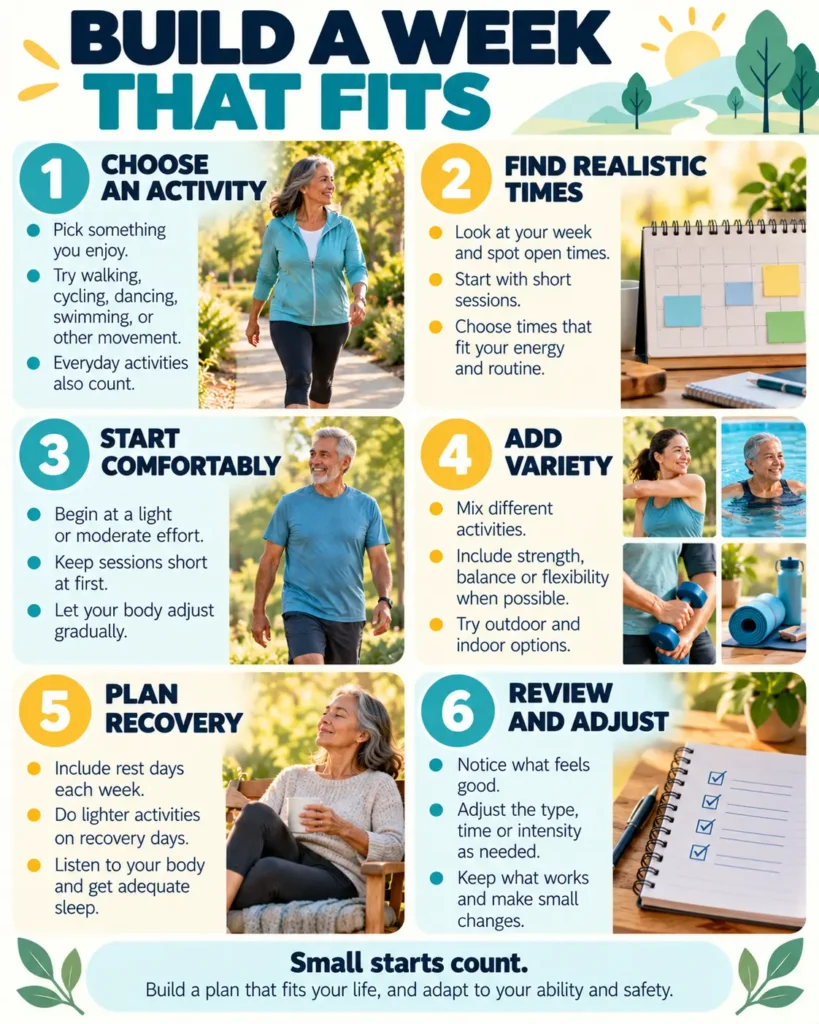
Build your routine in six simple steps
1. Choose one activity you can return to
Pick a familiar option such as a comfortable walk, easy cycling, adapted dance, or seated movement. If you dislike it or cannot access it, choose another.
2. Match movement to your actual schedule
Identify two or three plausible windows this week. Use existing transitions—after a meal, before work, during a break—if they are convenient.
3. Set an easy starting version
Use a short, comfortable amount you could repeat. Starting examples are illustrative, not a required duration or a guarantee of benefit.
4. Add a different kind of movement when appropriate
Consider a simple strength or mobility activity on another day: supported sit-to-stands, lifting light household items with safe technique, or accessible resistance work. Adjust for ability and any health limitations.
5. Put recovery and flexibility on the calendar
Allow lighter days and adapt when tired, ill, sore, or busy. A missed day is a reason to revise the plan, not to double the next session.
6. Check how the routine feels and revise
At the end of the week, notice whether the activity was manageable, safe, enjoyable, and repeatable. Keep what works; adjust time, location, intensity, or type where needed.
An example week you can change
This is a sample for illustration only; it is not a personalized exercise plan, rehabilitation protocol, or requirement to train on particular days.
| Day / opportunity | Illustrative option | Flexible fallback |
|---|---|---|
| Monday | Comfortable walk or wheeling outing | Move indoors for a shorter interval |
| Tuesday | Gentle strength or mobility practice | Supported, seated, or lighter variation |
| Wednesday | Rest or easy everyday movement | No planned session |
| Thursday | Walk, dance, cycle, or similar aerobic activity | Try a different time or location |
| Friday | Strength or mobility option | Shorter version or additional recovery |
| Weekend | Enjoyable activity and flexible recovery | Household movement, adapted activity, or rest |
Choose your version
| If your week looks like… | Try… | Remember… |
|---|---|---|
| Little time or low energy | One accessible brief movement opportunity on a few days | Consistency may mean adjusting downward |
| Some room to build | Add variety or a second activity type gradually | Avoid abrupt jumps in effort |
| Limited mobility or challenging environments | Adapted seated, supported, indoor, or accessible activities | Get individualized support for unfamiliar limitations |
How to judge your effort
For many aerobic activities, the talk test is an accessible guide: at moderate effort, you can usually talk but not sing; at vigorous effort, speaking more than a few words can be difficult. The test is approximate, and medications or health conditions can affect perceived effort. Comfortable movement is a reasonable starting point for many beginners. [3]
Common problems and useful adjustments
| What gets in the way | A more sustainable response |
|---|---|
| A packed calendar | Pick an easier opportunity rather than forcing a long session |
| Too intense on the first day | Reduce intensity or duration; return gradually |
| Boredom | Rotate walking, music, cycling, movement games or other enjoyable options |
| Pain, dizziness, or alarming symptoms | Stop; seek appropriate medical attention rather than pushing through |
| Missed several sessions | Restart with a smaller version, without compensatory overexertion |
What evidence supports—and what it does not
Regular physical activity supports numerous aspects of health. WHO recommendations are based on systematic evidence reviews linking activity with health outcomes across populations. The specific six-step planning approach in this article has not itself been established as a clinical intervention, and it cannot guarantee improvements in mood, sleep, weight, or pain for an individual. [1,2]
For a clearer explanation of aerobic intensity, see our Aerobic Exercise guide. Walking may be the most accessible option for some people; our Walking guide explains how to start and adjust. Both pages discuss safety rather than prescribing a personal target.
When to stop or seek help
Stop activity and seek urgent medical help for chest pain, fainting, severe or unusual breathing difficulty, sudden weakness, or other alarming symptoms. Avoid exercising through severe or worsening pain. Ask a qualified clinician about activity limits if you have significant cardiovascular, respiratory, balance, pregnancy-related, injury, post-surgical, or other medical concerns. Adjust plans for heat, air quality, traffic and environmental hazards. [2,3]
Your next small step
Write down one type of movement, the first realistic opportunity to do it, and one fallback. Try it at a manageable level, then check whether the routine fits—not whether it looks ideal on paper.
Related reading
Aerobic Exercise: Benefits, Types, How Much, and How to Start — https://ugetwell.com/physical/aerobic-exercise/
Walking: Health Benefits, How to Start, and Safety — https://ugetwell.com/physical/walking/
Yoga: Benefits, Styles, How to Start, and Safety — https://ugetwell.com/physical/yoga/
References
1. World Health Organization. Guidelines on physical activity and sedentary behaviour (2020) — https://www.who.int/publications/i/item/9789240015128/
2. WHO Guidelines on Physical Activity and Sedentary Behaviour — recommendations, NCBI Bookshelf — https://www.ncbi.nlm.nih.gov/books/NBK566046/
3. CDC. Physical Activity Basics for Adults — https://www.cdc.gov/physical-activity-basics/adults/index.html