

Trouble sleeping can become exhausting when it lasts for weeks or months. With so many sleep tips, supplements, and medications promoted online, it can be hard to see which approaches are actually supported by research.
The best-supported starting treatment for chronic insomnia in adults is cognitive behavioral therapy for insomnia (CBT-I). Other choices depend on your symptoms, health conditions, priorities, and access to care. [1–4]
QUICK INSIGHT
About Chronic Insomnia
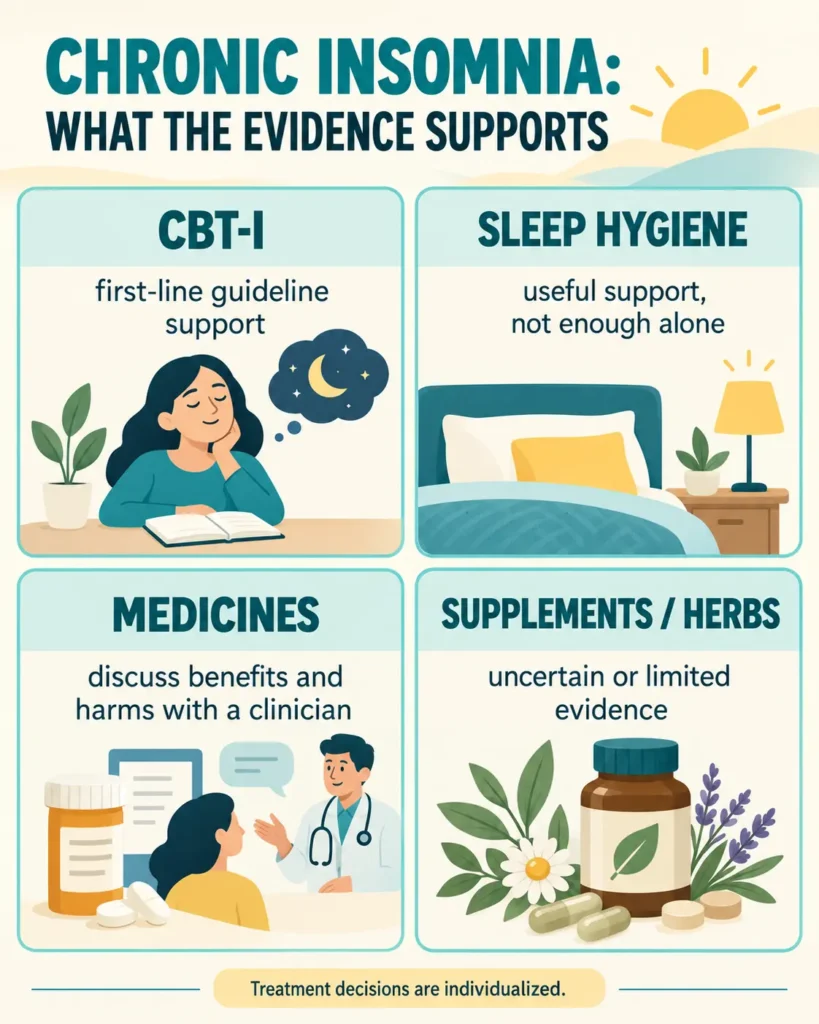
Chronic insomnia involves repeated trouble falling asleep, staying asleep, or getting restorative sleep despite a reasonable chance to sleep—and it affects daytime life. Structured CBT-I has strong guideline support. Medicines may have a role after an individual discussion of benefits and harms; herbal remedies and supplements are not substitutes for established treatment. [1–5]
What counts as chronic insomnia?
A commonly used clinical pattern is sleep difficulty at least three nights per week for three months or longer, accompanied by daytime consequences. Diagnosis requires context: another condition, medication, work schedule, or a different sleep disorder may contribute. You cannot establish a diagnosis from a checklist or an article. [1]
A healthcare professional may ask about your sleep schedule, daytime functioning, caffeine or alcohol use, medicines, mood, pain, snoring, and other symptoms. A brief sleep diary can make those patterns easier to describe. [1]
Which approaches have the strongest evidence?
This table is an evidence-navigation tool, not a treatment prescription. Recommendations vary by population, setting, and the exact intervention studied.
| Approach | What research/guidelines suggest | Important qualification |
|---|---|---|
| Structured CBT-I | Strong recommendation as initial treatment for adults with chronic insomnia. [2,3] | Includes several coordinated techniques; ideally guided by a trained clinician or validated program. |
| Sleep hygiene alone | Useful supporting habits; not recommended as the only chronic-insomnia treatment. [2] | An orderly bedtime routine is not equivalent to CBT-I. |
| Prescription sleep medications | May be considered through shared decision-making if CBT-I is insufficient or unavailable. [3,4] | Risks, duration, interactions, and preferences matter; choices are individualized. |
| Melatonin, herbs, other supplements | Evidence is variable or insufficient for routine chronic-insomnia treatment. [4,5] | Natural does not guarantee safety or effectiveness. |
| Exercise, stress management, environmental changes | Can support overall wellbeing and a workable sleep routine. [1,4] | Do not claim these alone resolve chronic insomnia. |
1. CBT-I: the evidence-backed foundation
CBT-I is a structured, usually time-limited treatment that addresses behaviors and thoughts that keep insomnia going. Depending on the program, it can include stimulus control, adjusting time in bed, cognitive strategies, relaxation, and sleep education. It is more than a generic list of bedtime tips. [2,3]
The American Academy of Sleep Medicine gives multicomponent CBT-I a strong recommendation. The American College of Physicians recommends it as initial treatment for adults with chronic insomnia. Improvements can persist after treatment, although outcomes vary and access to trained providers can be difficult. [2,3]
Some CBT-I components, especially time-in-bed restriction, can temporarily increase sleepiness and may be unsuitable or require specialized oversight for certain medical conditions or safety-sensitive work. Avoid attempting an aggressive self-directed sleep-restriction program. [2]
2. Medicines: a selective, individualized option
Prescription treatments differ in how they work, the situations in which they are studied, and their potential adverse effects. Possible concerns include next-day impairment, falls, interactions, complex sleep behaviors with some medicines, or difficulty stopping certain treatments. A clinician should discuss whether a medicine fits your situation and how it will be monitored. [3,4]
Guidelines do not imply that everyone with insomnia needs a sleeping pill. The ACP recommends shared decision-making about short-term medication if CBT-I alone has not helped sufficiently. Never start, increase, combine, or abruptly stop prescribed treatment based on this article. [3]
3. Supplements and herbal approaches: evidence gaps matter
Melatonin is sometimes helpful for certain circadian-timing problems, but it should not be treated as proven first-line therapy for chronic insomnia. Products vary, and safety considerations depend on other medications and medical history. [4,5]
Valerian, chamomile, and other herbs are often marketed for sleep; evidence for consistently treating chronic insomnia is limited or inconsistent. Preparation, dose, and quality vary. Combining sedating products with alcohol or medicines can raise risks. Speak with a qualified clinician or pharmacist before using them, especially during pregnancy or when managing other conditions. [4,5]
4. Habits and lifestyle: useful supports, not equivalent treatments
Consistent wake times, a comfortable sleep environment, attention to late caffeine and alcohol, and daytime movement can make sleep more manageable. Reducing stress or addressing nighttime worry may help certain individuals. But the AASM advises against sleep hygiene alone as the sole treatment for chronic insomnia. [1,2]
If practical changes have not helped, it is reasonable to ask about CBT-I rather than repeatedly adding stricter bedtime rules. Worrying excessively about getting “perfect” sleep can itself become unhelpful.
Why the evidence is not one-size-fits-all
Research participants vary in age, accompanying conditions, definitions of insomnia, delivery methods, and comparison groups. Trials of a standardized CBT-I program cannot automatically be generalized to an app with unrelated tips. Likewise, studies of a specific extract do not establish that every tea or supplement with the same plant has equal effects.
A guideline recommendation weighs benefits and harms across evidence; it is not a guarantee of benefit for any one reader. Coexisting sleep apnea, restless legs, pain, depression, medicines, and work schedules may change the clinical plan. [1,2,4]
What you can do next
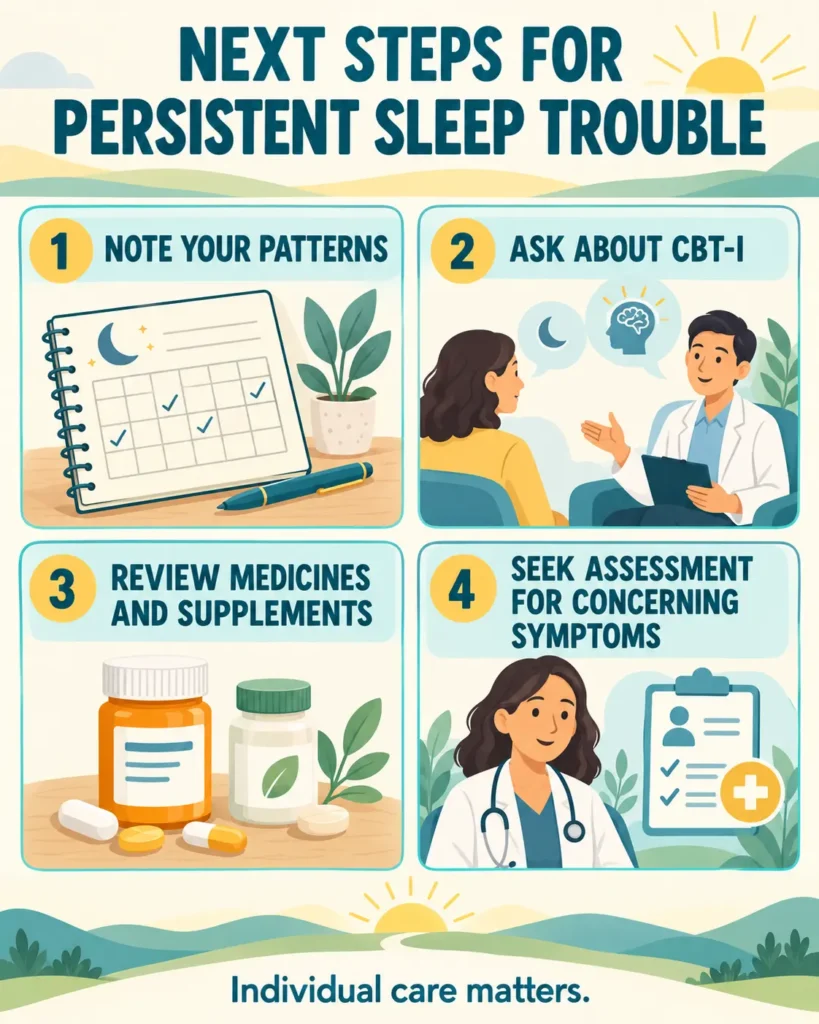
- Track your pattern briefly: bedtime, wake time, awakenings, naps, caffeine, and daytime effects. A few notes are enough to start a useful conversation.
- Ask a healthcare professional whether CBT-I is appropriate and what qualified in-person or validated remote options are available.
- Bring a complete medication and supplement list, including over-the-counter sleep aids.
- Choose modest, sustainable sleep supports; do not assume stricter routines or higher supplement doses are better.
When to seek professional assessment
Arrange an appointment if sleep problems persist, interfere with concentration or daily functioning, or cause distress. Mention loud snoring, observed breathing pauses or gasping, unusual sleep behaviors, severe daytime sleepiness, or significant mood changes; these can call for evaluation beyond routine insomnia tips. Seek urgent help for immediate danger, severe breathing problems, chest pain, or thoughts of self-harm. Do not drive when dangerously sleepy. [1,4]
The bottom line
If insomnia has become persistent, you do not need to keep cycling through unproven fixes. CBT-I is the best-supported starting point for adults. A qualified professional can help investigate other contributors and weigh additional options with you.
Educational information only. This article does not diagnose insomnia or replace individualized medical care.
For a broader overview of sleep habits and treatment options, explore our Sleep & Rest guide. If your sleep problems are persistent or affecting daily life, see when to seek professional help.
References
1. NIH NHLBI — Insomnia overview — https://www.nhlbi.nih.gov/health/insomnia
2. AASM — Behavioral and psychological treatments guideline (2021) — https://pmc.ncbi.nlm.nih.gov/articles/PMC7853203/
3. ACP — Chronic insomnia treatment guideline (2016) — https://pubmed.ncbi.nlm.nih.gov/27136449/
4. VA/DoD — Management of Chronic Insomnia Disorder and Obstructive Sleep Apnea (2025) — https://www.healthquality.va.gov/guidelines/CD/insomnia/index.asp
5. NCCIH — Sleep disorders and complementary health approaches — https://www.nccih.nih.gov/health/sleep-disorders-in-depth