
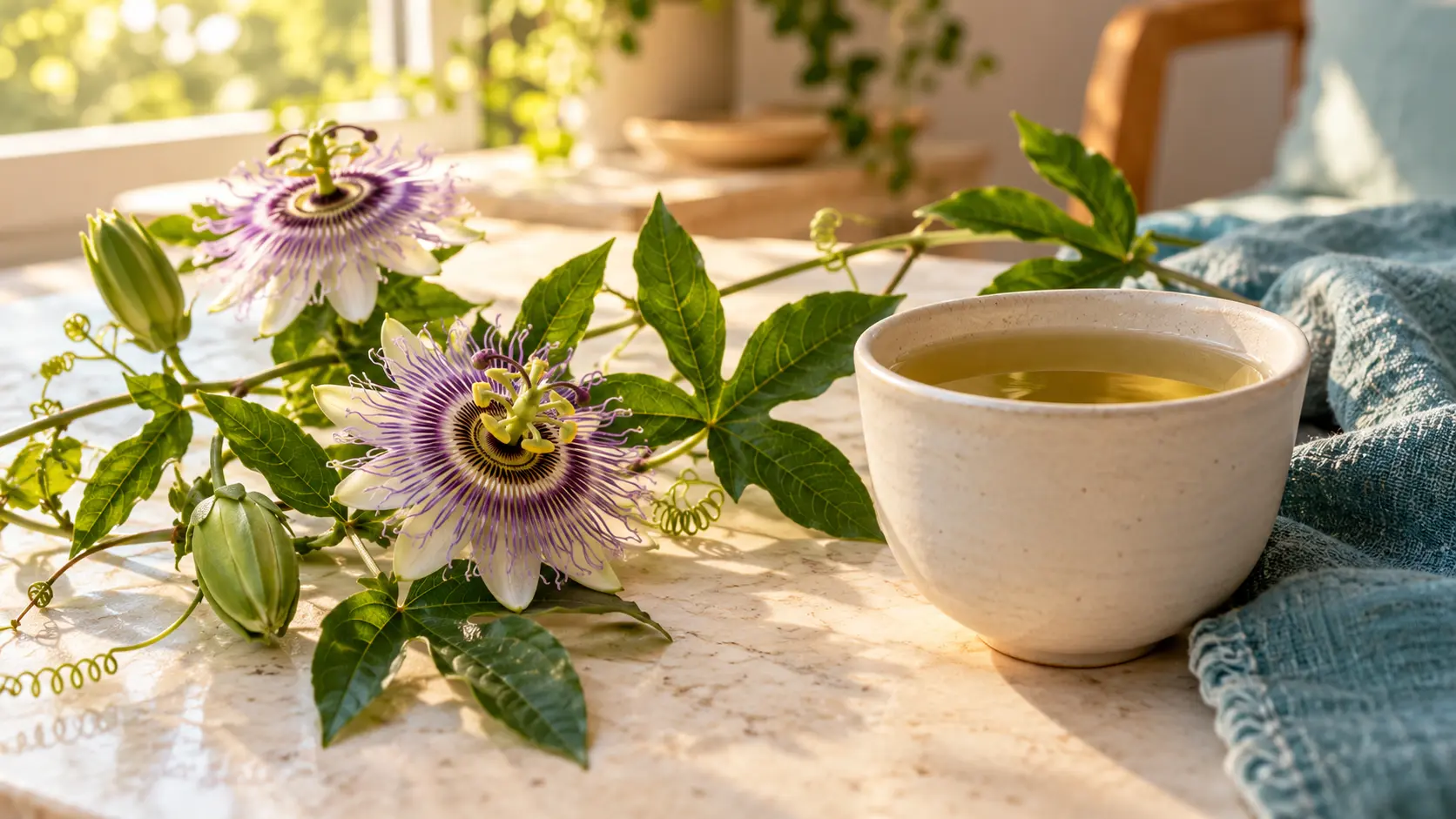
Passionflower has a long history of use for restlessness and mild mental stress. But traditional use and evidence from clinical trials are not the same thing: for everyday stress, research remains too limited to promise a reliable effect. [1,2]
If you are considering passionflower tea or a supplement, the species, plant part, preparation, and your medicines all matter. A gentle routine may be worthwhile, but an herb is not a substitute for addressing ongoing stressors or seeking appropriate care.
QUICK INSIGHT
About Passionflower and Stress
Bottom line: Passionflower may be used traditionally for mild stress, but there is not enough strong clinical evidence to establish that it improves everyday stress.
Evidence snapshot: Insufficient direct evidence for stress; small anxiety studies are related but do not settle the stress question.
Preparation / form that matters: The EMA traditional-use conclusion concerns specific oral preparations of dried above-ground Passiflora incarnata material; tea and extracts are not interchangeable with study products.
Practical route: Prioritize sleep, workload, social support, and other realistic stress-management steps; discuss an herbal product with a clinician or pharmacist when medicines or health conditions are involved.
Key safety point: Possible drowsiness, dizziness and confusion; avoid during pregnancy, review sedating medicines and anesthesia/surgery risks.
How Passionflower Connects to Stress
The plant typically intended in clinical and European herbal references is Passiflora incarnata L. (passionflower, maypop). The relevant medicinal material is generally the dried aerial or above-ground parts, not passionfruit juice or unrelated ornamental Passiflora species. [1,2]
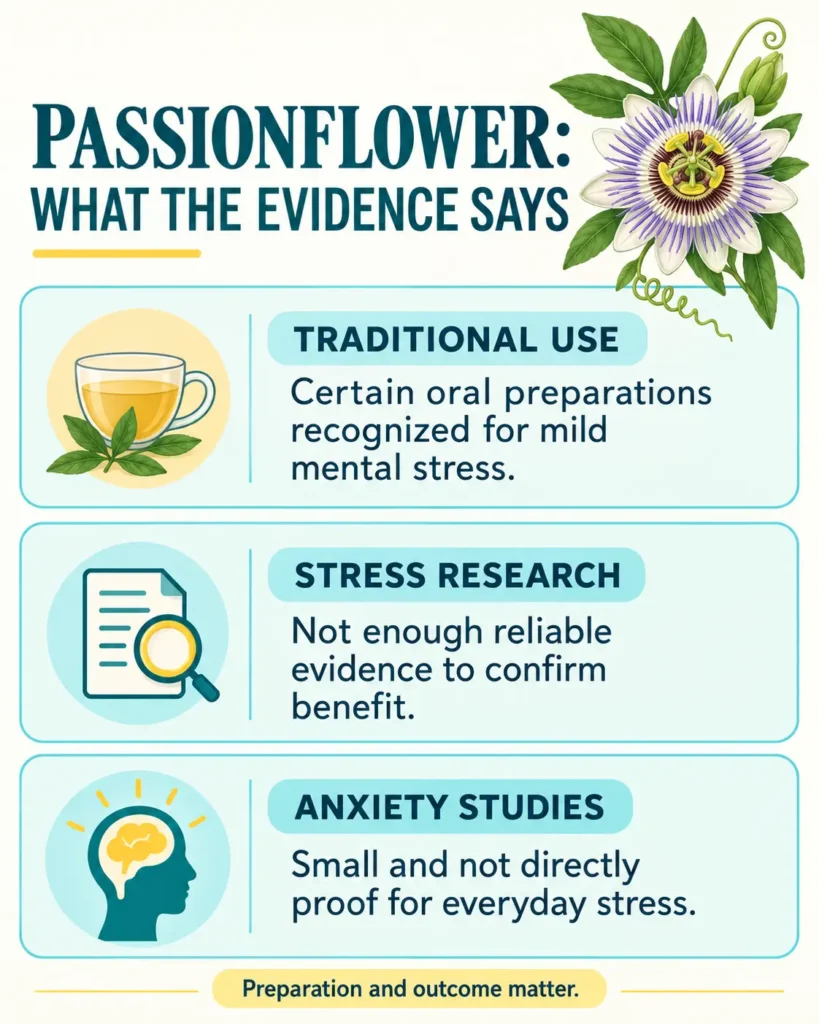
Passionflower has traditionally been used for mild mental tension and as a sleep aid. The European Medicines Agency (EMA) recognizes certain oral herbal preparations for mild symptoms of mental stress based on long-standing traditional use—not on high-certainty clinical proof. [2]
What the Evidence Shows
Direct evidence for everyday stress
The U.S. National Center for Complementary and Integrative Health (NCCIH) states that there is not enough evidence to determine whether passionflower helps with stress. This is the most relevant answer for the present article: evidence is insufficient, not that the herb has been proved ineffective. [1]
Anxiety outcomes are related, but different
A small amount of research on oral passionflower preparations suggests possible reductions in anxiety symptoms, including before dental or surgical procedures. Those studies are limited in size and quality, and short-term procedure-related anxiety is not the same outcome as day-to-day perceived stress. Their findings cannot establish a dependable stress benefit. [1,3]
Traditional-use authorization is not a clinical-effectiveness verdict
The EMA concluded that certain preparations may be used for mild mental stress based on traditional use. It explicitly notes that the available clinical studies were too small or otherwise limited to support firm conclusions. That is useful historical and regulatory context, but not proof that any capsule or tea will help. [2]
Why the Preparation Matters
A cup of tea made from dried aerial parts, a powdered-herb capsule, and a concentrated extract may expose a person to different quantities and mixtures of constituents. The EMA monograph concerns defined oral preparations of Passiflora incarnata aerial parts. [2]
Some small studies examine specific oral products, populations, and outcomes. Without a verified match in species, plant part, extraction process and composition, an ordinary store-bought product should not be described as equivalent to a studied preparation.
Combination “calming” formulas create another complication: if a trial combines passionflower with other herbs, it cannot prove which ingredient caused any effect.
Who Might Find It Relevant—and Where Uncertainty Is Greatest
Someone looking for a traditional calming tea may value its familiar ritual, but the ritual itself is not evidence of a pharmacological stress treatment. People seeking relief from persistent stress, anxiety symptoms, or impaired sleep should not depend on an unproven product in place of established support.
Research has not shown a clear best passionflower form, dose, or long-term use strategy for everyday stress. Evidence from short-term anxiety or sleep studies should not be repackaged as a recommendation to self-treat chronic stress.
Forms and Research Context
Oral teas, powders, and dry or liquid extracts appear in European herbal-use descriptions. NCCIH notes limited short-term safety information for tea or extracts, but that does not establish efficacy or a suitable personal dose. Study durations and product specifications differ; this application article intentionally does not provide a dosing schedule. [1,2]
Practical Decision Guide
- Define what you want help with: a stressful day, persistent worry, poor sleep, and significant anxiety are different concerns.
- Start with practical options that address the stressor, rest opportunities, social support, and appropriate care.
- If you are considering an herb, check that the label names Passiflora incarnata and specifies the preparation and ingredients.
- Review all medicines and other calming supplements with a pharmacist or clinician before use.
- Stop and reassess if you become unusually sleepy, dizzy, confused, or feel worse; do not increase the amount to chase an effect.
SAFETY
Passionflower can cause drowsiness, dizziness and confusion. It may add to the effects of anesthesia and medicines that slow the central nervous system. Do not use in pregnancy; safety during breastfeeding is not established. [1]
Persistent symptoms: seek assessment for stress that disrupts daily functioning; obtain urgent help for immediate danger or severe symptoms.
Pregnancy: avoid passionflower because of possible uterine-contraction risk.
Breastfeeding: there is insufficient reliable safety information; seek professional guidance.
Sedatives, sleep medicines, alcohol, other calming supplements: review possible additive sedation with a pharmacist.
Surgery or anesthesia: inform the clinical team of any use; NCCIH recommends discussing passionflower use within two weeks of planned surgery.
Driving and hazardous tasks: avoid if drowsy or dizzy, and never assume a botanical product is non-sedating.
The herb is not a replacement for prescribed treatment, psychotherapy, or evaluation of severe or persistent symptoms.

References
1. NIH NCCIH. Passionflower: Usefulness and Safety (updated April 2025).
https://www.nccih.nih.gov/health/passionflower
2. European Medicines Agency. Passiflorae herba — herbal medicinal product.
https://www.ema.europa.eu/en/medicines/herbal/passiflorae-herba
3. NIH NCCIH. Anxiety and Complementary Health Approaches.
https://www.nccih.nih.gov/health/anxiety-and-complementary-health-approaches