

Light is one of the clearest environmental signals to your body clock. For someone who sleeps at night, brighter light after waking and dimmer light before bed can help reinforce a consistent sleep-wake pattern. Timing matters: bright light late in the evening may shift your clock later, while morning light often shifts it earlier. Small, realistic changes are a sensible starting point; light is not a substitute for adequate sleep or assessment of persistent problems.
What Is Your Body Clock?
Your body runs on daily rhythms that help organize alertness, sleepiness, body temperature, and hormone release. The central circadian clock in the brain coordinates these patterns with cues from the environment. Light detected through the eyes is a particularly important cue. Sleep timing also depends on how long you have been awake, your schedule, medications, health conditions, and behavior. That is why changing lighting may help with timing without solving every sleep problem. [1, 2]
Why the Time of Light Exposure Matters
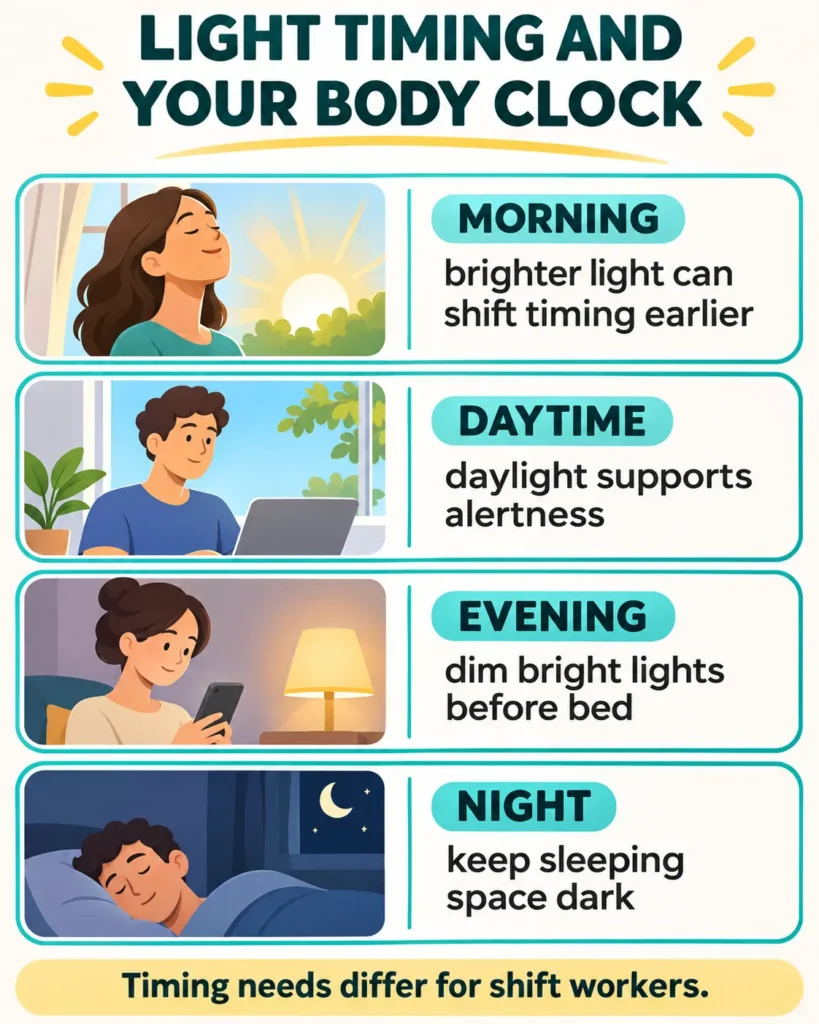
The circadian system does not respond identically to light at every hour. For people on a conventional daytime schedule, bright light in the morning generally moves the clock earlier, while bright light in the evening generally moves it later. The effect varies with your existing rhythm, intensity, duration, and timing; advice intended for day workers may not suit night-shift workers. [3, 4]
| Timing | Likely effect for a typical daytime schedule | Practical approach |
|---|---|---|
| Morning / after waking | Supports wakefulness and may shift the clock earlier | Spend some time in naturally lit outdoor space when feasible |
| Daytime | Supports alertness; reinforces a contrast between day and night | Use daylight breaks or a bright work area |
| Late evening | May delay internal timing and interfere with melatonin signaling | Dim bright room lighting as bedtime approaches |
| Overnight | Can signal wakefulness and disturb a dark sleep environment | Keep the bedroom as dark as safely practical |
These are directional patterns, not fixed treatment doses. There is no single outdoor duration or brightness level appropriate for everyone. [3, 4]
Morning Light: A Practical Starting Point
When possible, step outside after getting up: a short walk, time on a porch, or a commute that includes daylight may help establish a regular cue. You do not have to stare toward the sun, and you should never look directly at it. If outdoor light is inaccessible, try increasing ambient light in your morning environment. Aim for consistency with your actual wake time rather than chasing a rigid universal schedule. [3, 5]
Natural daylight can be much brighter than ordinary indoor illumination, even on overcast days. Still, the best routine is one that fits your mobility, work, weather, and eye-safety needs. UV-protective sunglasses, hats, and sun protection are compatible with sensible outdoor time. [5]
Evening Light: Think Beyond Your Phone
The issue is not only “blue light from screens.” Bright overhead lighting, televisions, tablets, phones, and late-evening work environments can all contribute to light exposure. Short-wavelength-rich light can be especially effective at signaling the circadian system, but total brightness, timing, duration, distance, and what you do on the device matter too. A screen filter alone is not a guarantee of better sleep. [1, 6]
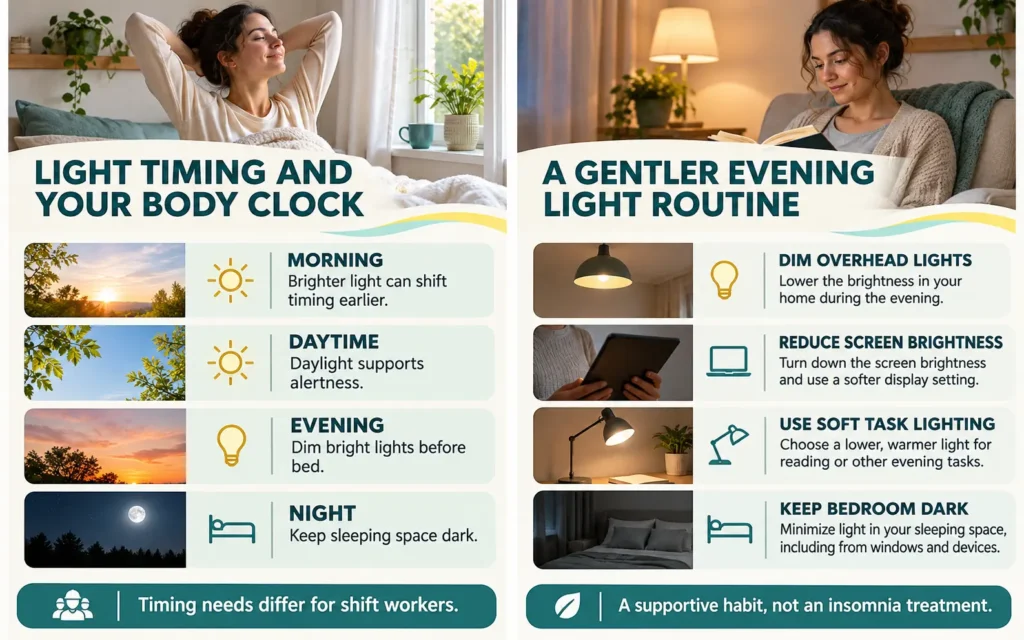
For a routine bedtime, consider turning down overhead lights and using warmer, dimmer task lighting during the last part of the evening. If you use screens, lower their brightness and consider whether the content itself keeps you awake. A practical experiment is to reduce bright light for about one to two hours before bed and notice whether your sleep timing feels easier to maintain. [3, 4]
A Simple Light-Routine Experiment
Try the following for one to two weeks, without trying to change everything at once:
- Choose a realistic, fairly consistent wake time.
- Get daylight or brighter ambient light after you wake up when safe and feasible.
- Build in a daytime light break, especially if you work indoors.
- Lower harsh or bright lighting as your intended bedtime approaches.
- Keep the bedroom reasonably dark overnight; use safe low-level lighting if you must get up.
- Notice your bedtime, wake time, daytime alertness, and what seems workable.
If you work rotating shifts, travel across time zones, or have a diagnosed circadian rhythm disorder, light timing requires more individualized planning. Avoid assuming that “morning light” always means sunrise or that it will help every shift pattern. [4, 7]
What Does the Evidence Actually Show?
Well supported: Light is a major cue for circadian timing
Physiology research and guidance from NIH and CDC support the role of timing and light-dark contrast in circadian regulation. Bright light at certain times can shift circadian phase. [1, 3]
Reasonable practical advice: More daytime light, less bright nighttime light
For many day-active adults, matching the environment to the desired wake-sleep schedule is low complexity and biologically plausible. It should be presented as supportive habit guidance rather than a guaranteed insomnia treatment. NIH clinical guidance includes managing light exposure as one part of circadian rhythm care. [4, 7]
More uncertain: How much a specific home change will improve sleep
Research linking artificial light at night with disturbed sleep is growing, but associations do not prove that a particular lamp, phone setting, or light reduction will cure an individual’s sleep problem. Study methods and exposures vary. A 2026 systematic review identified an association between greater nighttime light and sleep disturbance while noting methodological limitations. [8]
When Light Advice Needs More Care
Do not stare at the sun or intense lamps. Bright-light devices and carefully timed light therapy are different from ordinary home lighting: people with certain eye conditions, photosensitivity, medications that increase light sensitivity, or bipolar disorder should discuss light therapy with a qualified clinician before using it. Unsupervised bright-light treatment may be inappropriate for some people. [5, 7]
Persistent insomnia, extreme daytime sleepiness, snoring with breathing pauses, or a sleep schedule that is repeatedly incompatible with work or daily life warrants clinical assessment. Chronic insomnia may need evidence-based treatment such as cognitive behavioral therapy for insomnia (CBT-I), not light habits alone.
Common Questions
Is morning light always better?
Not for everyone. Morning light often shifts a typical daytime sleeper earlier, but the appropriate timing depends on the person’s internal clock and work schedule. Night-shift schedules require a different strategy. [3]
Do blue-light glasses solve evening screen problems?
They are not a universal solution. The brightness and timing of all light sources, along with stimulating content and bedtime habits, still matter. If you want to experiment, dimming screens and room lighting is a reasonable first step. [6]
Is it necessary to spend a precise number of minutes outside?
No single duration fits everyone. Research varies by individual schedules and exposure conditions. Consistency and a clear day-night contrast matter more for this general-purpose guide than an unsupported universal target. [3, 4]
Can light exposure replace sleep treatment?
No. It can be one part of a sleep-supportive routine, but sleep disorders and long-standing insomnia require individualized evaluation and sometimes targeted treatment. [7]
The Whole Picture
Light exposure interacts with regular wake times, adequate sleep opportunity, activity, caffeine timing, stress, and the sleep environment. The goal is not a perfect lighting schedule; it is a realistic pattern that makes daytime feel like daytime and nighttime feel like nighttime.
Related Reading
Published related article: Can Stress Make You Feel Exhausted?
Editorial note: Add other Sleep & Rest links only after their live URLs have been verified.
References
1. NHLBI/NIH — How Sleep Works: Your Sleep/Wake Cycle — https://www.nhlbi.nih.gov/health/sleep/sleep-wake-cycle
2. NHLBI/NIH — What Makes You Sleep? — https://www.nhlbi.nih.gov/health/sleep-deprivation/body-clock
3. CDC/NIOSH — Effects of Light on Circadian Rhythms — https://www.cdc.gov/niosh/work-hour-training-for-nurses/longhours/mod2/19.html
4. CDC/NIOSH — Using Light to Promote Better Morning Wake-Up Time — https://www.cdc.gov/niosh/work-hour-training-for-nurses/longhours/mod8/03.html
5. American Academy of Ophthalmology — The Sun, UV Light and Your Eyes — https://aao.org/eye-health/tips-prevention/sun
6. CDC/NIOSH — The Color of the Light Affects Circadian Rhythms — https://www.cdc.gov/niosh/work-hour-training-for-nurses/longhours/mod2/20.html
7. NHLBI/NIH — Circadian Rhythm Disorders: Treatment — https://www.nhlbi.nih.gov/health/circadian-rhythm-disorders/treatment
8. Kretzschmar et al. (2026) — Artificial Light at Night and Sleep Disturbance: Systematic Review — https://pubmed.ncbi.nlm.nih.gov/41500302/