

Sometimes a quick check becomes twenty minutes of comparison, conflict, or “just one more” post. Social media can help you feel connected, informed, and entertained—yet certain feeds and habits can leave you tense, distracted, or emotionally drained. The useful question is not whether social media is good or bad. It is what happens to you when you use it.
QUICK INSIGHT
Social Media Patterns
Notice the pattern, not just the screen-time number. If a feed leaves you agitated, less rested, or stuck checking for reassurance, try changing what you see, when you check, and how you respond. Small boundaries can be more realistic than quitting everything.
Why social media can begin to feel stressful
Social platforms place personal updates, breaking news, jokes, arguments, advertising, and alarming stories in the same endless stream. Even a positive interaction can be followed immediately by upsetting content. The constant switching may leave little room to recover from what you have just seen.
Researchers describe both potential benefits—especially connection and support—and potential risks, such as negative comparison, harassment, and sleep disruption. Findings depend on the person, platform design, content, and how the platform is used. Much of the evidence is observational, so an association does not prove that social media caused someone’s stress.
Five ways the pressure can build
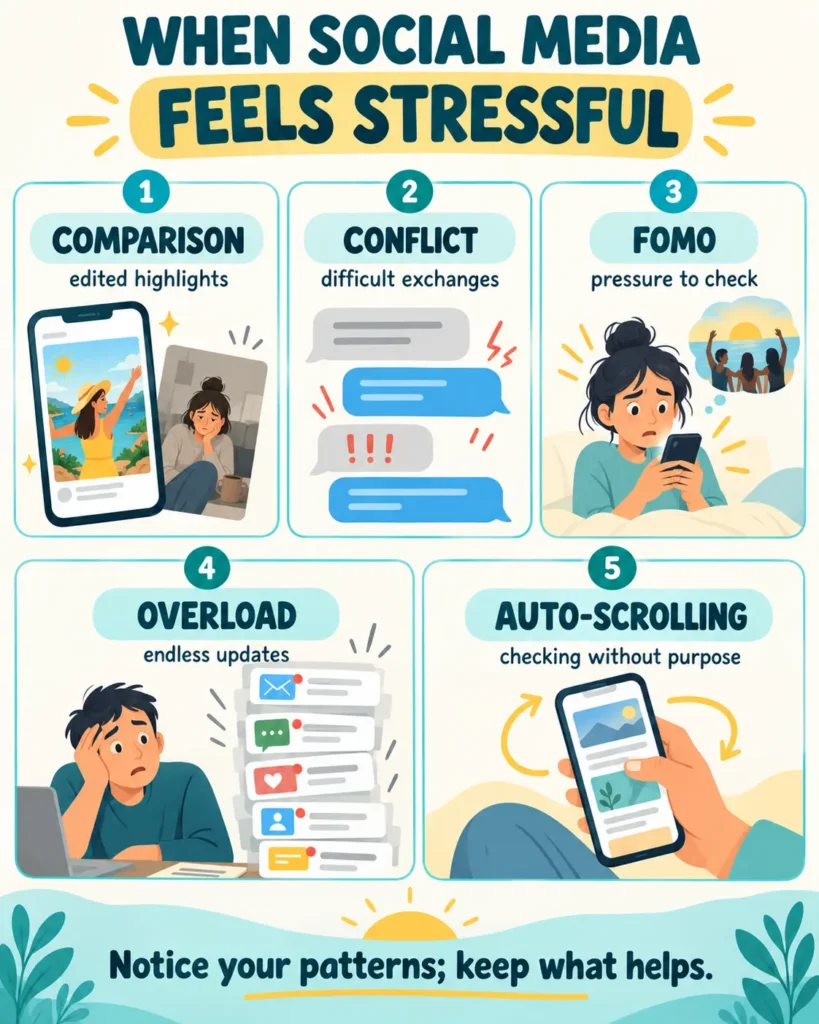
1. Comparing your everyday life with other people’s highlights
Photos and updates often showcase selective moments. Comparing a difficult Tuesday to someone else’s polished vacation can make ordinary life feel inadequate. Ask: “Am I comparing their edited selection with my entire experience?” Consider muting feeds that repeatedly trigger this reaction.
2. Conflict, criticism, and upsetting conversations
A heated thread can pull you into defending yourself, checking replies, or anticipating the next message. Before responding, decide whether the conversation is useful and safe. You are allowed to disengage, restrict replies, block harassment, or document threats.
3. The feeling you might miss something
Notifications, trending posts, and group chats can create a sense of urgency even when nothing requires immediate action. Choose which people or updates truly need alerts; let the rest wait for a planned check-in.
4. Information overload
When news, commentary, and personal updates arrive without a natural stop point, it can become harder to feel finished. Set a specific purpose before opening an app—for example, check one friend’s message rather than scrolling until there is no new content.
5. Using scrolling to escape discomfort—then feeling worse
A short distraction can be pleasant. But if you reach for an app every time you are bored, worried, or lonely, you may miss a chance to address what you actually need. Try a brief alternative first: stretch, text a trusted person directly, drink water, or step outside.
What the evidence can—and cannot—tell us
A 2024 umbrella review of adolescent studies reported both risks and opportunities, with outcomes shaped by user characteristics, content, and design. A 2025 systematic review of adolescent anxiety studies found mixed associations. Those findings should not be generalized automatically to all adults or interpreted as proof of causation. The U.S. Surgeon General’s advisory similarly emphasizes uncertainty alongside concerns for young people. Adult experiences may differ.
The evidence is stronger for identifying concerning patterns—harassment, appearance-focused comparison, disrupted sleep, compulsive checking—than for naming one universal “safe” number of minutes for every person. A personalized experiment is more useful than a rigid rule.
Try a calmer social-media routine
| If you notice… | Try this change | What to observe |
|---|---|---|
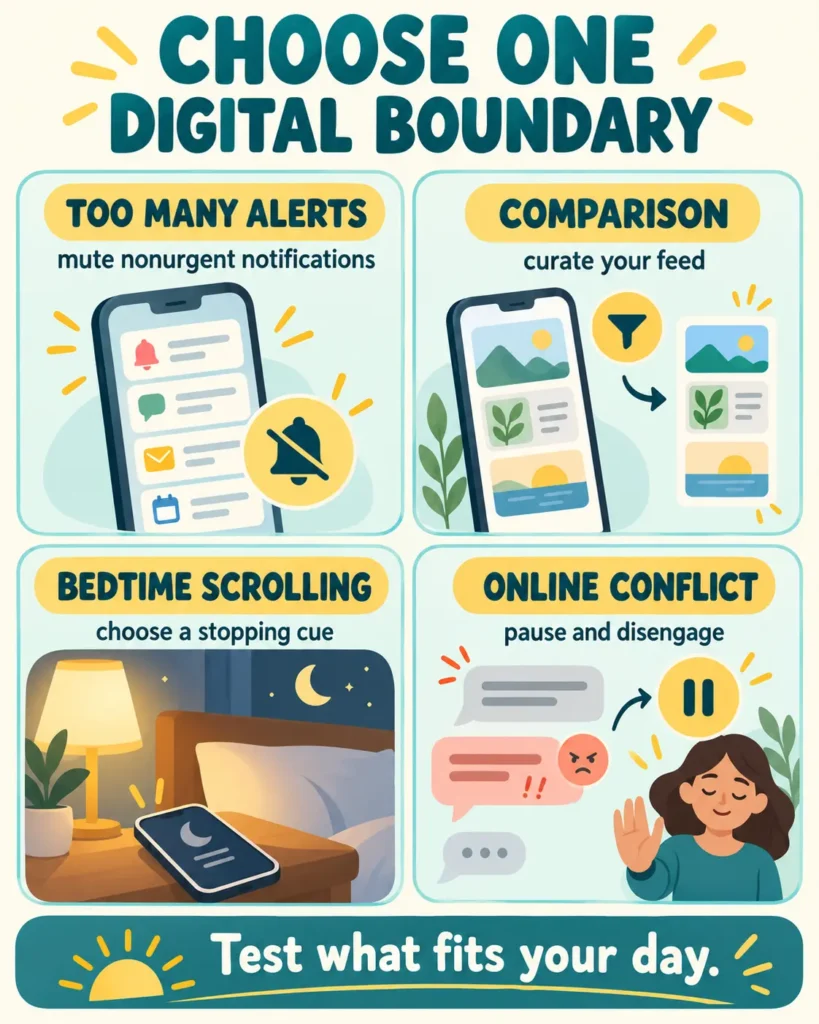
| Feeling worse after certain accounts | Mute or unfollow a few accounts for a week | Does your mood after browsing change? |
| Checking every alert | Disable nonessential notifications | Do interruptions feel less frequent? |
| Late-night scrolling | Move apps off the home screen; set a stopping cue | Does bedtime feel easier to protect? |
| Argument loops | Avoid repeat reply-checking; block harassment | Do you recover attention sooner? |
| Lonely but still scrolling | Send one direct message or plan a real conversation | Does the interaction feel more connecting? |
A simple seven-day experiment
Days 1–2: Notice which apps, accounts, and times of day leave you feeling better or worse. Days 3–4: Change one trigger—perhaps nonessential alerts or a comparison-heavy feed. Days 5–6: Replace one automatic check with a purposeful action or direct conversation. Day 7: Keep what helped; adjust or discard what did not. This is a self-observation exercise, not a medical intervention or a diagnostic test.
What if you use social media for work, community, or support?
You do not need an all-or-nothing rule. Many people use social media to find peer support, maintain distant relationships, promote a business, or stay informed. Separate purposeful use from habitual checking: create work windows, use direct messages for important conversations, and consider keeping one account or feed primarily for supportive connections.
For caregivers and teens, age, development, privacy, harassment, and sleep deserve extra attention. Avoid surveillance as the only response; discussion, literacy, and safer settings can be more constructive.
When to seek extra support
If social-media use contributes to persistent distress, anxiety, sleep problems, loss of functioning, or conflict that feels hard to manage, consider talking with a qualified mental-health professional. If you are experiencing harassment, threats, or exploitation, preserve evidence and use appropriate platform reporting or local support. For immediate danger, contact emergency services. These suggestions do not replace individualized care.
Questions readers often ask
Do I have to quit social media to feel less stressed?
Not necessarily. Some people benefit from time away, while others benefit more from curating their feed, changing notifications, or using social media intentionally. Connection can be valuable, too.
Is more screen time always worse?
No single amount has the same meaning for everyone. Content, the reason you are using the platform, your circumstances, and whether it displaces sleep or important activities can matter.
Could a digital break help?
It may help you notice habits and reset boundaries, but results vary. Start with a modest, practical experiment rather than a promise that a detox will resolve stress.
The takeaway
Social media works best when it serves your relationships and interests—not when every notification determines your attention. Notice how you feel, keep the parts that genuinely connect you, and build boundaries around the parts that drain you.
Related reading
Stress: A Whole-Picture Guide (Registry: UGW-C0005; published) — https://ugetwell.com/health/stress-whole-picture-guide
Anxiety: A Whole-Picture Guide (Registry: UGW-C0004; published) — https://ugetwell.com/health/anxiety
References
U.S. Surgeon General (2023). Social Media and Youth Mental Health advisory — https://www.hhs.gov/surgeongeneral/reports-and-publications/youth-mental-health/social-media/index.html
Sala, Porcaro & Gómez (2024). Social media and adolescents’ mental health: umbrella review — https://doi.org/10.1016/j.chbr.2024.100404
Journal of Adolescent Health (2025). Associations between social media use and anxiety among adolescents: systematic review — https://doi.org/10.1016/j.jadohealth.2024.09.003
American Psychological Association (2023). Health advisory on social media use in adolescence — https://www.apa.org/topics/social-media-internet/health-advisory-adolescent-social-media-use