

Cognitive behavioral therapy, or CBT, is a structured form of talk therapy that helps people notice patterns between thoughts, emotions, and actions—and practice different responses. You do not need to know psychology vocabulary to understand how it works.
Imagine receiving a short message from a colleague: “Can we talk?” One interpretation is “I’ve done something wrong.” That thought may trigger worry and the urge to avoid the conversation. CBT explores that pattern with curiosity: What evidence do I actually have, and what useful action could I take?
QUICK INSIGHT
About CBT
CBT is an evidence-based psychotherapy, especially well established for many anxiety and depressive problems. It is collaborative and practical, often combining discussions with exercises between sessions. The right approach and pace depend on the person and the condition; a worksheet or a positive thought is not a substitute for therapy.
What CBT is—and what it is not
CBT is a family of psychological treatments focused on connections between interpretation, behavior, bodily reactions, and feelings. A qualified therapist helps you understand patterns that keep a problem going and try manageable changes that fit your goals. It is not about denying painful reality, blaming people for their symptoms, or insisting that every negative thought is wrong.
CBT is also not one single script for every condition. Treatment for social anxiety, depression, insomnia, panic, or obsessive-compulsive disorder may use different techniques and specialized protocols. Therapists consider health history, safety, preferences, and what matters to you.
How thoughts, feelings, and actions can influence one another
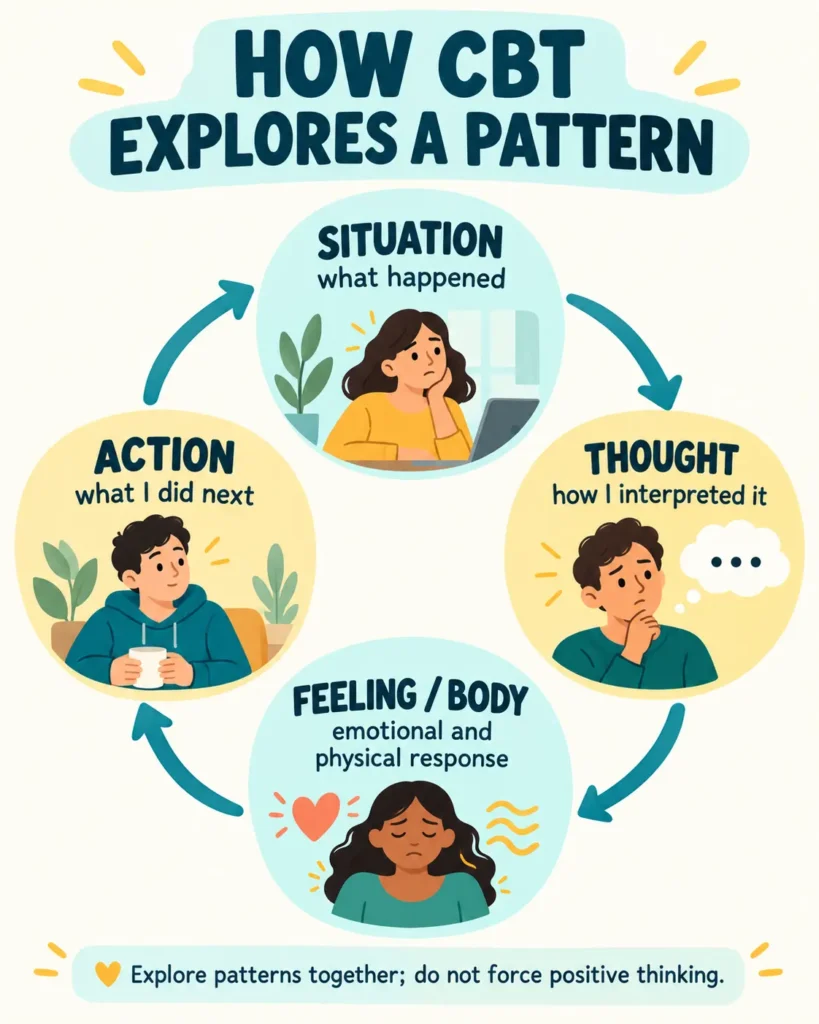
A situation can produce an interpretation (“I will fail”), a feeling (fear), body changes (tight shoulders), and a response (postponing a task). Avoidance may briefly reduce discomfort while making the next attempt feel even harder. A CBT therapist can help explore alternative interpretations and actions—not simply talk someone out of an emotion.
A simple illustration—not a therapy prescription
| Part of the pattern | Everyday example | Possible question in CBT |
|---|---|---|
| Situation | A friend cancels plans | What happened, without adding assumptions? |
| Interpretation | “They must be upset with me.” | What other explanations fit the facts? |
| Feeling / response | Worry; repeated checking | What does checking change in the short term? |
| Alternative action | Send one kind reply and resume the day | Would this be a more useful response? |
This example illustrates the model, not a requirement to challenge every thought. Some situations genuinely are difficult or unsafe; CBT should not be used to dismiss those realities.
What actually happens in CBT sessions?
The details vary, but you can usually expect the following sequence:
1. Start with goals and an assessment. You explain what has been difficult, how it affects daily life, and what you hope to change. The clinician considers whether CBT is appropriate.
2. Map a pattern together. You and the therapist identify situations, thoughts, emotions, bodily responses, and behaviors relevant to your specific concern.
3. Choose an evidence-informed strategy. That might involve checking predictions, scheduling meaningful activity, practicing coping skills, or a carefully planned behavioral exercise.
4. Try something between sessions. Short observations or assignments are commonly used to test ideas in ordinary life. They should be agreed upon, manageable, and adapted to your circumstances.
5. Review and adjust. The therapist checks what changed, what felt difficult, and whether goals or the treatment plan should be revised.
Sessions may take place in person, by video, individually or in a group. Some situations suit guided digital CBT. The number and length of sessions vary; for generalized anxiety disorder, NICE describes a typical course of 12–15 weekly one-hour CBT sessions when high-intensity treatment is chosen. That is a condition-specific example, not a universal dose of therapy.
Where the evidence is stronger—and where to be careful
CBT has substantial support as a treatment option for several conditions, including anxiety disorders and depression. Professional guidelines frequently include it among recommended approaches. But “CBT works” is too broad: the quality of evidence, appropriate techniques, expected benefit, and alternatives differ by diagnosis, age, therapist expertise, and treatment format.
For example, NICE recommends CBT as one high-intensity psychological option for adults with generalized anxiety disorder when less intensive approaches have not helped or impairment is marked. This does not mean CBT always works, is the only good treatment, or is preferable to medication for every person. Some people benefit from different psychotherapy, medication, combined treatment, or additional support.
Some CBT tasks can temporarily feel uncomfortable, particularly when discussing distressing experiences or changing long-standing avoidance patterns. Tell the therapist if a task feels too intense or culturally inappropriate, if symptoms worsen, or if the plan is not helping. Progress is often uneven.
CBT compared with everyday coping tips
| Professional CBT | Self-help inspired by CBT |
|---|---|
| Tailored assessment, agreed goals and an evidence-based treatment plan | General reflections, journals or worksheets |
| Clinician monitors progress, risk, fit, and adaptations | User must decide when more help is needed |
| May include specialized condition-specific techniques | Not equivalent to formal treatment for a disorder |
A gentle question such as “What facts support my interpretation?” can be useful for everyday reflection. It should not be mistaken for a complete CBT intervention or used in place of assessment for serious distress.
Is CBT worth considering for you?
- You want structured, goal-focused therapy and are comfortable trying small changes between sessions.
- Worry, low mood, avoidance, or related symptoms interfere with sleep, work, relationships, or daily responsibilities.
- You would like to compare psychotherapy, medication, guided self-help, and other available options with a qualified professional.
- You have already tried self-help strategies but the problem persists—or feel unsure where to begin.
CBT may need substantial adaptation for trauma history, neurodivergence, communication or cognitive differences, disability, chronic illness, language, or cultural context. Ask how the therapist tailors pacing and materials; you are allowed to say when an approach does not fit.
How to find a qualified CBT therapist
Start with your health plan, primary care team, a licensed-therapist directory, or a reputable professional association. Check licensing in your jurisdiction and experience with your particular concern—not just a generic claim to “use CBT.”
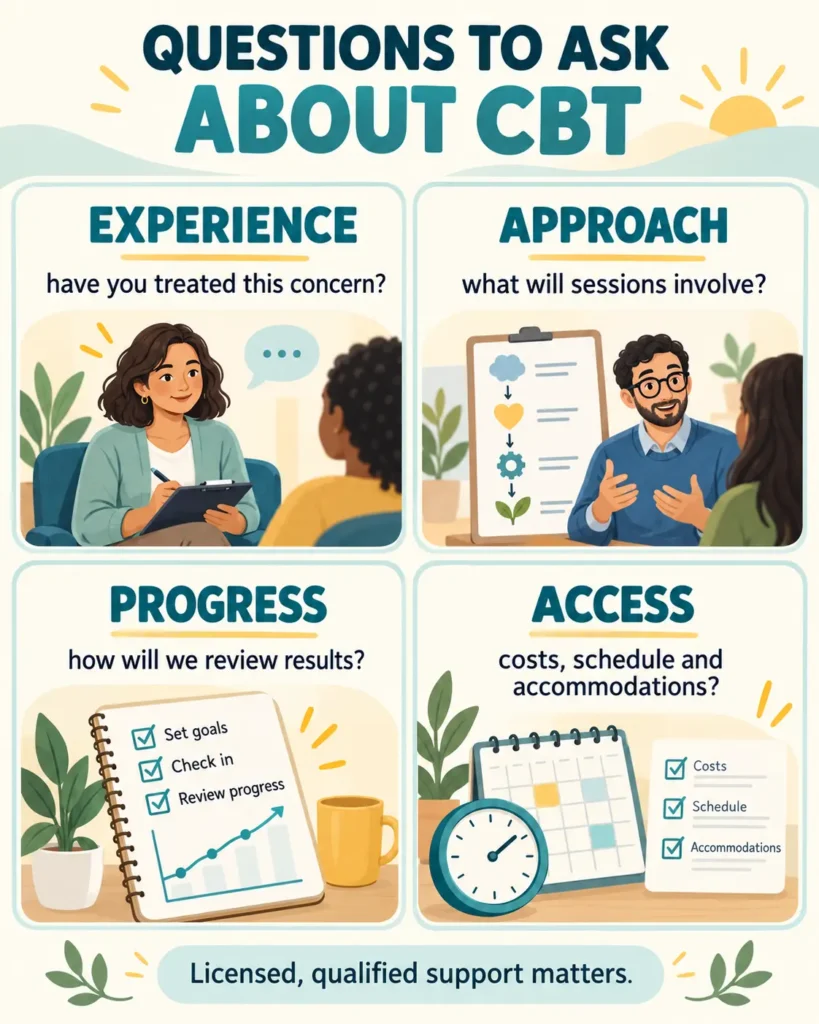
Questions worth asking before you start
- What training and supervision do you have in CBT for my specific concern?
- What will the first assessment include, and how will we decide on goals?
- How often are sessions, what might happen between sessions, and how will we track progress?
- What does treatment cost, is telehealth available, and what happens if I do not improve?
- How do you accommodate accessibility needs, cultural preferences, or previous difficult therapy experiences?
The relationship with your clinician matters. You should be able to ask questions and make decisions collaboratively, including whether another approach would be a better fit.
When to seek help rather than rely on self-help
Seek professional assessment when symptoms persist, worsen, cause significant impairment, or involve panic, severe depression, obsessive rituals, trauma-related distress, substance use, or major sleep disruption. If you are in immediate danger or might harm yourself or someone else, seek urgent emergency help. In the U.S., call or text 988 for a mental health crisis; call 911 for immediate physical danger.
Do not change prescribed medications or discontinue ongoing treatment based on an online article. A clinician can help you weigh benefits, burdens, safety, and alternatives.
Common questions
Does CBT mean being positive all the time?
No. Good CBT examines whether an interpretation is accurate and useful. Sometimes the problem is real; then the work may focus on problem-solving, support, behavior, or acceptance rather than pretending everything is fine.
Will I have homework?
Often, but it varies. A therapist may invite you to track patterns or test manageable actions between sessions. You can discuss capacity, accessibility, and concerns before agreeing.
How long will CBT take?
There is no universal timeline. Some programs are brief; others take longer depending on the condition, complexity, response, and goals. Ask your clinician for a working plan and regular reviews.
Is an app the same as seeing a CBT therapist?
No. Some guided digital CBT programs have been studied for specific conditions, but apps and unstructured online worksheets differ in clinical oversight, evidence, privacy, and safety. Check the program and its support arrangements.
The bottom line
CBT offers a practical way to understand and change patterns that affect how you feel and function. It is not instant positive thinking or a universal cure. If symptoms are affecting your life, a qualified therapist can help you decide whether CBT—and what kind—is an appropriate next step.
References and further reading
National Institute of Mental Health — Psychotherapies: https://www.nimh.nih.gov/health/topics/psychotherapies
Association for Behavioral and Cognitive Therapies — What to Expect from CBT: https://www.abct.org/get-help/what-to-expect-from-cognitive-behavioral-therapies/
NICE — Generalised anxiety disorder and panic disorder in adults, recommendations: https://www.nice.org.uk/guidance/cg113/chapter/Recommendations
American Psychological Association — How to Choose a Psychologist: https://www.apa.org/topics/choose-therapist
American Psychological Association — Understanding Psychotherapy: https://www.apa.org/topics/psychotherapy/understanding
Editorial safety note: General educational information, not a diagnosis or personal treatment recommendation. Individual treatment decisions belong with an appropriately qualified clinician.