

A crowded inbox, an argument, and a racing mind can all make stress feel as though it has taken over the whole room. Grounding is a simple way to shift some attention back to what is happening around you right now. It will not erase the source of stress—and it does not have to. Sometimes a brief pause is enough to help you decide what to do next.
QUICK INSIGHT
What is Grounding
Grounding uses sights, sounds, touch, and other present-moment cues to steady attention during a stressful moment. Try a short version first; you do not need to complete every step. Evidence for the exact 5–4–3–2–1 method is limited, and it is not a replacement for care or solving the underlying problem.
What does grounding mean when you feel stressed?
Grounding means deliberately noticing something in the present: the weight of your shoes, the sound of a fan, the shape of a chair. It is different from demanding that your mind go blank. If stress is pulling attention into worst-case predictions or replaying an unpleasant event, focusing on a neutral detail may create a little breathing room.
Grounding is not the same as a full mindfulness course or psychotherapy. It is a brief coping skill that can be used alongside more substantial support.
Try a flexible 5–4–3–2–1 grounding exercise
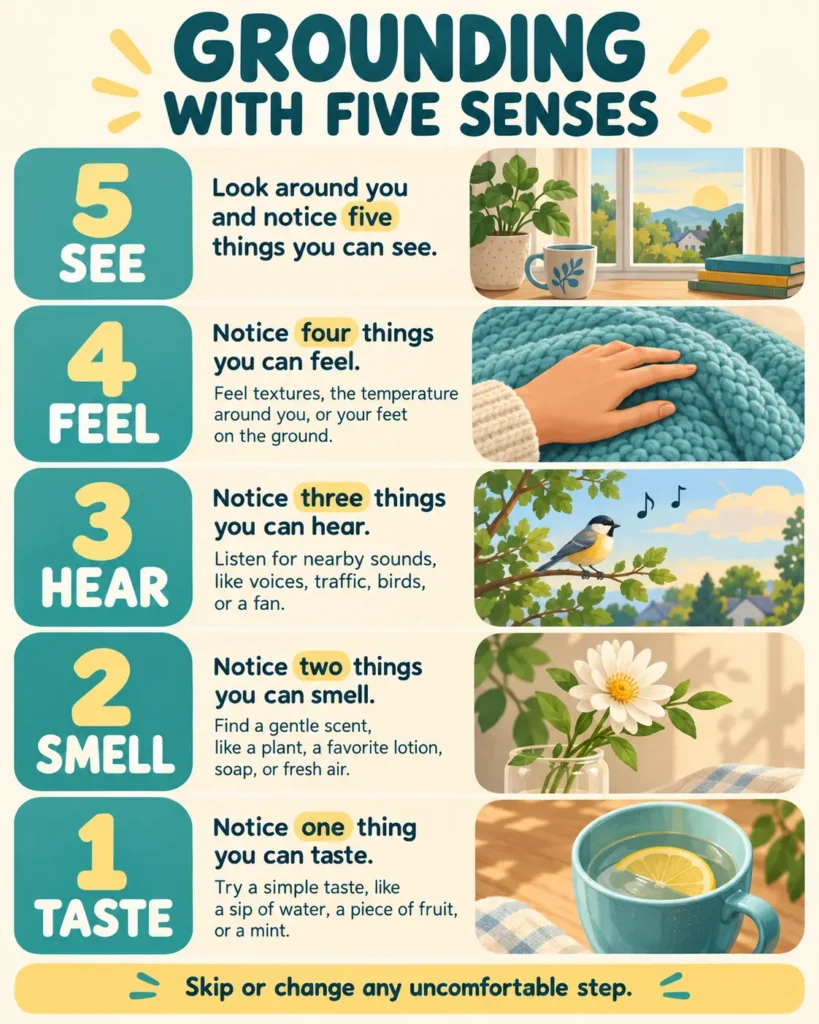
- 5 things you can see: Notice colors, shapes, light, or ordinary objects.
- 4 things you can feel: The chair beneath you, your feet on the floor, clothing against your arm, or a smooth tabletop.
- 3 things you can hear: Near or distant sounds; there is no need to judge them as pleasant.
- 2 things you can smell: Notice scents only if comfortable; otherwise skip or imagine two familiar neutral scents.
- 1 thing you can taste: Notice an existing taste, or simply skip this step.
You may keep your eyes open, name items silently, and breathe naturally. There is no required breath-holding or forced deep breathing. NHS services describe 5–4–3–2–1 as a grounding exercise, but counts are optional when they create frustration.
Need something even simpler?
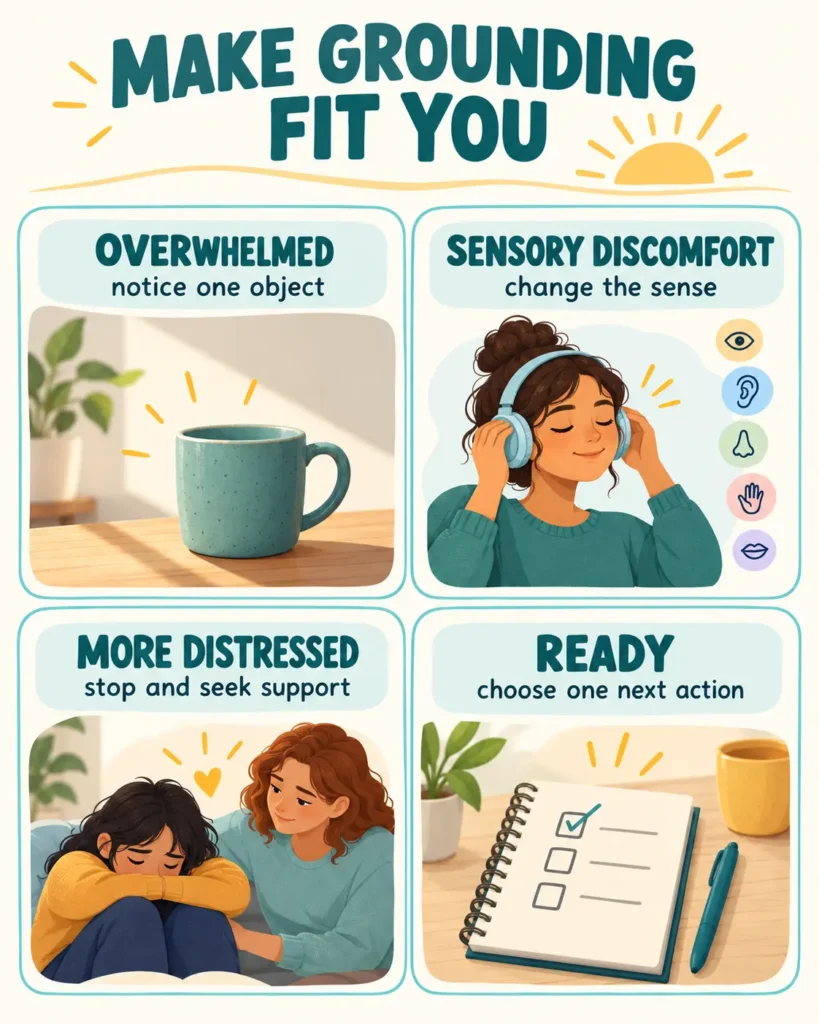
| If this feels true | Try this adjustment |
|---|---|
| Too overwhelmed to count | Name one visible object and describe its color and shape |
| Touch feels uncomfortable | Focus on external sights or sounds instead |
| In a crowded place | Silently notice the floor, a doorway, and one steady sound |
| Senses feel overwhelming | Stop the exercise; move somewhere more comfortable if possible |
A 20-second check-in can be enough to test whether the skill feels useful; there is no minimum time that makes it “work.”
When might grounding be useful?
You might experiment before a difficult conversation, after an upsetting message, while waiting for an appointment, or when stress makes it hard to choose the next task. The goal is not to eliminate all emotion. It is to gain enough space to respond intentionally.
What grounding cannot do
Grounding does not fix an unsafe environment, eliminate financial pressure, resolve conflict, or treat an anxiety disorder. There is no strong evidence that this specific sensory-counting exercise reliably reduces stress symptoms for everyone. Research into structured mindfulness and relaxation programs cannot automatically be transferred to a single short grounding exercise.
If the stressor is changeable, pair the pause with action: clarify the problem, set a boundary, make a plan, ask for help, or take a safe next step. If it is not changeable right now, the pause may still support coping without pretending the problem disappeared.
Safety: adjust or stop when it does not feel right
Grounding may be unpleasant for some people, particularly if certain sensations, sounds, or body-focused instructions evoke distress. If you feel more panicked, dizzy, disconnected, or unsafe, stop; return to something familiar, reach out to a trusted person, or seek appropriate professional support. Do not use grounding to delay help for severe or persistent symptoms. If you are in immediate danger or have a medical emergency, seek emergency services.
For trauma-related symptoms, seek guidance from a qualified professional about techniques that suit you; the VA notes grounding can sometimes be counterproductive and should be stopped when distress increases.
A realistic way to build the habit
Try a brief sensory check-in during a neutral moment, perhaps while making tea or sitting at your desk. Later, if tension rises, choose one of the same cues. Afterward ask: “Do I feel more able to choose my next action?” If not, try another approach rather than pushing harder.
Common questions
Do I have to use all five senses? No. Skipping uncomfortable or unavailable senses is fine.
Is this meditation? Not necessarily. It is a short attention exercise that can overlap with mindfulness skills without requiring a formal meditation practice.
Does grounding cure anxiety? No. It may be a coping tool, but ongoing symptoms deserve evidence-based assessment and care.
The useful takeaway
Grounding is a small tool for a specific job: redirecting attention when stress feels too loud. Use the version that is accessible to you, stop if it worsens distress, and follow the pause with the support or action the situation actually calls for.
References
Oxford Health NHS — Ground yourself https://oxfordhealth.nhs.uk/camhs/self-care/sleep/relaxation/ground-yourself/
Kent Community Health NHS — Panic attacks and grounding https://www.kentcht.nhs.uk/leaflet/panic-attacks/
US VA National Center for PTSD — Grounding cautions https://www.ptsd.va.gov/professional/treat/care/toolkits/police/managingStrategies.asp
NCCIH — Meditation and Mindfulness: Effectiveness and Safety https://www.nccih.nih.gov/health/meditation-and-mindfulness-effectiveness-and-safety
NCCIH — Relaxation Techniques for Stress https://www.nccih.nih.gov/health/tips/things-to-know-about-relaxation-techniques-for-stress
Educational information only; not medical advice, diagnosis, or treatment.