

Have you ever finished a meal without really tasting it—or opened your phone, then wondered where the last ten minutes went? Mindfulness starts with noticing moments like these, without scolding yourself for them.
It means paying attention to what is happening now—your surroundings, thoughts, feelings, or physical sensations—with curiosity rather than instant judgment. You can practice it during a short pause, a walk, or a formal meditation session. You do not have to clear your mind or feel calm to be doing it.
QUICK INSIGHT
About Mindfulness
Mindfulness is an attention skill, not a demand to relax. Some structured mindfulness programs show benefits for stress-related symptoms, anxiety, and sleep, but results vary. Start small, adapt the practice, and stop if it feels distressing.
What mindfulness actually means
Imagine noticing the sound of traffic, the pressure of your feet on the floor, and the thought “I am behind today.” Mindfulness is the moment you recognize all three. You do not have to decide whether the thought is true, make the noise disappear, or force a positive mood.
A useful distinction: mindfulness is a quality of attention; meditation is a broader group of practices that can train that attention. Mindfulness can be practiced while seated, moving, eating, or doing everyday tasks. A structured program such as mindfulness-based stress reduction (MBSR) is much more than a quick breathing exercise: it combines guided practice, learning, and repeated sessions.
Where it can fit into an ordinary day
| Approach | What you actually do | Good first experiment |
|---|---|---|
| Everyday attention | Notice sensations while washing dishes, eating, or walking | Notice three sounds on a short walk |
| Breath or body anchor | Pay attention gently to a breath, hand, or feet | Try 30–60 seconds, eyes open if preferred |
| Guided practice | Follow a teacher or audio recording | Choose a short, trauma-sensitive recording |
| Mindful pause | Notice what you are feeling before responding | Name a feeling and choose the next small action |
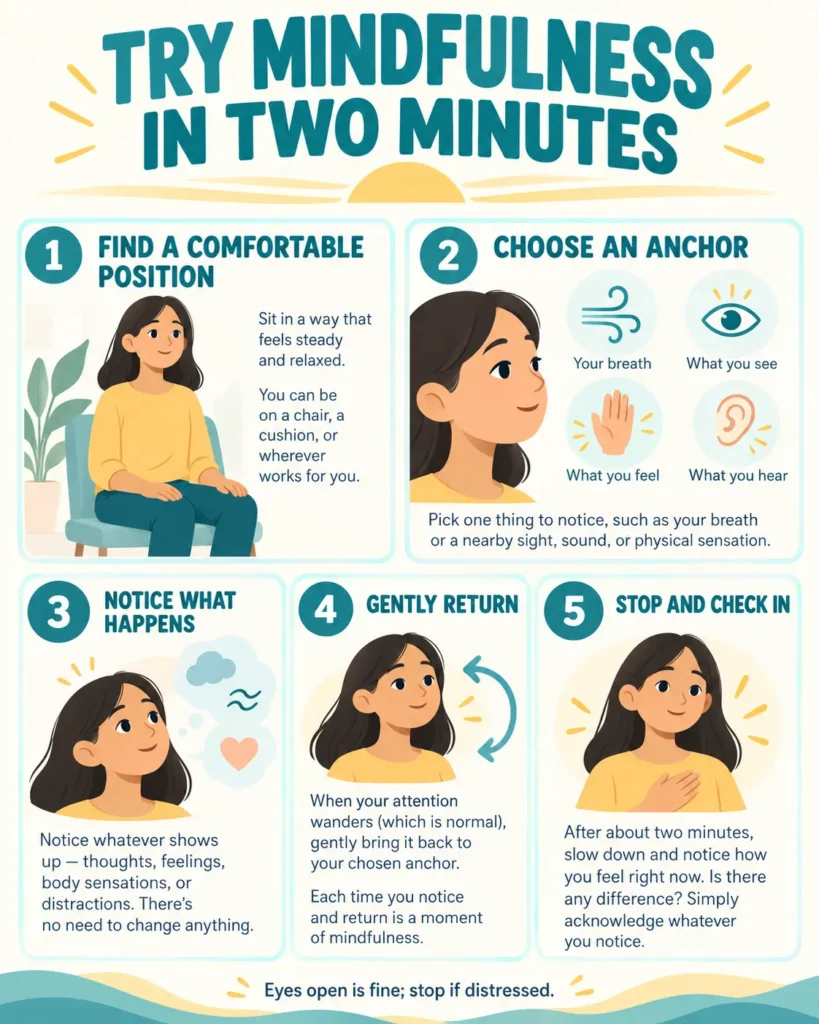
How to try mindfulness: a flexible two-minute start
- Find a comfortable position. Sit, stand, or walk slowly in a safe place; eyes can stay open.
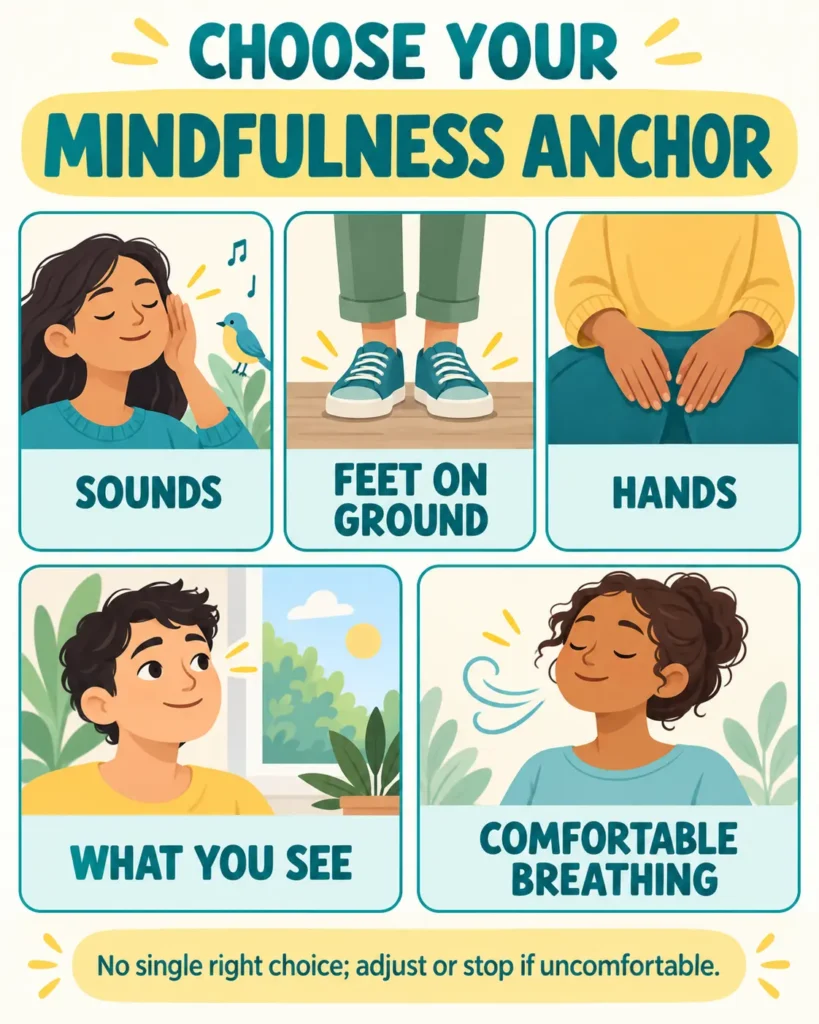
- Choose an anchor. Feel your feet on the ground, your hands resting, or sounds around you. Breath focus is optional.
- Notice what happens. You may feel restless, distracted, or calm. All are normal experiences, not a score.
- When your mind wanders, gently return. The noticing-and-returning is the practice.
- Stop and check in. If tension increases, shift attention outward, move, or end the exercise.
A 20-second version: feel both feet, name one sound and one object you can see, then continue your day. If closing your eyes or focusing inward makes you uncomfortable, do not force it.
What does the evidence say?
Mindfulness has been studied in different formats, populations, and clinical settings. Results from intensive programs cannot automatically be transferred to a one-minute exercise or an app.
| Area | Reasonable interpretation |
|---|---|
| Stress and emotional wellbeing | Some structured programs can help with stress-related symptoms; effects are variable and comparisons matter. |
| Anxiety and depression | Reviews report possible improvements, particularly with structured approaches. They are not substitutes for assessment or indicated treatment. |
| Sleep | Some trials show better perceived sleep quality than educational controls, but effects may not exceed established treatments. |
| Pain and other health outcomes | Results are mixed and condition-specific; avoid claims that mindfulness cures disease. |
The National Center for Complementary and Integrative Health (NCCIH) notes that studies differ considerably in methods and quality. A clinical trial of MBSR in people with anxiety disorders is evidence about a formal program—not proof that all mindfulness practices work equally well. Practical takeaway: consider mindfulness one optional skill among several, not an all-purpose treatment.
What to expect—and what not to expect
- Expect your mind to wander. Mindfulness is not the absence of thought.
- Some days it feels neutral, even boring. That does not mean failure.
- A short practice can be useful for attention, but benefits from research programs often involve more time and instruction.
- If you are seeking support for persistent anxiety, depression, trauma symptoms, or insomnia, professional care may be more important than adding an app or routine.
Common obstacles and gentler alternatives
| If you notice… | Try instead… |
|---|---|
| Sitting still feels irritating | Try noticing sensations during a slow, comfortable walk. |
| Breathing focus triggers discomfort | Use sounds, colors, or the sensation of feet on the ground. |
| Self-criticism: “I cannot do it” | Label “judging” softly and return to an external anchor. |
| Distressing memories or panic | Stop, orient to your surroundings, and seek qualified support if needed. |
Safety: when to pause or get help
Mindfulness and meditation are usually considered low-risk, but unwanted effects such as increased anxiety, distressing memories, or mood changes have been reported. People with trauma histories or significant mental health symptoms may benefit from individual guidance and an option to stop or adapt practices. Avoid long or intense sessions simply because they seem more advanced.
If a practice causes persistent distress, stop and speak with an appropriately qualified clinician. Mindfulness is not a replacement for mental health treatment, medication, or emergency support.
A simple week of experimenting
Try 30–60 seconds on two or three days. Choose a familiar activity, like arriving at your desk or stepping outside. Afterward ask: Did I notice anything? Was this comfortable? Would another anchor fit better? It is fine to stop. The goal is to discover whether this skill belongs in your routine, not to create another obligation.
Questions readers often ask
Is mindfulness the same as meditation?
Not exactly. Mindfulness is present-moment awareness that can be part of meditation or ordinary activities. Meditation is an umbrella term for many structured practices.
Do I need to sit still or close my eyes?
No. Standing, walking, and eyes-open practice are reasonable alternatives when they are comfortable and safe.
How long do I have to practice?
There is no universally proven dose for everyday use. Research often evaluates structured programs, while short practices are an accessible way to experiment.
Can mindfulness make me feel worse?
Sometimes. If attention to inner sensations increases distress, stop or switch to an external anchor. Seek professional advice if symptoms persist.
The practical bottom line
Mindfulness is a way to notice your experience before reacting automatically. Start with a tiny, comfortable experiment, allow distractions, and keep what genuinely helps. It is only one piece of wellbeing—not a test of discipline and not a substitute for care.
References
NCCIH — Meditation and Mindfulness: Effectiveness and Safety — https://www.nccih.nih.gov/health/meditation-and-mindfulness-effectiveness-and-safety
NCCIH — Anxiety and Complementary Health Approaches — https://www.nccih.nih.gov/health/anxiety-and-complementary-health-approaches
NCCIH — Mind and Body Practices — https://www.nccih.nih.gov/health/mind-and-body-practices