

A long stretch at a screen can leave your neck, shoulders, and back feeling stiff—even when the work itself is going well. A brief movement break gives you a chance to change position, move comfortably, and return to the task with less time spent sitting still.
You do not need workout clothes, an app, or a perfect office setup. Try one easy movement first, notice how it feels, and adjust or skip anything that causes pain. Movement breaks can support physical comfort; they cannot fix an unreasonable workload by themselves.
QUICK INSIGHT
About Desk Movement
Who it may suit: People doing prolonged desk or computer work. What you need: A clear spot beside your desk or a stable chair; no special equipment. Time: Try an optional 2–4-minute example sequence, or just one movement. Safety: Stay within a comfortable range and stop for pain, dizziness, or unusual symptoms.
Before you start
Move your chair away from obstacles, put down any hot drink, and choose a stable surface if you want support. Keep movement easy enough to speak naturally; avoid holding your breath, forcing a stretch, or trying to “crack” your neck or back. Seated options count when standing is inconvenient or not possible.
If you already have an injury, neurological symptoms, significant balance difficulty, a recent procedure, or a clinician-prescribed movement restriction, choose advice tailored to your circumstances before trying unfamiliar movements.
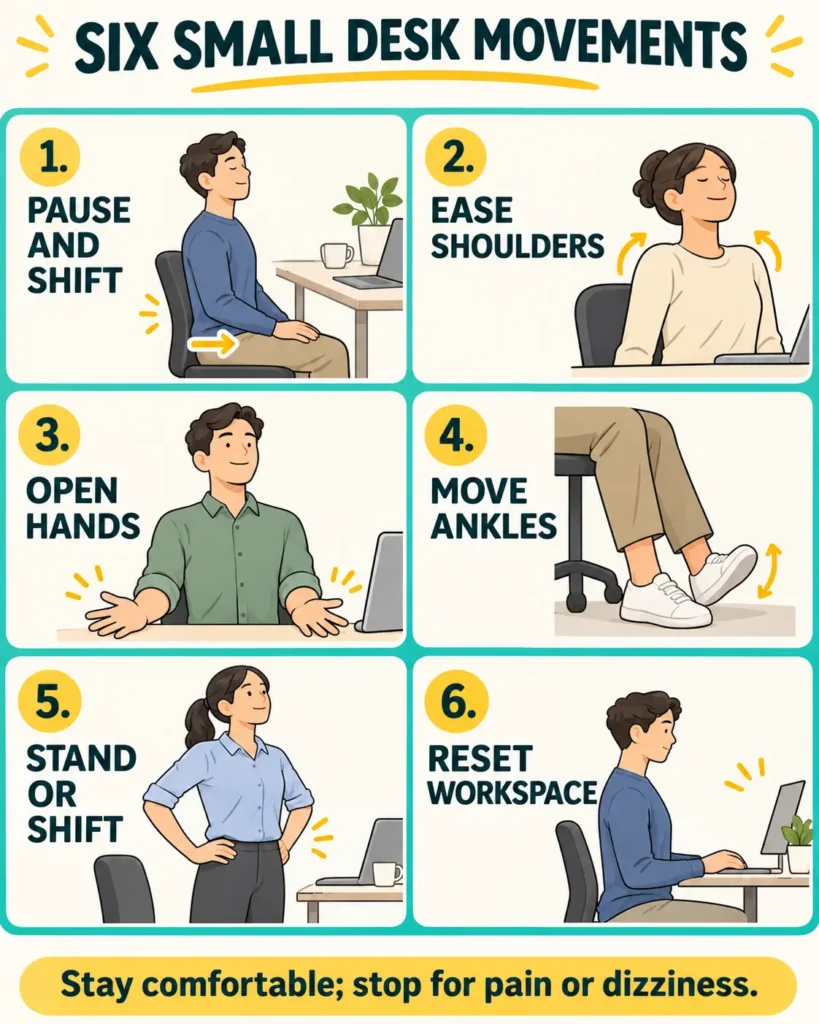
A simple desk movement break: six actions
1. Pause and change position
Save your work, move your hands off the keyboard, and shift to a supported upright position. Notice whether your shoulders or jaw are tensed. Relax them gently without trying to hold an artificial “perfect posture.”
2. Roll or ease your shoulders
Let your arms rest at your sides. Make a few small, comfortable shoulder circles, first backward and then forward, or simply lift and release your shoulders. Keep the movements soft. If circles aggravate the shoulder, skip them.
3. Open and close your hands
Uncurl your fingers, spread them comfortably, then relax the hands. Rotate your wrists slowly within a pain-free range, or rest your hands and gently change their position. Do not press through tingling or sharp wrist pain.
4. Move your ankles or march lightly
While seated, place your feet in a stable position and alternate lifting the heels and toes. Or, if comfortable, slowly lift one foot at a time as though marching. Standing option: take a few easy steps in place with stable support nearby.
5. Stand or shift your body weight—if suitable
If standing is accessible, rise from the chair using armrests or a stable support as needed. Walk a short distance or transfer weight gently from one foot to the other. Seated alternative: change how you sit and make small, comfortable trunk movements without twisting hard.
6. Reset your workspace and return
Take a normal breath, check that the screen and keyboard are within comfortable reach, and return to work. Ask: “Do I feel better, the same, or worse?” Shorten or simplify the next break based on your answer.
Choose a version that works today
| Situation | Movement option | How to adapt |
|---|---|---|
| Very little time | Choose any one action. | A position change is better than waiting for a perfect routine. |
| Seated or limited standing | Hands, shoulders, ankles, gentle seated shifts. | Use chair support; avoid painful or unstable movements. |
| Room to move | Shoulder movements plus a short easy walk. | Keep pathways clear; move at a comfortable pace. |
| Stressful meeting day | Add a short break between tasks if possible. | A break supports comfort but does not replace workload changes. |
Make it repeatable without another obligation
A sample sequence is shoulder movement → hand opening → ankle movement → stand or shift position → return to work. This is an illustration, not an evidence-based prescription or a required number of repetitions. Some people prefer a break after completing a call, sending a report, or refilling water; others benefit from a gentle reminder. Choose a cue you can realistically use.
If reminders become stressful or your workplace gives you little control over breaks, focus on what is feasible and consider discussing task design or break opportunities with your supervisor. You can also use small posture changes during work without treating them as a substitute for actual recovery time.
Common mistakes and quick corrections
- Forcing a deep stretch: use a smaller, comfortable range instead.
- Holding the breath while moving: breathe naturally, without a fixed rhythm.
- Trying to sit rigidly “straight” all day: comfortable position changes are more useful than remaining frozen in one posture.
- Using movement breaks to ignore persistent pain or numbness: seek assessment if symptoms persist, recur, or worsen.
- Expecting a break to resolve job pressure: physical pauses and organizational changes solve different problems.
Do breaks actually help stress and tension?
Two kinds of evidence matter here. Public-health guidance encourages adults to reduce prolonged sedentary time and replace some of it with movement at any intensity; this is broader activity guidance, not a validated desk-break treatment for stress. [1,2]
OSHA workplace guidance recommends varying computer tasks, positions, and opportunities for short recovery pauses because sustained static postures can contribute to muscular fatigue and discomfort. [3,4]
In a small 2025 study, 31 office workers completed an eight-week program of guided active breaks. Researchers reported reductions in neck and lower-back discomfort; perceived stress did not decrease significantly in the full group. Without a randomized comparison group, the study cannot establish that these particular desk movements caused the improvements. [5]
So the practical expectation is modest: you may find a brief break more comfortable or restorative, but results vary and the evidence does not justify promising relief from chronic stress, burnout, or persistent pain.
When to stop or get help
Stop the movement and get medical assessment for new or worsening pain, persistent tingling or numbness, or weakness. Seek urgent medical care for chest pain, fainting, sudden weakness, or severe unexplained shortness of breath. If work stress is affecting sleep, functioning, or mental health, consider professional support and workplace changes in addition to movement.
A movement break is not a rehabilitation program or medical treatment. The right exercises may differ with disability, pregnancy-related complications, recent surgery, injury, or a diagnosed condition.
One step to try today
After your next long desk task, pick just one comfortable movement—shoulder release, opening your hands, ankle motion, or a short walk. Notice whether it helps. Then decide whether the same small break fits somewhere tomorrow.
Related reading
Walking for Stress Relief: Why a Simple Walk Can Help
Setting Boundaries for Stress: How to Protect Time and Energy
How to Build a Sustainable Weekly Movement Routine
References
1. World Health Organization (2020). WHO guidelines on physical activity and sedentary behaviour. https://www.who.int/publications/i/item/9789240015128
2. Centers for Disease Control and Prevention. Adult Activity: An Overview. https://www.cdc.gov/physical-activity-basics/guidelines/adults.html
3. Occupational Safety and Health Administration. Computer Workstations: Work Process and Recognition. https://www.osha.gov/etools/computer-workstations/work-process
4. Occupational Safety and Health Administration. Computer Workstations: Good Working Positions. https://www.osha.gov/etools/computer-workstations/positions
5. Rabal-Pelay J, et al. (2025). Effect of active breaks on stress and musculoskeletal discomfort during work in office workers. Sport Sciences for Health. https://link.springer.com/article/10.1007/s11332-025-01488-6