

A low-pressure guide to choosing movement that fits your day—not another obligation.
Some days, a ten-minute walk feels doable. On others, you may prefer stretching, a swim, or a few simple strength exercises. For stress support, the most useful activity is often one you can safely repeat—not the hardest workout you can tolerate.
Quick insight: Physical activity can support mood and overall well-being, but results vary. Walking, other aerobic movement, strength training, yoga, and tai chi offer different experiences; research is not equally strong for every approach. Start with a manageable option and adjust to how you feel.
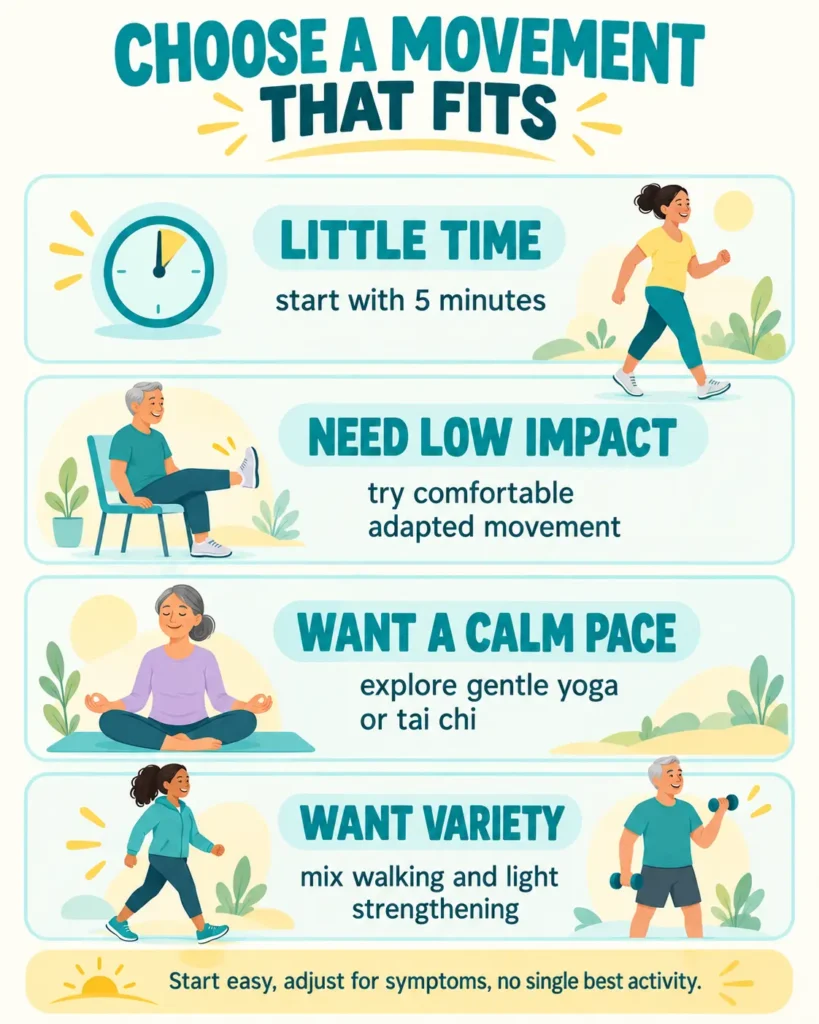
If you have five minutes: take an easy walk, move gently in a chair, or stand and stretch. You do not have to turn a stressful day into a fitness test.
Which movement might fit today?
| Activity | A sensible starting point | What to know |
|---|---|---|
| Walking or rolling outdoors | 5–10 comfortable minutes | Low equipment needs; pace and terrain can be adjusted. |
| Cycling or swimming | Easy, comfortable effort | Can provide aerobic movement; requires access and suitable safety conditions. |
| Strength training | Brief, light routine | Builds muscle and function; stress-specific effects are less certain. |
| Gentle yoga | Short beginner-friendly session | Some studies report lower perceived stress; styles differ greatly. |
| Tai chi or qigong | Short guided practice | Slow coordinated movement; stress-specific findings are mixed or limited. |
These are examples, not a ranking or a prescription. A seated option, mobility aid, or supervised program can be just as appropriate for getting started.
What the research actually says
The strongest general message is that regular physical activity supports physical and mental health. That does not mean every workout lowers stress immediately, or that a specific activity works better for everyone. Many studies measure mood or anxiety rather than everyday perceived stress; the distinction matters.
CDC recommends that adults work toward 150 minutes of moderate-intensity aerobic activity per week plus muscle-strengthening activity on two days, while emphasizing that some movement is better than none. These are broad public-health targets, not a required starting dose for stress relief. Source: https://www.cdc.gov/physical-activity-basics/guidelines/adults.html
The NIH National Center for Complementary and Integrative Health (NCCIH) notes a smaller and less certain body of research on exercise for stress and anxiety than for depression. It also distinguishes limited findings on yoga, tai chi, and qigong. Source: https://www.nccih.nih.gov/health/providers/digest/mind-and-body-approaches-for-stress-science
For yoga specifically, a 2020 review summarized by NCCIH included 12 studies and 672 participants and found improvements in perceived stress across those studies. Different yoga programs and study designs limit precise generalization. Source: https://www.nccih.nih.gov/health/yoga-effectiveness-and-safety
For strength training, swimming, cycling, and other individual activities, evidence for general health should not be automatically relabeled as proof of a direct stress-treatment effect. They may still be enjoyable, sustainable ways to move.
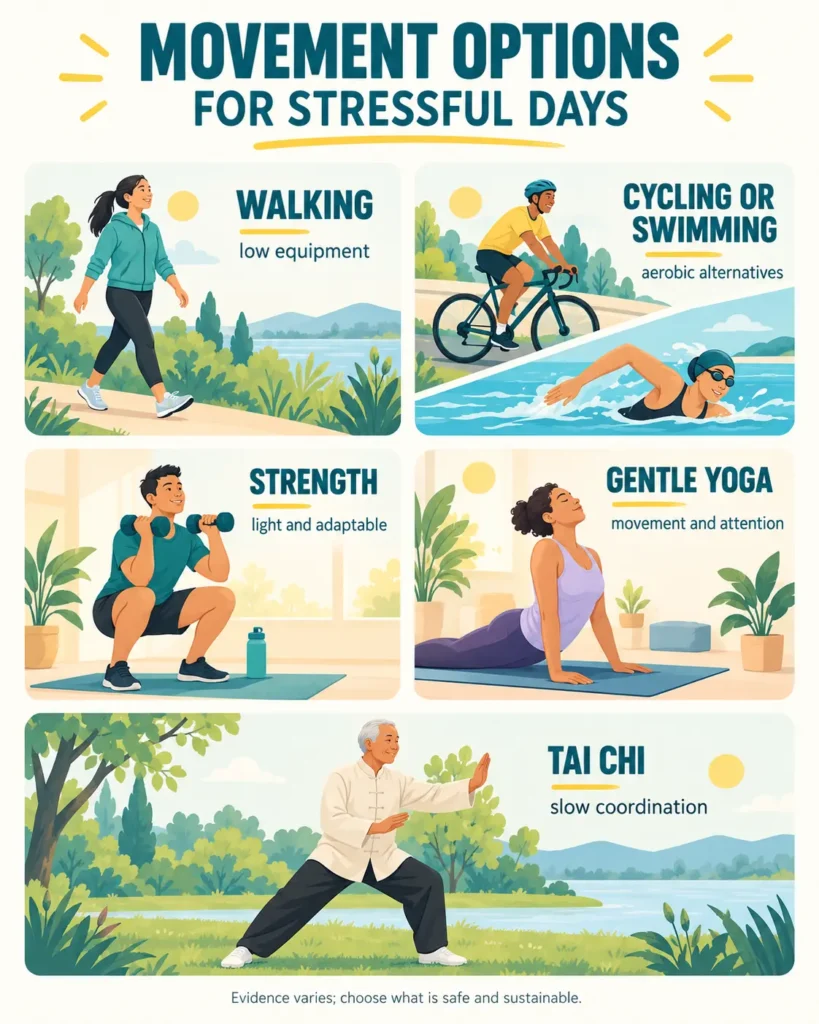
Five movement options, without the hype
1. Walking: a simple place to begin
A short neighborhood or indoor walk can give you a change of scene without scheduling a class. Try a comfortable pace at which you can still talk. Pick a level, familiar route and turn back when you want; a shorter walk still counts as movement.
Best practical fit: low-cost, flexible days. Consider seated or wheeled movement when walking is not accessible. Longer walks and stress-related study outcomes do not guarantee immediate relief.
2. Cycling or swimming: aerobic activity with a different feel
If you prefer moving without long walks, an easy stationary-bike ride or swim may appeal. Begin at a pace that leaves you comfortable. Swimming requires water competence and supervision where appropriate; cycling calls for route and traffic awareness. It is fine if neither option is practical.
3. Strength training: brief, purposeful movement
A few sit-to-stands, light resistance-band movements, or wall push-ups can fit into a small space. Choose a manageable load, breathe normally, and allow rest. Strengthening benefits are well established, but the right claim here is that this is a useful activity option—not a proven stand-alone treatment for stress.
4. Gentle yoga: movement plus attention
Gentle yoga can combine positions, breathing, and a change of focus. A beginner or chair-based class may be more approachable than an advanced class. Research suggests possible stress benefits, but the wide range of styles matters. Avoid painful positions and tell an instructor about limitations.
5. Tai chi or qigong: slow, coordinated practice
These practices use controlled movements, breathing, and attention. They may suit someone who dislikes fast-paced workouts, but teaching quality and physical demands vary. The specific evidence for stress remains less certain, so consider them options to explore rather than guarantees.
Choose by energy, access, and preference
| If today feels like… | You could try… | Make it easier by… |
|---|---|---|
| Overwhelmed or short on time | Brief walking or seated movement | Starting with 3–5 comfortable minutes |
| Restless and wanting rhythm | Cycling, swimming, or a walk | Keeping effort easy rather than competitive |
| Mentally scattered | Gentle yoga or tai chi | Following a simple beginner video or class |
| Wanting a sense of progress | Basic resistance training | Using fewer repetitions and extra rest |
There is no need to “push through” a bad day. Doing less—or taking a rest day—can be sensible.
A flexible 7-day starter example
This is an illustration for generally healthy beginners, not a medical exercise prescription or a claim that this schedule has been clinically tested for stress:
| Day | Option |
|---|---|
| Monday | 5–10 minutes easy walking or wheeling |
| Tuesday | 5 minutes gentle mobility or chair yoga |
| Wednesday | Rest or brief comfortable movement |
| Thursday | 5–10 minutes easy walking, cycling, or swimming |
| Friday | A few light strengthening movements, with rest |
| Saturday | A short activity you genuinely enjoy |
| Sunday | Rest, check in, and adjust for next week |
If it becomes comfortable, add time gradually. If symptoms, pain, fatigue, or obligations make it too much, scale back. A few brief movement breaks can be easier to sustain than a demanding plan
Safety: when to slow down or seek help
Stop activity and seek urgent medical evaluation for chest pain, fainting, or severe/unusual breathlessness. New dizziness, significant pain, or worsening symptoms also deserve attention. If you have a heart or lung condition, major mobility limitations, recent injury, pregnancy-related concerns, or are recovering from surgery, ask a qualified clinician about a safe starting plan. Choose appropriate footwear, hydration, temperature, traffic conditions, and supervision.
Stress that disrupts your sleep, functioning, or relationships deserves support beyond exercise. Physical activity can complement—not replace—mental health care, adequate rest, and changes to ongoing stressors.
NCCIH advises talking with a professional when stress is hard to cope with or symptoms persist. Source: https://www.nccih.nih.gov/health/stress
Quick questions
Do I have to exercise intensely for stress benefits?
No. There is no reason to assume harder is better for stress. Begin comfortably, especially if you have been inactive; adjust intensity to your capacity.
Is yoga better than walking?
Not necessarily. Studies differ in population and methods, so a universal winner is not established. Preference, access, comfort, and consistency may be more useful deciding factors.
What if I cannot walk or stand comfortably?
Seated mobility, adapted strength work, wheelchair-based activity, and suitable guided sessions may be options. Match the plan to your abilities and medical guidance.
The take-home point
Start with an activity that feels accessible. Make it short enough to repeat, keep the effort comfortable, and notice whether it fits your life. Exercise is one useful part of stress support, not another test you need to pass.
References
CDC — Adult Activity: An Overview — https://www.cdc.gov/physical-activity-basics/guidelines/adults.html
CDC — Adding Physical Activity as an Adult — https://www.cdc.gov/physical-activity-basics/adding-adults/
NCCIH — Mind and Body Approaches for Stress and Anxiety — https://www.nccih.nih.gov/health/providers/digest/mind-and-body-approaches-for-stress-science
NCCIH — Yoga: Effectiveness and Safety — https://www.nccih.nih.gov/health/yoga-effectiveness-and-safety
NCCIH — Stress — https://www.nccih.nih.gov/health/stress