
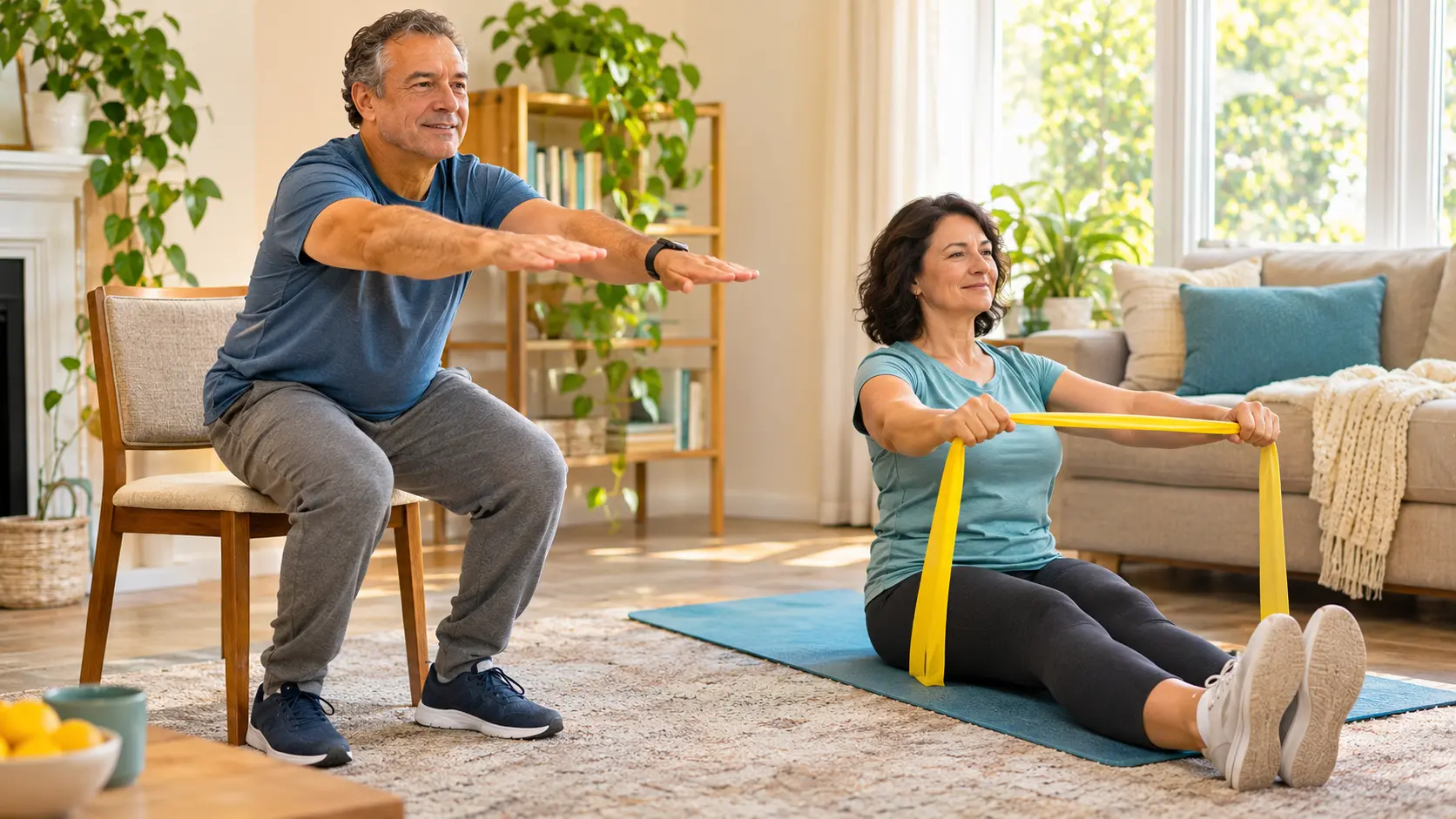
Strength training is not only about heavy weights or bodybuilding. It means asking your muscles to work against resistance—from standing up from a chair to using a resistance band or lifting a dumbbell. If you are new to it, start with a few comfortable movements and learn the technique before worrying about heavier loads.
The goal is to build a routine you can practice, recover from, and adjust—not to push through pain or follow a perfect workout.
QUICK INSIGHT
About Strength Training
Best for: Adults who want to build or maintain strength and make everyday tasks easier. Starting point: Try a short, light session covering several major muscle groups, with a stable chair or wall if helpful. What to expect: Progress happens with repetition and recovery, not one intense session. Safety: Stop for concerning symptoms, and seek tailored guidance if an injury or health condition changes what is safe for you.
What counts as strength training?
Resistance is simply something your muscles work against. Your own bodyweight, elastic bands, household items, free weights and gym machines can all provide it. Some exercises emphasize your legs and hips; others train the back, chest, shoulders, arms, and midsection.
Unlike aerobic activity, which often involves sustained rhythmic movement such as brisk walking, strength training asks muscles to produce force during a movement or hold. Both types of activity belong in a balanced weekly routine.
Why people choose it
Strength training can improve muscle strength and physical function. Depending on the training approach and person, it can also support muscle size, mobility-related tasks and aspects of physical performance. The American College of Sports Medicine’s 2026 evidence review found that different resistance-training methods can work; advanced techniques are generally unnecessary for healthy adults starting out.
Strength training is also part of national public-health guidance. The CDC recommends that adults perform muscle-strengthening activities on two or more days per week, involving the major muscle groups, alongside aerobic movement. That is a population-level target—not a requirement to start at full volume on day one.
Strength gains do not require a gym membership, and a single exercise cannot guarantee injury prevention, weight loss, or improvement in a particular disease.
Start with what you have
| Option | Useful when | What to keep in mind |
|---|---|---|
| Bodyweight / chair | You want a free, accessible starting point | Choose stable surfaces; modify depth or range of motion |
| Resistance band | You prefer portable, adjustable resistance | Check bands for wear; anchor securely |
| Dumbbells / household weights | You want a simple way to adjust load | Pick a weight you control without twisting or holding your breath |
| Gym machines | You prefer a guided movement path | Adjust seat and handles; ask for setup help if needed |
There is no universal “best” option. The practical choice is one you can use safely and consistently.
A beginner-friendly sequence
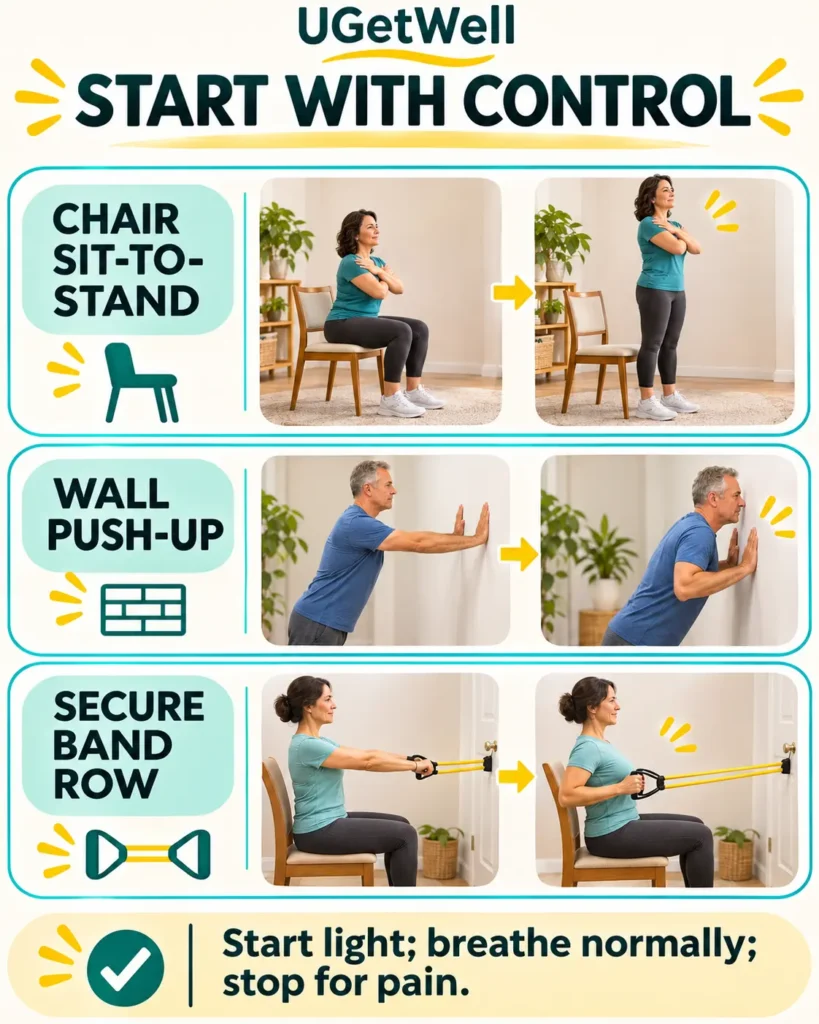
The following is an illustrative, adjustable practice session—not a personalized prescription. Start with easy movements and stop before your form breaks down.
- Prepare your space. Wear comfortable shoes if needed, clear obstacles and use a firm chair or stable wall for support.
- Warm up gently. Walk around the room or move your arms and legs comfortably for a few minutes before resistance work.
- Choose a lower-body movement. Practice standing up from a chair or a shallow supported squat, moving slowly and using your hands for support when useful.
- Choose a pushing movement. Try a wall push-up with hands at a comfortable height and body aligned; make it easier by standing closer to the wall.
- Choose a pulling movement. Use a light resistance band with a secure anchor for a row, drawing elbows back without shrugging; skip this if you cannot anchor the band safely.
- Add a simple carry or hold if suitable. Hold a light item close to your body, stand tall and breathe normally; a supported variation is fine.
- Review and recover. Notice whether you can move comfortably and perform ordinary tasks afterward. Leave time for recovery and repeat when ready.
You might use only a few controlled repetitions of two or three movements at first. There is no need to train to exhaustion, test a maximum lift, or increase difficulty every session. If possible, a qualified exercise professional can help check movement technique.
How to progress without rushing
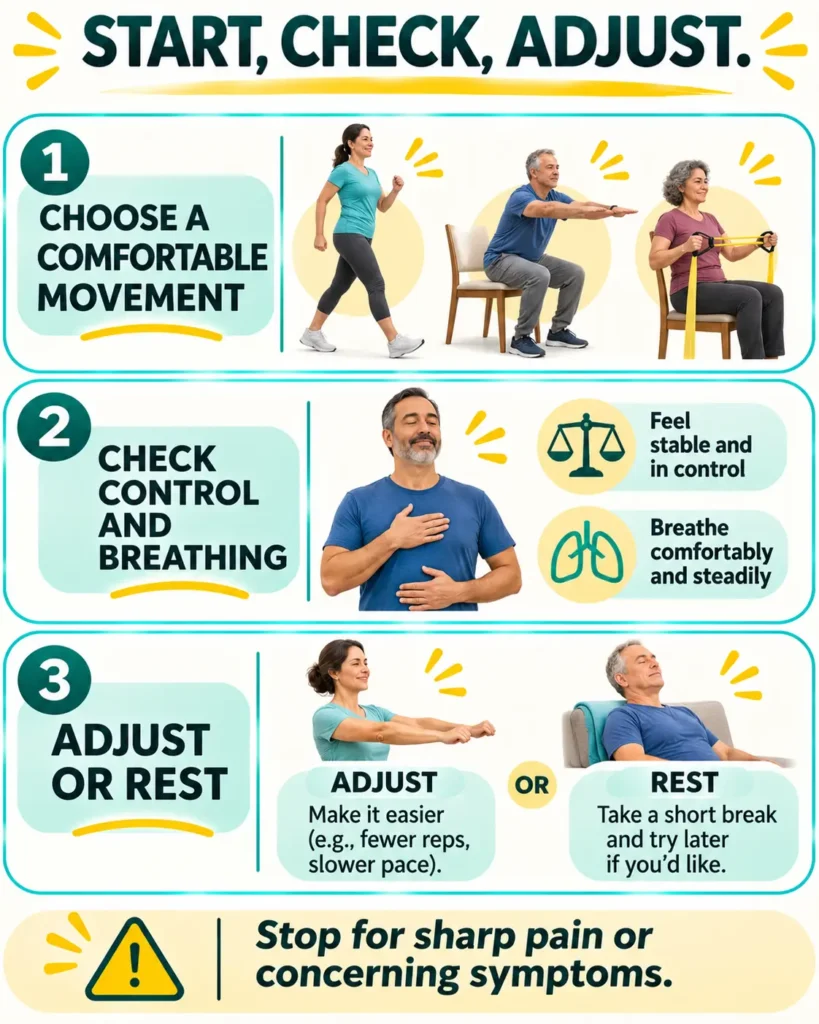
Choose a version you can control and keep breathing comfortably. Once it feels familiar, you can make one variable slightly more challenging: an extra repetition, an added set, a modest increase in resistance, or a more demanding movement variant. Change one thing at a time and allow recovery between harder sessions.
For general adult health, the CDC target is strength work on two or more days weekly. If that is too much at first, beginning with a lighter, less frequent session can be a reasonable on-ramp; build toward guideline levels as your ability and circumstances permit. The 2026 ACSM statement emphasizes that consistency and individualized progression matter.
Make it fit real life
- Limited time? Choose two simple movements and practice them carefully rather than skipping the session entirely.
- No gym? A chair, wall or appropriate band may be enough. Do not use unstable furniture or improvised equipment that could slip.
- Mobility limitations? Supported standing or seated variants may be possible; get individual guidance if balance, pain, or neurological issues affect safety.
- Already active? Keep resistance training alongside walking or other aerobic activity, rather than treating one as a complete substitute for the other.
- Schedule changes? Think in repeatable opportunities through the week, not rigid days that create guilt when missed.
Common mistakes—and what to do instead
| Instead of… | Try… |
|---|---|
| Adding weight before you control the movement | Keep resistance lighter and practice comfortable technique |
| Holding your breath during effort | Breathe steadily; avoid prolonged straining |
| Training through sharp or worsening pain | Stop and reassess; seek advice if pain persists |
| Doing a difficult session every day | Give worked muscles time to recover |
| Copying advanced gym routines | Build a few movements you can repeat safely |
Safety: when to adjust or ask for help
Muscle effort and some temporary soreness can occur with unfamiliar activity; sharp pain, joint instability or a worsening injury are reasons to stop. Seek urgent assessment for chest pain, fainting, or severe/unusual breathlessness during activity. If you have recent surgery, an injury, a cardiovascular condition, significant balance problems, or restrictions from a clinician, ask a qualified professional how to adapt resistance exercises before beginning.
Pregnancy, disability, older age and chronic conditions do not automatically exclude strength training, but the safest exercise choices and supervision may differ. A personal assessment is especially useful if you are uncertain about safe movement or resistance.
A useful next action
Pick one stable lower-body movement and one gentle upper-body movement. Practice them comfortably, then note one detail: Was the movement controlled, and did you feel okay afterward? Use that answer—not a social-media target—to decide what to try next.
Related reading
Aerobic Exercise: Benefits, Types, How Much, and How to Start — UGW-C0280 https://ugetwell.com/physical/aerobic-exercise
How to Build a Sustainable Weekly Movement Routine — UGW-C0325 https://ugetwell.com/how-to/build-sustainable-weekly-movement-routine/
Walking: Health Benefits, How to Start, and Safety — UGW-C0279 https://ugetwell.com/physical/walking
Yoga: Benefits, Styles, How to Start, and Safety — UGW-C0282 https://ugetwell.com/physical/yoga
References
CDC — Adult Activity: An Overview https://www.cdc.gov/physical-activity-basics/guidelines/adults.html
U.S. Office of Disease Prevention and Health Promotion — Physical Activity Guidelines Q&A https://odphp.health.gov/our-work/nutrition-physical-activity/physical-activity-guidelines/about-physical-activity-guidelines/questions-answers
American College of Sports Medicine (2026) — Resistance Training Position Stand, PubMed https://pubmed.ncbi.nlm.nih.gov/41843416/
ACSM (2026) — Five Things to Know About Resistance Training https://www.acsm.org/wp-content/uploads/2026/03/Resistance-Training-Position-Stand-infographic.pdf
CDC — Health Benefits of Physical Activity for Adults https://www.cdc.gov/physical-activity-basics/health-benefits/adults.html