

A sleep routine does not need to be perfect, expensive, or identical every night. A few repeatable cues—when you get up, how you use light, and how you transition toward rest—can make it easier to protect sleep opportunity. The simplest place to start is choosing one wake-up anchor you can usually keep. [1, 2]
This guide is for adults who want a manageable daily rhythm, including people with busy households or changing schedules. It is not a treatment plan for persistent insomnia, and you do not need to force yourself to sleep at a set moment.
Start tonight: decide on tomorrow’s realistic wake time, then choose one quiet activity to repeat before bed.
QUICK INSIGHT
WHO IT MAY HELP
Adults looking for steadier sleep habits. START SMALL — Keep a feasible wake-up anchor and one wind-down cue. LIMIT — A routine alone is not recommended as the sole treatment for chronic insomnia; ask about CBT-I when sleep problems persist. [3, 4]
Before you start
You need little more than a way to check the time and a place to unwind. A lamp you can dim, a book, quiet audio, or comfortable bedding may help—but none is required. Choose a schedule that allows sufficient sleep opportunity within your actual obligations. For many adults, guidance calls for at least seven hours of sleep, though individual needs vary. [1]
If you work rotating shifts, care for someone overnight, or have an unpredictable schedule, use a repeating sequence of cues rather than an unrealistic fixed clock time. Avoid driving or other safety-sensitive tasks if you are dangerously sleepy.
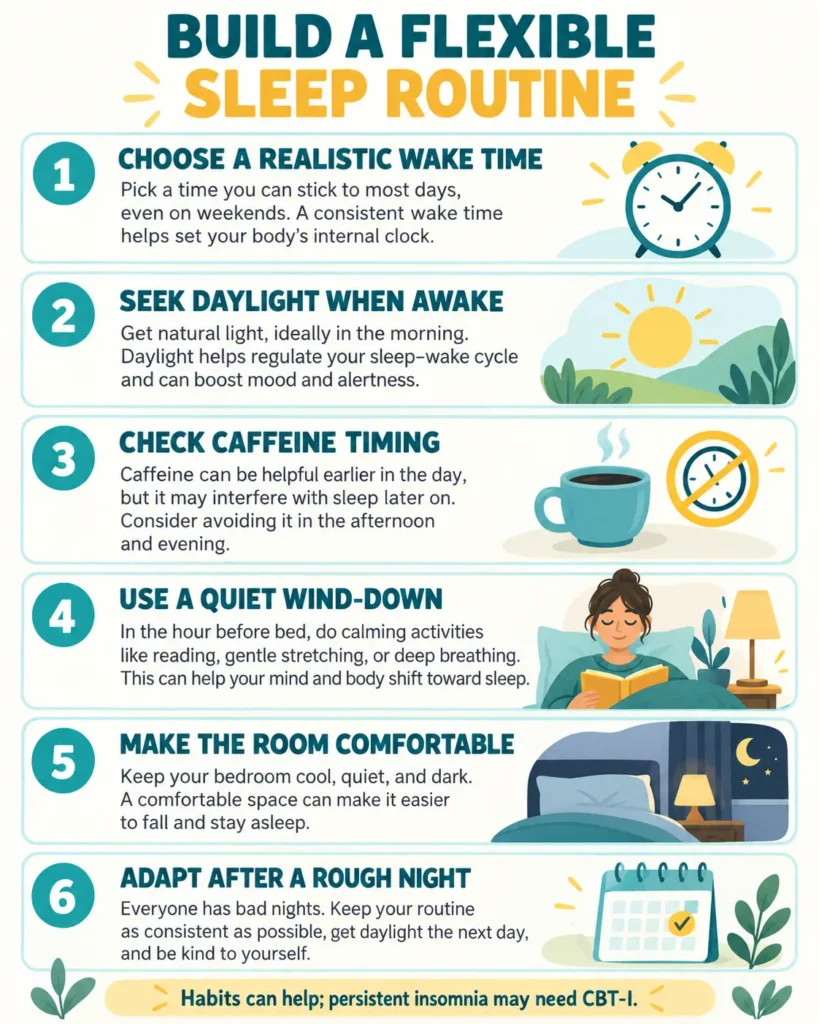
Build your sleep routine: six practical steps
1. Choose a realistic wake-up anchor
Pick a morning time you can keep on most days, with room for real-life obligations. Consistency is a helpful target, not a pass–fail rule. When work shifts rotate, aim for the most stable schedule feasible within each shift block. [1, 2]
2. Get some daylight after waking
If practical, step outside or sit near natural daylight early in your waking period. Daytime light exposure helps signal the timing of your body clock. A short walk is optional; daylight by a window or brief time outdoors is a simpler alternative when movement is difficult. [1, 5]
3. Move stimulating choices earlier
Notice what makes you alert—late-day coffee, energy drinks, nicotine, work messages, or vigorous activity. Caffeine can interfere with sleep hours after consumption, and sensitivity differs; begin by moving it earlier rather than assuming one cutoff fits everyone. [2, 6]
4. Begin a low-pressure wind-down
Use a repeatable quiet transition before bed: switch from demanding tasks to reading, calm music, a warm shower, or preparing tomorrow’s essentials. Dim bright light if possible. You can start with just a few minutes; there is no evidence that one precise routine length works for everyone. [2, 5]
5. Make your sleep space more comfortable
Reduce disruptive light and noise where you can. A cool, dark, quiet environment is commonly recommended, but adapt to your needs: a dim night-light, white noise, fan, or eye mask may suit your circumstances. [2, 6]
6. Respond flexibly to a difficult night
If sleep does not arrive, try not to treat the clock as a test. Avoid extending time in bed indefinitely to force sleep. If you repeatedly struggle to sleep or have significant daytime consequences, seek an assessment; individualized CBT-I includes techniques that go beyond these general habits. [3, 4]
Make it fit your life
- Two-minute version: set tomorrow’s feasible wake-up time, lower the lights, and put the phone away from your pillow.
- Ten-minute version: add a quiet activity, set out morning essentials, and lower evening light.
- Fuller version: add early-day daylight, a caffeine check, a comfortable sleep environment, and a repeated wind-down cue.
- Caregiving or unpredictable nights: focus on a brief calming sequence and flexible wake-time consistency where possible; do not blame yourself for interrupted sleep.
- Shift work: protect a dark and quiet sleep space when off duty, and seek professional advice if ongoing schedule conflict or sleepiness affects safety. [6]
A simple starter checklist
| When | Try | Flexible alternative |
|---|---|---|
| After waking | Light exposure when feasible | A few minutes by daylight |
| Earlier in your waking day | Notice caffeine timing | Start by changing one drink |
| Before planned sleep | Repeat a calming cue | Two quiet minutes |
| At sleep time | Make the room comfortable | Use any accessible light/noise adjustment |
Try this for several days without grading yourself. Notice patterns, not perfection.
Common obstacles and small fixes
- “I missed the routine yesterday.” Restart with one anchor tonight or tomorrow. Missing one evening does not erase progress.
- “My home is noisy or shared.” Earplugs (if safe for your situation), a fan, or a short quiet pause may be more realistic than complete silence.
- “I get anxious when I watch the time.” Move the clock out of view and focus on a comfortable activity rather than tracking minutes.
- “My schedule changes every week.” Keep the same *sequence*—dim, pause, prepare, rest—even if the clock time varies.
- “I feel wired, even though I am tired.” Reduce evening demands if possible; persistent trouble may need an individualized evaluation rather than a stricter routine.
What the evidence suggests—and what it does not
Public-health and NIH guidance consistently recommend regular sleep–wake timing, suitable light exposure, caffeine awareness, and a restful sleep environment as healthy sleep habits. These recommendations are reasonable building blocks, but they do not prove that this exact six-step routine will prevent or cure insomnia. [1, 2, 5, 6]
Clinical guidelines strongly recommend multicomponent cognitive behavioral therapy for insomnia (CBT-I) as first-line treatment for adults with chronic insomnia. Sleep hygiene advice alone should not be presented as an equivalent substitute. [3, 4]
Safety, limits, and when to get help
Talk with a qualified healthcare professional when difficulty falling asleep, nighttime awakening, or sleep-related daytime impairment keeps recurring. Seek prompt assessment for loud snoring with witnessed breathing pauses or gasping, or for severe daytime sleepiness—especially when driving or operating machinery may be affected. Shift workers may need individualized advice rather than standard bedtime suggestions. [4, 6]
Seek emergency help for serious breathing difficulty, chest pain, or another immediate danger. Do not use alcohol, sedatives, or supplements as a substitute for sleep evaluation, and do not stop prescribed medication without professional advice.
Medical disclaimer: This article provides general educational information, not diagnosis or individualized medical advice. Sleep problems can have several causes. A clinician can help you decide whether screening, CBT-I, or other care is appropriate.
Your next small step: choose one comfortable wind-down cue you could repeat tonight. Keep it flexible.
References
1. CDC. About Sleep and Your Heart Health (2024).
https://www.cdc.gov/heart-disease/about/sleep-and-heart-health.html
2. NHLBI, NIH. Insomnia Treatment: Healthy sleep habits.
https://www.nhlbi.nih.gov/health/insomnia/treatment
3. American Academy of Sleep Medicine. Behavioral and psychological treatments for chronic insomnia in adults: clinical practice guideline (2021).
https://pmc.ncbi.nlm.nih.gov/articles/PMC7853203
4. American College of Physicians. Management of Chronic Insomnia Disorder in Adults: clinical practice guideline (2016).
https://pubmed.ncbi.nlm.nih.gov/27136449
5. NHLBI, NIH. Circadian Rhythm Disorders — Treatment.
https://www.nhlbi.nih.gov/health/circadian-rhythm-disorders/treatment
6. NHLBI, NIH. Sleep Deprivation and Deficiency — Healthy Sleep Habits.
https://www.nhlbi.nih.gov/health/sleep-deprivation/healthy-sleep-habits