

A few minutes outside may offer a useful pause in a stressful day—but there is no scientifically established number of outdoor minutes that works for everyone. The best starting point is time you can access safely, enjoy reasonably, and repeat without adding another obligation.
A park is one option, not a requirement. A shaded sidewalk, courtyard, porch, or accessible outdoor seating area may be more realistic. If you cannot comfortably go outdoors, that does not mean you are failing at stress management.
QUICK INSIGHT
About Outdoor Time for Stress
Connection: Time in natural settings may help some people feel calmer or more restored. Evidence: promising but varied, especially for a precise dose. Try: a short, flexible outdoor pause and notice whether it helps. Caution: adjust for heat, UV, smoke, accessibility, and personal safety. [1–5]
What counts as outdoor time?
Outdoor time can mean sitting under a tree, walking along a familiar block, eating lunch on a shaded patio, gardening, or simply taking a quiet break outdoors. You do not need to hike, exercise hard, travel to wilderness, or spend money to try it.
These experiences combine different elements: a change of setting, natural sights and sounds, daylight, gentle movement, and a pause from demands. Because those components overlap, it is hard to attribute every reported benefit to nature alone.
Why might outdoor time feel restorative?
A manageable change of scene may interrupt repetitive demands and give attention a different focus. Green spaces may make it easier to unwind or move at a comfortable pace. Daylight also helps synchronize the body clock, although circadian effects depend on timing and individual sleep schedules. None of these pathways establishes outdoor time as a treatment for chronic stress. [1,3]
Some people prefer quiet greenery. Others find a neighborhood stroll, outdoor conversation, or sitting in filtered daylight more comfortable. A noisy, crowded, unsafe, excessively hot, or smoky environment may have the opposite effect.
What does research actually show?
A 2024 systematic review examined eight publications of randomized clinical trials of nature-exposure interventions for stress, anxiety, or depression. Some studies reported improvements in psychological or biological measures, but the settings, interventions, comparison groups, and outcomes varied. The review does not provide a single reliable outdoor-duration prescription for everyday stress. [1]
Broader research also frequently finds associations between green-space access and aspects of wellbeing. Such associations can reflect differences in neighborhood resources, physical activity, social connection, and health—not simply an isolated effect of looking at greenery. Results from supervised nature-based programs should not be assumed to apply identically to a brief break outside the office.
How much outdoor time do you need?
There is no universal minimum for stress relief. Popular numbers, including “20 minutes” or “two hours a week,” can come from particular studies or associations; they are not individualized prescriptions or guarantees. Choose duration based on opportunity, comfort, weather, and whether you can return without falling behind on essential responsibilities.
An adjustable example: step outside briefly between tasks, sit somewhere comfortable for a few minutes, or take part of an existing walk outdoors. If you feel better afterward and the routine is manageable, repeat it. If the outing is unpleasant or unsafe, try a different option. No stopwatch is necessary.
Three ways outdoor time can fit a real day
| Situation | Possible approach | What to consider |
|---|---|---|
| Busy workday | Take a short outdoor pause between existing tasks | Keep it optional; do not replace needed rest or breaks |
| Limited mobility or energy | Sit in accessible shade near home or work | A safe seat, level path, or companion may help |
| Childcare or caregiving | Combine time outdoors with a normal errand or supervised activity | Safety and the person you care for come first |
| Hot, smoky, or unsafe day | Skip the outdoor plan or use a pleasant indoor change of setting | Air quality, heat, and personal safety outweigh a stress habit |
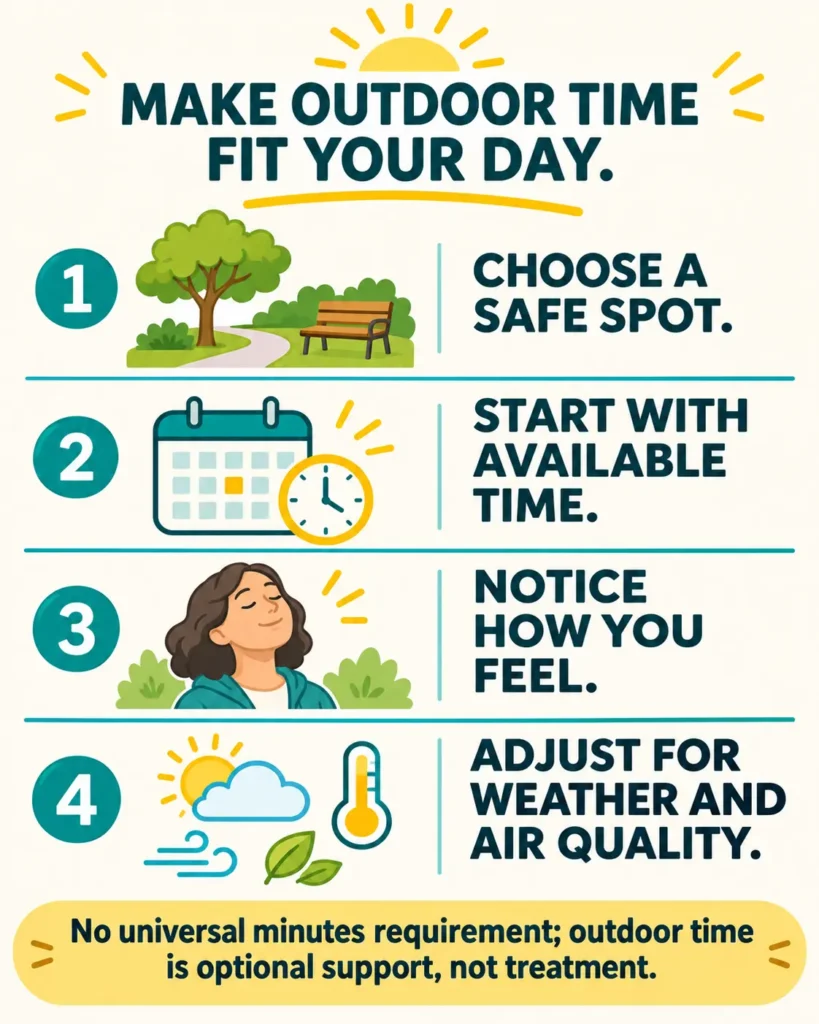
Try a low-pressure outdoor break
1. Pick a safe, realistic location—a familiar sidewalk, courtyard, garden, or accessible bench.
2. Check the weather and air quality before going out. Choose shade and sun protection when needed.
3. Begin with whatever time is available, even if brief. There is no target to “hit.”
4. Notice one ordinary detail: a sound, breeze, tree, or change in light. You do not have to meditate.
5. Return and ask a simple question: Did this make the next part of the day feel easier, neutral, or harder?
6. Adjust rather than force it. You can try another setting, time of day, or indoor alternative.
When outdoor time may help less—or not at all
For someone living near heavy traffic, without green space, managing a mobility limitation, working irregular shifts, or concerned about personal safety, routine outdoor breaks may be difficult. Stress arising from excessive workload, caregiving demands, money worries, or workplace conflict is unlikely to disappear because of a walk. Improving the conditions creating stress may be more important than adding another personal habit.
If you dislike nature activities or find crowded parks overstimulating, there is no need to force the idea. Quiet indoor breaks, boundaries, social support, gentle movement, or professional care may fit better. People with severe or persistent symptoms deserve assessment and support rather than another checklist.
Daylight is useful—but more sun is not always better
Daylight can act as a timing cue for the body clock; this is different from the claim that direct sunlight treats stress. Never look directly at the sun. Being outdoors in shade can still provide daylight exposure. To understand timing, see the related guide on light exposure and the body clock. [3]
Protect skin and eyes when needed: choose shade, suitable clothing, sunglasses, and broad-spectrum sunscreen. CDC notes that UV exposure can occur on cloudy or cooler days; UV protection is particularly important when the UV Index is elevated. [2]
Safety: when to change the plan
• Heat or cold: reduce time, seek shelter, and avoid conditions that cause overheating, lightheadedness, or discomfort.
• Wildfire smoke or unhealthy air: check local air-quality information; postpone outside exercise or choose cleaner indoor air when indicated. [4–6]
• Allergies, insects, or uneven ground: choose a safer route, seating area, or alternative.
• Medical conditions or mobility limitations: adapt to clinician guidance and available accommodations.
• Acute warning signs: stop activity and seek urgent medical evaluation for chest pain, fainting, severe difficulty breathing, or another serious symptom.
If stress causes ongoing sleep disruption, severe distress, inability to function, or symptoms that worry you, contact a qualified healthcare or mental-health professional. Outdoor time is supportive self-care, not a replacement for therapy, workplace changes, medication, or urgent help.
One useful next step
Choose a safe opportunity to step outside once during your next ordinary day. Keep it short and comfortable. See whether the change feels worthwhile; if it does, find a convenient way to repeat it. If not, choose another stress-support strategy without guilt.
Related reading
Light Exposure and Your Body Clock: What to Know
Setting Boundaries for Stress: How to Protect Time and Energy
References
[1] Paredes-Céspedes et al. (2024), The Effects of Nature Exposure Therapies on Stress, Depression, and Anxiety Levels: A Systematic Review — https://pubmed.ncbi.nlm.nih.gov/38534901/
[2] CDC (2026), Sun Safety Facts — https://www.cdc.gov/skin-cancer/sun-safety/
[3] CDC/NIOSH, Effects of Light on Circadian Rhythms — https://www.cdc.gov/niosh/work-hour-training-for-nurses/longhours/mod2/19.html
[4] CDC (2026), Safety Guidelines: Wildfires and Wildfire Smoke — https://www.cdc.gov/wildfires/safety/how-to-safely-stay-safe-during-a-wildfire.html
[5] CDC, How to Use the HeatRisk Tool and Air Quality Index — https://www.cdc.gov/heat-health/hcp/clinical-guidance/how-to-use-the-heatrisk-tool-and-air-quality-index.html
[6] AirNow, When Smoke Is in the Air — https://humo.airnow.gov/wildfires/when-smoke-is-in-the-air/