

After an intense day, you may have stopped working yet still feel “on.” Your attention keeps circling through unfinished tasks, your body feels tense, or everyday conversation takes more effort. Recovery time is the space in which demands ease enough for you to rest, reset attention, or do something personally meaningful.
Recovery does not have to look like meditation or a perfect evening routine. A few minutes of a different kind of activity, a protected meal break, or a realistic end-of-work boundary can be a useful place to begin. And when the demands themselves are excessive, individual breaks are not a complete solution.
QUICK INSIGHT
About recovery
Recovery time means stepping out of a physically or mentally demanding mode and giving yourself a chance to replenish. It includes short pauses, rest between efforts, leisure, and sleep—but these are not interchangeable. Try one low-pressure transition after a demanding task and notice whether it suits you. The goal is support, not a guarantee of stress relief.
What recovery time is—and what it is not
A short break interrupts a task. Decompression is the process of moving from a high-demand state toward a calmer or less effortful one. Recreation can offer enjoyment or connection. Sleep supports functions that waking rest cannot fully replace. Recovery may include several of these, depending on what depleted you and what you can control. [1,2]
Recovery is not a moral achievement or a productivity competition. A parent handling an evening of caregiving or a person working shifts may have very different opportunities from someone who can turn off a laptop at five.
Why recovery time matters for everyday wellbeing
Demanding tasks draw on physical and mental resources; extended shifts, poor sleep, stress, and difficult environments can contribute to fatigue. Work-related fatigue may reduce attention, reaction time, judgment, and safety. These risks are not solved by willpower alone. [1]
A brief pause sometimes reduces the feeling of fatigue or restores a sense of energy. A 2022 systematic review of micro-break experiments reported small average improvements in vigor and fatigue, but did not find a clear overall performance improvement. That evidence does not prove that a specific five-minute ritual prevents illness, burnout, or accidents. [2]
Long working hours have also been linked to health risks in WHO/ILO research. Such evidence relates to broader workload conditions; it should not be translated into a claim that a short break cancels those risks. [3]
Common signs you could use a different rhythm
- You move straight from one demanding task to the next without an opportunity to reset.
- You are mentally replaying work, caregiving, or conflict long after the immediate task ends.
- You feel physically tired but keep postponing meals, a comfortable position, or needed sleep.
- You find yourself becoming more irritable or forgetful when demands pile up.
These experiences can have many causes. They are cues to reassess demands and recovery opportunities—not a diagnosis of burnout, anxiety, or another condition.
What the evidence suggests—and what remains uncertain
Research on short breaks offers reasonable support for modest improvements in immediate feelings of energy and fatigue. Study tasks, participants, break lengths, and activities varied, so there is no single best break for everyone. [2]
Occupational-health guidance emphasizes prevention of excess fatigue through appropriate scheduling, adequate sleep opportunity, and organizational controls as well as individual strategies. Evidence does not support treating personal resilience habits as substitutes for safer working conditions. [1]
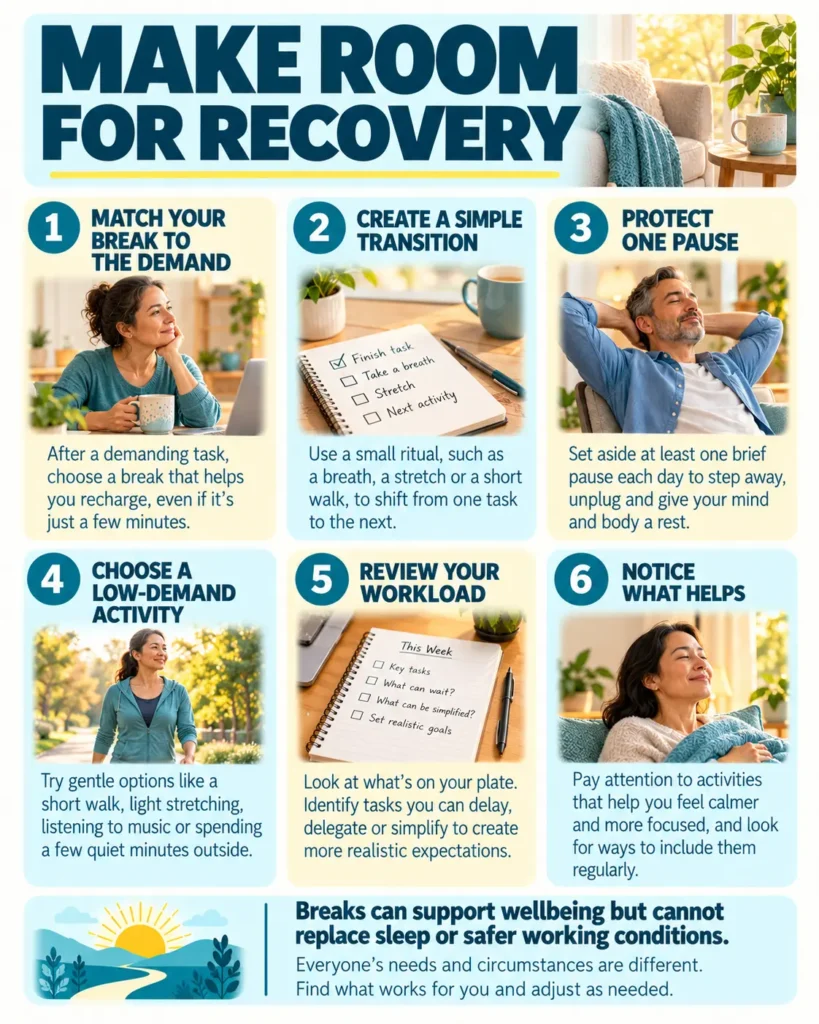
Six practical ways to create more recovery space
1. Match the break to the kind of demand
After concentrated screen work, look away, change posture, or step into another room if practical. After physical exertion, a comfortable seated rest may fit better. After emotionally demanding conversations, silence or a low-demand activity may help. None is compulsory.
2. Create a small transition
Before moving between work and home roles, set down what you are carrying, wash your hands, change clothes, or sit for a moment. Choose an action that signals a shift without requiring special equipment or perfect quiet.
3. Protect one ordinary pause
A meal without multitasking, a few moments outdoors, or a deliberate pause between tasks may be easier to repeat than an elaborate recovery ritual. Begin with an available window rather than a rigid number of minutes.
4. Give yourself a choice of low-demand activities
Listening to familiar music, light movement, sitting quietly, chatting with someone safe, or doing something creative may each feel restorative at different times. If solitude feels isolating, choose connection; if company adds demands, choose privacy when possible.
5. Look beyond the break
If fatigue is constant, review sleep opportunity, shift patterns, workload, and unmet basic needs. Where possible, discuss staffing, scheduling, rest opportunities, or accommodations with people who can help change the conditions. [1]
6. Check whether the change actually helps
After a few days, ask: “Am I a little less depleted, or is this another chore?” Keep useful changes, adapt unhelpful ones, and consider professional guidance for persistent symptoms.
A low-pressure starting plan
| Situation | One possible recovery choice |
|---|---|
| Between demanding tasks | Move, stretch comfortably, or sit quietly before starting the next task. |
| Coming home or changing roles | Make one simple transition: change clothes, wash up, or take an undistracted pause. |
| Busy evening with little privacy | Choose a small pause already available, or ask for shared responsibility where possible. |
| Day off | Leave some unstructured time if feasible; leisure and household responsibilities can coexist. |
Obstacles and realistic alternatives
- “I only have a minute.” A single intentional pause may be a workable starting point, but it is not a substitute for adequate sleep or safe work schedules.
- “My household needs me.” Try a shared transition, an agreed short handoff, or rest while sitting with family rather than requiring isolation.
- “I cannot switch off mentally.” Jot down one next action for tomorrow, then try a low-demand activity. If thoughts remain intrusive or impair functioning, seek support.
- “I work shifts or irregular hours.” Plan recovery around actual demands and your main sleep period rather than somebody else’s evening schedule.
- “I do not control my workload.” Personal breaks may help in the moment, but sustained overload can require changes by supervisors, employers, or caregivers sharing responsibilities.
Safety, limits, and when to seek support
Do not use brief rest or caffeine to justify driving or operating equipment when significantly sleepy. Fatigue can impair judgment and reaction time. Seek help arranging a safe alternative when needed. [1]
Persistent exhaustion, significant sleep disruption, unusual breathlessness, dizziness, fainting, depression, or difficulty managing daily activities deserves assessment rather than assuming that recovery habits will fix it. Seek urgent medical care for chest pain, fainting with concerning symptoms, severe breathing difficulty, or immediate danger.
Recovery practices can support everyday coping, but they do not replace medical care, safe working conditions, financial or social support, or treatment for a sleep or mental health disorder.
Helpful next step
Choose one transition in the next day that usually feels rushed. Add a small, realistic pause and notice whether it makes the next activity more manageable. If you find the same demands consistently overwhelming, focus on changing those demands where possible, not just adding another personal habit.
References
1. CDC/NIOSH. Fatigue and Work (2026).
https://www.cdc.gov/niosh/fatigue/about/index.html
2. Albulescu P, et al. “Give me a break!” A systematic review and meta-analysis on micro-breaks. PLOS ONE (2022).
https://doi.org/10.1371/journal.pone.0272460
3. World Health Organization. Long working hours and health: Questions and answers (2021).