

A sleep-friendly bedroom does not have to look perfect—or cost a lot. Light, sound, warmth, and physical comfort can make it easier or harder to settle into sleep, especially when they keep disturbing you. The useful question is not “What should I buy?” but “What in my actual sleep space is getting in the way?” [1–3]
Quick Insight
What matters: A darker, quieter, comfortably cool and supportive sleeping space is a reasonable starting point. What to try: Notice one recurring disturbance and make one affordable change. Evidence limit: These are practical sleep recommendations, not a guaranteed treatment for insomnia or other sleep disorders. [1–3]
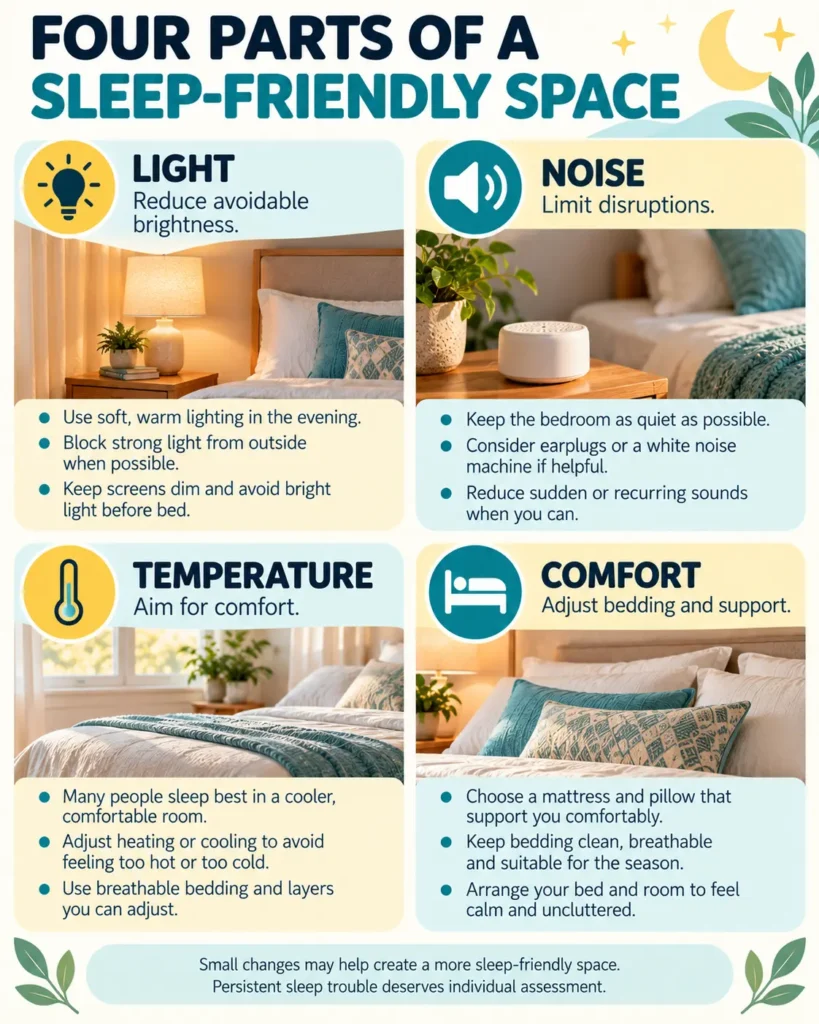
The four parts of a sleep environment
Your bedroom is an environment made of exposures and practical constraints—not a test you must pass. Light can signal alertness and influence biological timing. Sudden sounds may interrupt sleep. Excess warmth or cold may affect comfort. An uncomfortable mattress, pillow, or sleeping arrangement can create repeated disturbance. Effects vary widely by person, schedule and living conditions. [1–4]
1. Light: darkness during sleep, useful light while awake
Bright or intrusive light in the sleeping area can interfere with the conditions that support rest. Streetlights, hallway light, glowing devices, or sunlight during daytime sleep may be relevant. Consider dimming avoidable lights and reducing light leaks, while retaining safe visibility for getting up at night. For shift workers, daytime light blocking may be especially helpful. [1–3]
A simple first choice is to turn off an unnecessary glowing display or adjust a curtain you already own. Avoid creating a fall hazard by making nighttime pathways completely dark. The separate question of how daytime light affects circadian timing deserves its own explainer, rather than a long detour here.
2. Noise: reduce disruption, not necessarily achieve silence
Traffic, household activity, devices, pets, or a bed partner may interrupt sleep. Try silencing nonessential notifications, closing a door, changing the timing of noisy activities, or discussing quiet periods with others in the home. Some people consider earplugs, a fan, or broadband masking sounds. [1, 2]
However, “white noise improves sleep” is not a settled scientific conclusion. A systematic review of continuous broadband noise studies found very low-quality evidence for improvement, with inconsistent outcomes and potential downsides. If you use sound masking, keep volume comfortable and avoid blocking an alarm or necessary safety signal. [4]
3. Temperature: comfortably cool, not one magic number
A room that feels too hot, cold, humid, or stuffy can make rest harder. Public-health advice often recommends a cool sleeping environment, but comfort varies with age, bedding, climate, health, and individual preference. Try changing layers, airflow, or bedding before assuming you need a new cooling device. [1–3]
If cooling or heating is costly or unavailable, small feasible adjustments still count. Do not tolerate extreme temperatures or unsafe equipment simply to reach a recommended number.
4. Comfort: support and fit matter more than luxury
A pillow that strains your neck, bedding that traps heat, or a mattress that causes discomfort can matter. You may be able to adjust pillow position, blankets, or a sleep surface you already have before buying anything. No mattress material or pillow style is universally best for everyone. [1, 2]
Comfort also includes accessibility and safety: a clear route to the bathroom, appropriate lighting when rising, space for mobility aids, and arrangements that work for caregiving or shared housing.
What does the evidence actually support?
The NIH and CDC recommend cool, dark, quiet, comfortable sleep surroundings as part of healthy sleep habits. This supports low-risk environmental improvements as reasonable options, but it does not show that changing the bedroom alone cures chronic insomnia. Some evidence, particularly for continuous white noise, is much less certain than common product advertising suggests. [1–4]
Sleep can also be disrupted by shift work, pain, stress, medical conditions, medicines, or breathing problems. A better bedroom may help with environmental barriers without solving those other causes. [3, 5]
A practical choice table
| If you notice… | Try first | Consider the trade-off / when to ask for help |
|---|---|---|
| Light from devices or outdoors | Dim, cover or move a light source; use available curtains | Keep a safe night pathway; avoid blocking necessary alerts |
| Traffic or household noise | Silence unnecessary alerts; discuss a quiet window | Masks or earplugs must not prevent hearing safety signals |
| Too hot or cold | Adjust layers or ventilation if safe | Consider housing constraints and heat/cold safety |
| Neck or body discomfort | Adjust existing pillow or bedding position | Persistent pain deserves an appropriate health assessment |
| Daytime sleep after a night shift | Reduce daylight and household interruptions | Shift schedules may require broader support beyond bedroom changes |
Five low-effort changes worth considering
1. Remove one avoidable light or notification from the sleeping space.
2. Notice the loudest recurring interruption and choose one feasible response.
3. Adjust bedding layers for comfortable temperature rather than chasing a fixed thermostat number.
4. Check that your pillow, bedding and path through the room feel physically comfortable and safe.
5. Reassess after several nights: did the change help, make no difference, or create a new problem?
Who may need a different approach?
People working at night may need darkness during daytime sleep. Caregivers may need audible alerts and quick access to others. Renters, roommates, and people facing noisy housing may have little control over their environment. Sensory sensitivity, hearing needs, disability, limited budgets, and household safety should shape the choice—not be treated as a failure to follow advice.
When environment changes are not enough
If you regularly struggle to sleep, feel sleepy enough to affect safe driving, experience daytime impairment, or have snoring with gasping or witnessed breathing pauses, seek a healthcare assessment. Chronic insomnia often needs more than sleep hygiene alone; clinician-guided cognitive behavioral therapy for insomnia (CBT-I) is an established first-line option. [3, 5]
The takeaway
Start with the disturbance you can actually change. A sleep-supportive space can be simple and inexpensive, and it should fit your circumstances. If problems persist, investigate more than the bedroom.
References
1. CDC/NIOSH — Create a Good Sleep Environment https://www.cdc.gov/niosh/work-hour-training-for-nurses/longhours/mod6/02.html
2. CDC/NIOSH — Create a Good Sleep Environment (continued) https://www.cdc.gov/niosh/work-hour-training-for-nurses/longhours/mod6/03.html
3. NHLBI — Insomnia Treatment https://www.nhlbi.nih.gov/health/insomnia/treatment
4. Riedy et al. — Noise as a sleep aid: systematic review (2021) https://pubmed.ncbi.nlm.nih.gov/33007706/
5. NHLBI — Sleep Disorder Treatments https://www.nhlbi.nih.gov/health/sleep-disorder-treatments