

Some days, support looks like a friend listening without trying to fix anything. Other days, it is someone picking up groceries, sharing useful information, or simply inviting you along. Social support is not about knowing dozens of people. It is about having relationships that feel trustworthy, respectful, and helpful when life gets complicated.
You can begin with one small connection. A short message, a shared routine, or a specific request for help may be more workable than a dramatic plan to “be more social.”
QUICK INSIGHT
What is Social Support
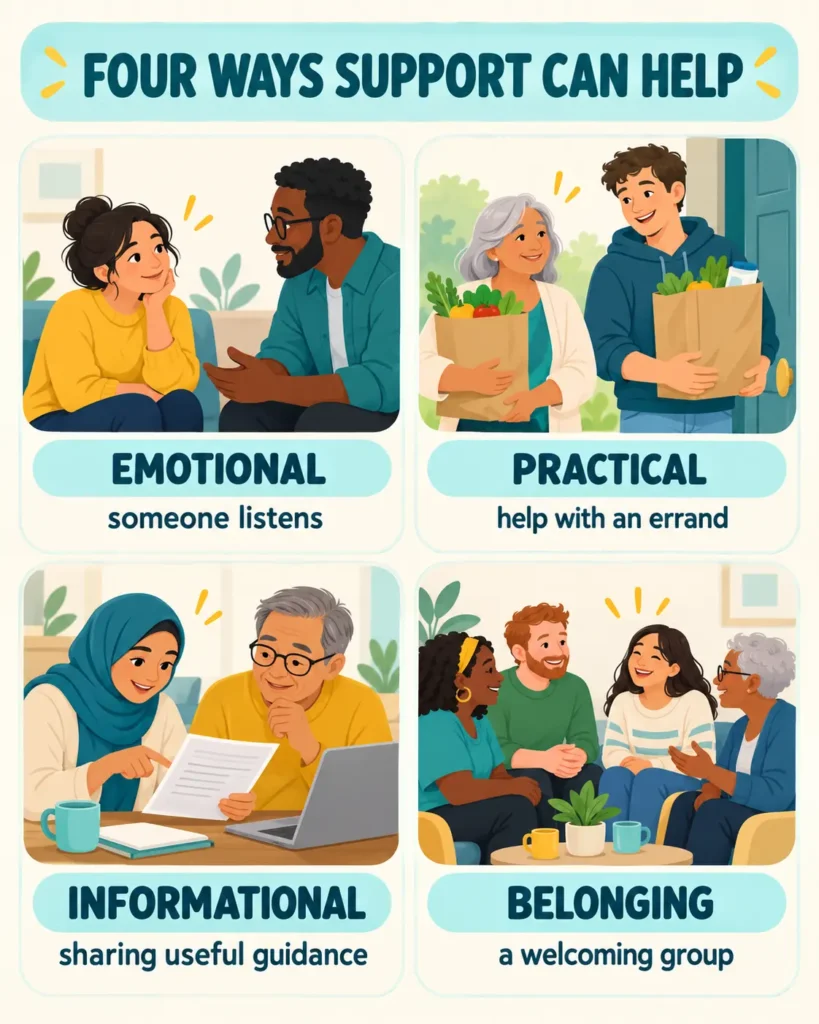
Social support includes emotional care, practical help, useful guidance, and a sense of belonging. Research consistently links good-quality social relationships with wellbeing, but no single friendship or activity guarantees better health. Start with one safe, manageable connection and build from there.
What counts as social support?
Social support is the help and connection people exchange through friendships, family, colleagues, neighbors, peers, and communities. It is different from having a large contact list: relationship quality, reciprocity, and safety matter.
| Kind of support | What it can look like |
|---|---|
| Emotional | A friend listens and takes your concerns seriously |
| Practical | A neighbor helps with a ride or an errand |
| Informational | Someone shares a trustworthy resource or explains a process |
| Companionship / belonging | A walking group, hobby club, or regular shared meal |
These forms overlap. A brief phone call can offer both companionship and emotional reassurance; a support group may combine practical tips with belonging.
Connection, loneliness, and time alone are not the same thing
Loneliness is the unwanted feeling of disconnection. Social isolation refers more to limited contact or relationships. Solitude can be enjoyable and restorative. You can feel lonely in a crowded room—or feel content with a small circle. The useful question is not “How many friends should I have?” but “Do I have enough of the kinds of connection I actually need?”
Why connection matters
Supportive relationships can make everyday challenges more manageable: someone can help us think clearly, share responsibilities, celebrate milestones, or encourage a healthy habit. CDC guidance describes social connection as an important part of physical and mental wellbeing. Large observational studies connect loneliness and social isolation with poorer health outcomes, but those associations do not mean that simply increasing social activity cures a condition. Health, mobility, money, community access, and social circumstances can all affect connection in both directions. [1–3]
This is a good reason to make room for meaningful connection—not a reason to blame someone who is isolated, grieving, disabled, or navigating an unsafe environment.
Five ways to strengthen support without overcomplicating life
1. Make one specific, low-pressure invitation
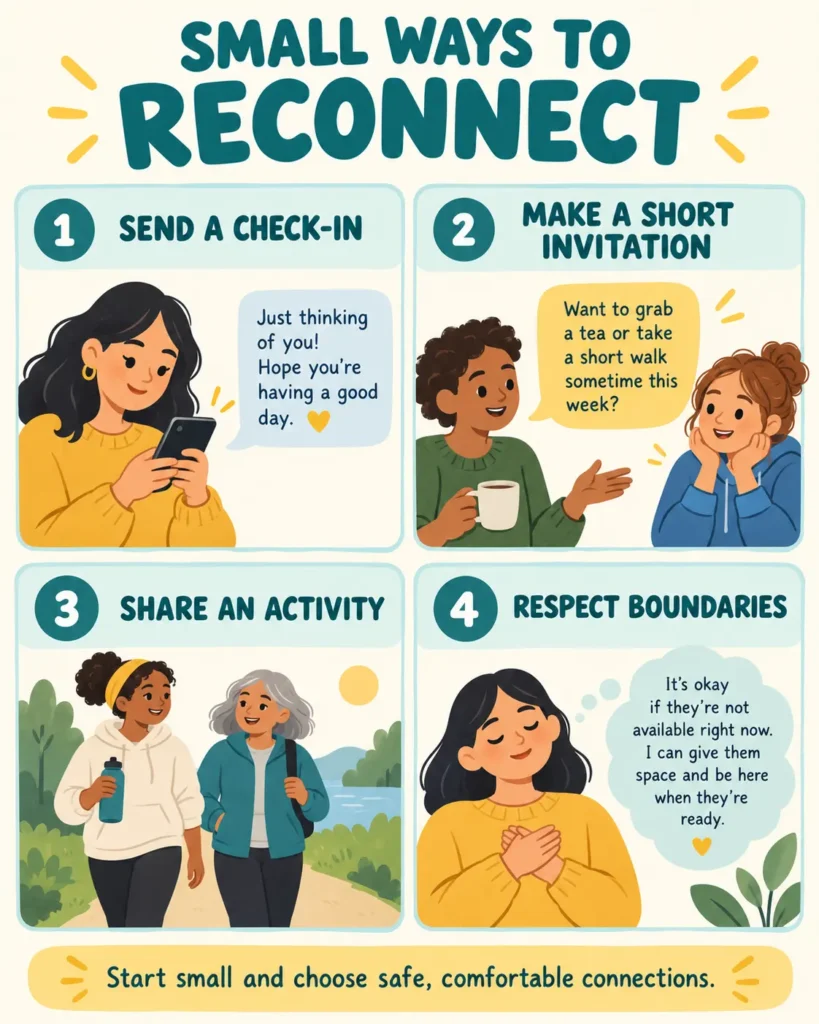
Instead of “We should catch up,” try “Would you like a 15-minute call on Thursday?” A small, clear invitation gives the other person an easy way to respond. If they cannot, it does not necessarily mean rejection.
2. Ask for the kind of help you actually need
A vague “I need support” can be hard for someone to interpret. Try “Could you listen for ten minutes?” or “Would you be able to give me a ride next week?” You can also ask whether they have capacity first.
3. Let shared interests do some of the work
A class, community garden, volunteering shift, library event, walking group, or online interest community can provide repeat contact without demanding instant closeness. Choose settings that feel accessible, affordable, and safe.
4. Maintain the connections already there
Send an occasional thoughtful message. Remember a meaningful event. Share an ordinary update. Reliable small gestures are often more sustainable than waiting for a perfect weekend together.
5. Practice mutual support—and healthy limits
Relationships work better when listening and asking are possible in both directions. You can care about someone and still say, “I cannot talk tonight, but I can check in tomorrow.” You do not have to remain in a hurtful or unsafe relationship to meet a social goal.
A gentle one-week connection plan
| When | Try this | Flexible alternative |
|---|---|---|
| Day 1 | List two people or places that feel safe | Think of one past supportive interaction |
| Day 2 | Send a short check-in text | Leave a voice note or write a card |
| Day 3–4 | Invite a short conversation or shared activity | Join an accessible virtual group |
| Day 5 | Offer small practical kindness | Share a useful resource, without pressure |
| Weekend | Notice which interaction felt nourishing | Rest and revisit when energy returns |
This is an optional experiment, not a quota. If one step is too much, repeat a smaller step or leave it for later.
If making connections feels difficult
Connection is not equally easy for everyone. Chronic illness, caregiving, disability, transportation, language differences, shift work, discrimination, financial constraints, grief, and changes in life stage can narrow opportunities. Try an accessible format—audio calls, online peer groups, a short meeting near home, a free library program, or a group designed around shared experiences. Local organizations and professionals may be able to help identify options.
If social situations bring intense anxiety, begin with a trusted person or discuss the difficulty with a qualified mental health professional. You do not need to force yourself into large groups.
How to recognize support that is not supportive
Healthy support respects privacy, consent, boundaries, differences, and your ability to make choices. Repeated guilt, pressure, humiliation, manipulation, or threats are warning signs. Prioritize safety over social contact; consider contacting a trusted professional or appropriate support service when needed.
What does the evidence actually say?
CDC explains that social connections involve the number, quality, and variety of relationships, the functions they serve, and their positive or negative qualities. Public-health reviews associate social isolation and loneliness with multiple adverse health outcomes. The 2023 U.S. Surgeon General advisory highlights community and structural factors—not just individual behavior. Evidence does not establish one universally effective dose of social time or prove that any particular activity will prevent illness. [1–4]
When to seek additional support
If loneliness or isolation is persistent, makes daily functioning difficult, or occurs alongside depression, severe anxiety, major grief, or hopelessness, consider talking with a healthcare or mental health professional. If someone is threatening or abusing you, focus on safety and seek appropriate help. Social connection can complement—but not replace—medical or psychological care.
Questions readers often ask
Does social support have to come from family?
No. Friends, chosen family, neighbors, colleagues, community groups, peers, and trusted professionals may all play a role. The quality and safety of the relationship matter.
Do online relationships count?
They can. Online communities and calls can be meaningful, especially when geography or mobility makes meeting difficult. Notice whether a particular interaction leaves you feeling understood and supported, and protect your privacy.
What if I like being alone?
Enjoying solitude is not the same as unwanted loneliness. There is no need to force extra social time if your connections meet your needs.
What is the easiest first step?
Choose one person and make a small, specific invitation—or explore a recurring activity where conversation can develop naturally over time.
A practical takeaway
Good support is not a popularity contest. Start with one trustworthy connection, one clear request, or one welcoming place. Make the next step small enough to repeat.
Social connection is one part of managing everyday stress. Explore the broader picture in our Stress: A Whole-Picture Guide.
References
1. CDC — Social Connection — https://www.cdc.gov/social-connectedness/about/index.html
2. CDC — Health Effects of Social Isolation and Loneliness — https://www.cdc.gov/social-connectedness/risk-factors/index.html
3. National Institute on Aging — Tips for Staying Connected — https://www.nia.nih.gov/health/loneliness-and-social-isolation/loneliness-and-social-isolation-tips-staying-connected
4. U.S. Surgeon General — Our Epidemic of Loneliness and Isolation — https://www.ncbi.nlm.nih.gov/books/NBK595227/
5. CDC — Improving Social Connectedness — https://www.cdc.gov/social-connectedness/improving/index.html