

Grounding techniques are simple ways to bring your attention back to what is happening around you when your thoughts or feelings become overwhelming. You might notice your feet on the floor, describe an ordinary object, or name a few things you can see and hear. They are optional coping tools, not tests you have to pass or treatments for an underlying condition.
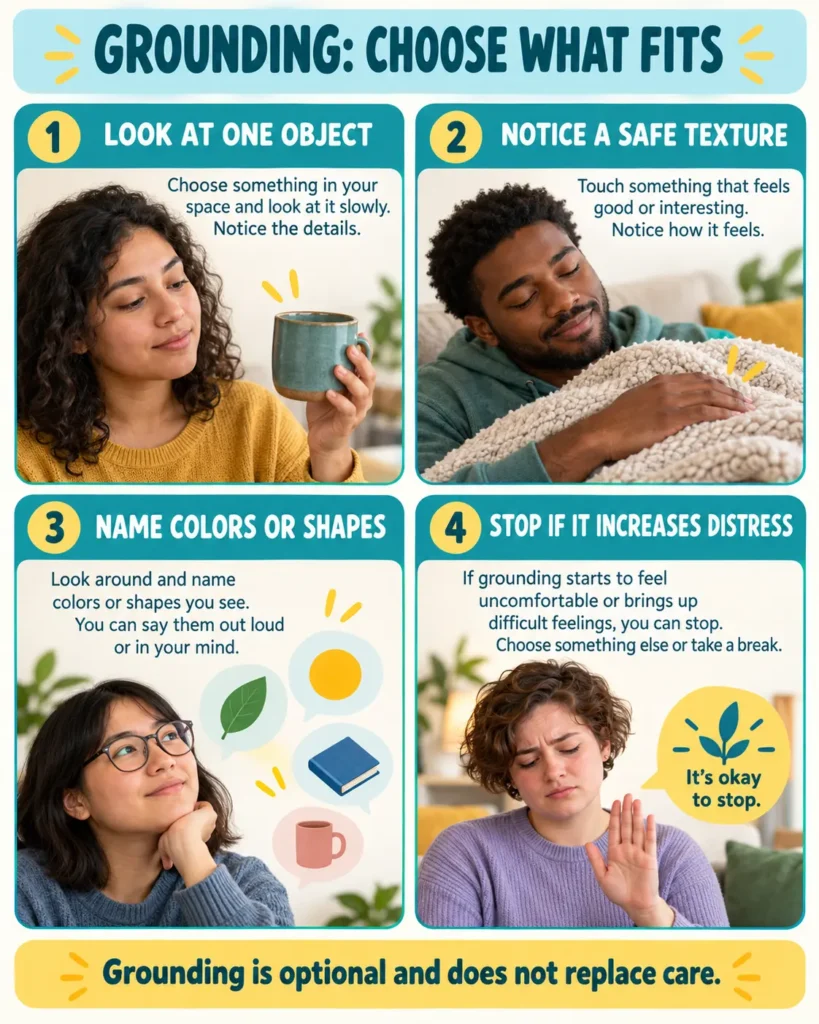
If you want to try one now, look around and name three ordinary objects you can see. Notice one detail about each. Stop or switch methods if it feels uncomfortable.
QUICK INSIGHT
About Grounding
Grounding shifts attention toward the present moment. It may help some people during stress, anxious feelings, or a sense of disconnection. Start with a single sight or touch cue, and remember that a technique does not need to feel relaxing to everyone. [1–3]
What Are Grounding Techniques?
Grounding is a broad term for exercises that deliberately direct attention to current surroundings, physical contact with a safe surface, or a simple here-and-now mental task. Sensory grounding uses sights, sounds, textures, or smells. Cognitive grounding might involve describing a room or naming objects in a category. These are coping strategies rather than a specific diagnosis or a formal psychotherapy protocol.
Grounding differs from mindfulness meditation: a grounding exercise usually has an immediate, concrete focus, often outside the body. Breathing exercises can be paired with it, but breath control is not required.
When Might Grounding Be Useful?
- An anxious moment: shift your focus from spiraling thoughts to neutral objects in the room.
- After a stressful event: orient yourself to a familiar, reasonably safe place.
- While waiting for support: use a small sensory task if you find it settling.
It is equally reasonable not to use grounding if your environment is unsafe, sensory input is triggering, or you need to act on an urgent problem. It should not replace leaving a dangerous situation or seeking appropriate help.
What Does the Evidence Suggest?
Health-service self-help guidance, including NHS resources, recommends sensory grounding as one option for managing overwhelming anxiety or stress. The widely shared 5-4-3-2-1 exercise is a practical technique, but recommendations for the technique are not proof that this specific sequence is a well-validated standalone treatment for anxiety disorders, post-traumatic stress disorder, panic attacks, or dissociation. [1–3]
Research supporting broader psychological treatments cannot simply be transferred to this single exercise. If symptoms are frequent, severe, or impair daily life, assessment and evidence-based care matter more than perfecting the counting sequence.
Try It Gently: A 5-4-3-2-1 Example
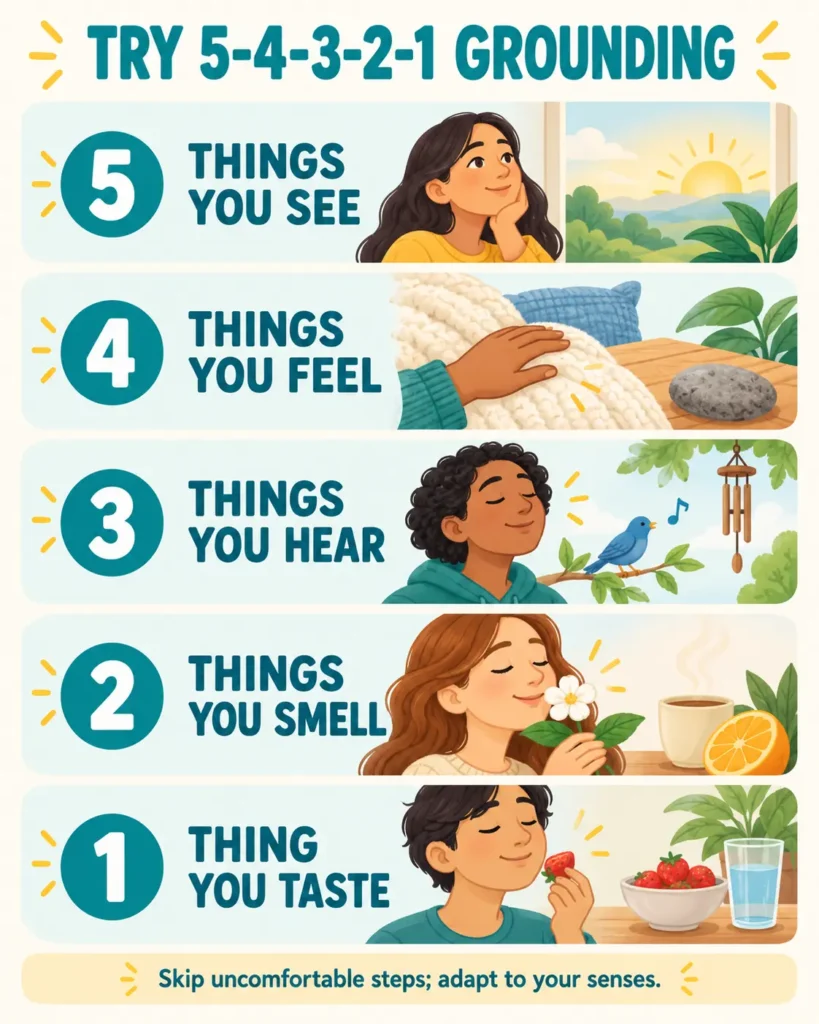
You may keep your eyes open, stay seated, and breathe normally. If a step does not work for you, skip it. This is an illustration, not a required protocol.
- 1. Look for five things you can see. Notice colors, edges, or patterns.
- 2. Notice four safe things you can feel: your feet on the ground, clothing, a chair, or an object you are holding.
- 3. Listen for three sounds, near or far. You do not need to identify where they come from.
- 4. Notice two smells, if accessible and comfortable. If not, skip this step or recall familiar neutral scents.
- 5. Notice one taste, if available, or simply return your attention to an object you can see.
Check in with yourself. If it helps, continue with an easy activity. If the exercise increases distress, stop and switch to something more comfortable. NHS guidance describes the 5-4-3-2-1 approach, but you are not required to complete every sense. [1,2]
Choose a Version That Fits You
| Situation | Try | Adapt or skip |
|---|---|---|
| You have little time | Name three things you see. | One object is enough. |
| Touch is more comfortable | Feel a chair or a textured everyday object. | Avoid sensations linked with pain or distress. |
| Sensory input is overwhelming | Quietly read a short, familiar sentence or name colors. | Use fewer senses; move to a quieter place if safe. |
| You are driving or operating equipment | Prioritize the task and a safe stop when needed. | Do not do multi-step attention exercises while operating equipment. |
Common Mistakes and Realistic Expectations
- Trying to force calm: success is not measured by instant relaxation. The goal is to try a workable attention shift.
- Insisting on all five senses: people with sensory disabilities or sensitivities can choose different cues.
- Using grounding to avoid every difficult feeling: short-term coping is not a substitute for addressing recurring problems.
- Ignoring a real threat: grounding should never take priority over getting to safety.
Safety, Limits, and When to Seek Support
Some people find attention to their body, surroundings, or senses uncomfortable, particularly after trauma or during panic or dissociative experiences. Use external, neutral cues rather than forced breathwork, closed eyes, intense sensations, or painful physical techniques. If you feel more detached, frightened, dizzy, or distressed, stop and consider support from a qualified professional.
Seek professional care if anxiety, trauma symptoms, panic, or a sense of disconnection recur or interfere with work, sleep, relationships, or daily functioning. For immediate danger, suicidal intent, chest pain, severe breathing difficulty, or another medical emergency, use emergency services rather than relying on grounding. In the U.S., call or text 988 for suicide or emotional-crisis support. [4]
One Small Next Step
Pick one neutral cue—an object you can see or the feel of a chair beneath you—and try noticing it for a moment when you are comfortable. Keep it only if it helps.
References
1. NHS inform. Grounding exercises (updated December 2025). — https://www.nhsinform.scot/healthy-living/mental-wellbeing/breathing-and-relaxation-exercises/grounding-exercises/
2. Oxford Health NHS Foundation Trust. Ground yourself. — https://oxfordhealth.nhs.uk/camhs/self-care/sleep/relaxation/ground-yourself/
3. NHS inform. Anxiety self-help guide. — https://www.nhsinform.scot/illnesses-and-conditions/mental-health/mental-health-self-help-guides/anxiety-self-help-guide
4. 988 Suicide & Crisis Lifeline. — https://988lifeline.org/