

Stress is your mind and body responding to a challenge, demand, or perceived threat. A deadline may briefly sharpen your focus; weeks of pressure with little recovery can leave you tense, exhausted, or distracted. Knowing how the response works can help you decide which kind of support to explore—not just learn a scientific definition. [1–3]
QUICK INSIGHT
About stress
What it is: A coordinated response involving the brain, nervous system, and hormones. Why it matters: Short-lived activation can be useful, while ongoing strain can interfere with sleep, mood, energy, and daily functioning. Start here: Notice which part of stress affects you most—sleep, mental overload, tension, or disrupted routines—then choose a practical next step rather than trying every remedy at once. [1–3]
What happens when you feel stressed?
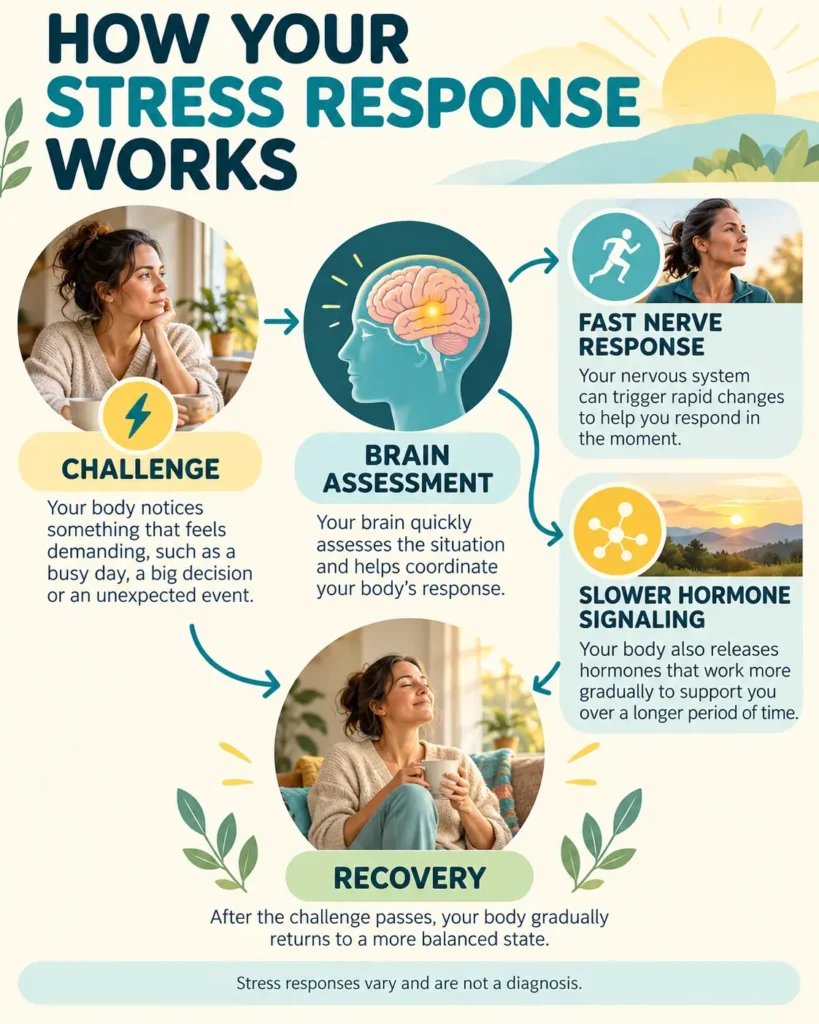
A stressful situation is often called a stressor. Your brain assesses what is happening and mobilizes resources to respond. The sympathetic nervous system can rapidly increase alertness, heartbeat, and muscle tension; signaling through the hypothalamic-pituitary-adrenal (HPA) axis contributes to a slower hormonal response, including cortisol. These systems are useful parts of ordinary physiology—not signs that your body is malfunctioning. [3, 4]
When the demand passes, regulatory and recovery processes help the body settle. Repeated demands and limited recovery can make that harder. No single symptom proves that stress, cortisol, or a particular hormone level is its cause. [2–4]
Short-term versus ongoing stress
Acute stress is a response to an immediate or relatively short-lived challenge. It may increase attention while also feeling uncomfortable. Ongoing stress involves prolonged or repeated demands and can be associated with changes in sleep, concentration, appetite, energy, and physical comfort. Many of these changes have other possible explanations, so persistent symptoms deserve appropriate evaluation. [1–3]
Find a stress-support approach that fits your situation
The best place to begin depends on what you are experiencing and what is contributing to it. The options below are starting points—not diagnoses or evidence that you need a supplement.
| What you notice | Possible starting point | Read next |
|---|---|---|
| Feeling tense or restless | Learn about calming approaches and differences in herbal evidence; consider non-product options first. | Herbs for Stress: What the Evidence Says |
| Stress is disrupting sleep | Review routines, sleep environment, and reasons to seek help for persistent sleep trouble. | Sleep & Rest: A Whole-Picture Guide |
| Sitting all day or feeling physically wound up | Consider an easy, adaptable walk if movement is appropriate for you. | Walking for Stress Relief: Why a Simple Walk Can Help |
| Worry loops or mental overload | Explore coping skills and ways to respond to difficult thoughts. | Mental Strategies for Stress: Skills That Can Help You Respond Differently |
| Irregular meals or low energy | Start with regular, practical food choices before assuming a deficiency. | Foods for Stressful Days: What to Eat When Appetite and Energy Are Off |
If more than one concern fits, start with the most manageable change. If symptoms are severe or persistent, professional evaluation may be more useful than adding self-help methods.
Where do the five UGetWell approaches fit?
Herbal: Some products and preparations are studied for specific stress-related outcomes, but findings vary by herb, formulation, and study population. Evidence is not a reason to assume that any “calming” product will work for everyone. [3]
Nutrition: Regular meals and adequate nourishment support general wellbeing; a stressful week alone does not establish a nutrient deficiency. [2]
Physical: Comfortable activity such as walking may help some people manage stress and build sustainable routines. [2]
Mental: Skills for responding to worry, setting priorities, and seeking support can matter when stress feels cognitively overwhelming. [1, 2]
Lifestyle: Recovery time, sleep opportunities, workload changes, and supportive relationships may be as important as any individual coping technique. [2]
For an integrated overview of all five approaches, see Stress: A Whole-Picture Guide.
Three useful things to try first
1. Name the main pressure. What can be changed, postponed, shared, or discussed rather than simply endured?
2. Choose one realistic support action—for example, a short comfortable walk, a steadier mealtime, or a pause from notifications—and notice whether it fits your life.
3. Review the pattern after several days. If you are persistently struggling, seek help rather than escalating products or relying on self-diagnosis. [1, 2]
Stress, anxiety, and burnout are not identical
Stress typically refers to a response to a demand. Anxiety may persist without an immediate external stressor. Burnout refers specifically to an occupational phenomenon associated with chronic workplace stress; it is not a label for every form of exhaustion. These concepts can overlap, and a professional can help when symptoms are disruptive. [1]
When to get help
Talk with a health professional if stress-related concerns persist, disrupt sleep or relationships, or make daily responsibilities difficult. Seek urgent medical attention for sudden chest pain, severe breathing difficulty, or other potentially serious symptoms rather than attributing them to stress. If you are in emotional crisis in the United States, call or text 988. [1–3]
The takeaway
Understanding stress helps you make a better first decision. You do not need to use five approaches—or buy anything—to begin. Identify what needs attention, explore one fitting pathway, and seek appropriate care when needed.
References
1. NIMH, I’m So Stressed Out! Fact Sheet
https://www.nimh.nih.gov/health/publications/so-stressed-out-fact-sheet
2. CDC, Managing Stress (reviewed May 12, 2026)
https://www.cdc.gov/mental-health/living-with/index.html
3. NCCIH, Stress
https://www.nccih.nih.gov/health/stress
4. Endotext, Stress: Endocrine Physiology and Pathophysiology
https://www.ncbi.nlm.nih.gov/books/NBK278995/